

♥ Wishlist
Compare 53 verified Drilling Accessories products in United Kingdom. Reviews, ratings, pros, cons and buying advice updated for October 2026.
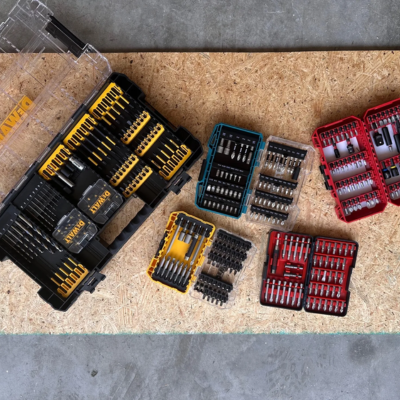
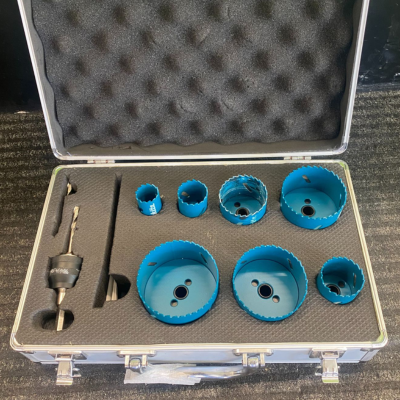
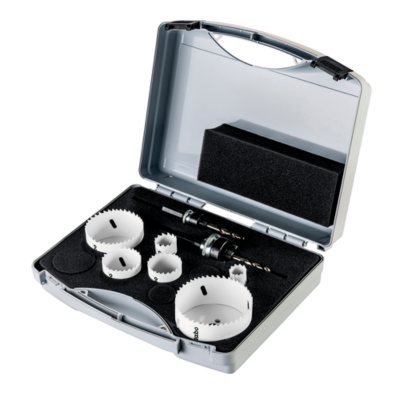
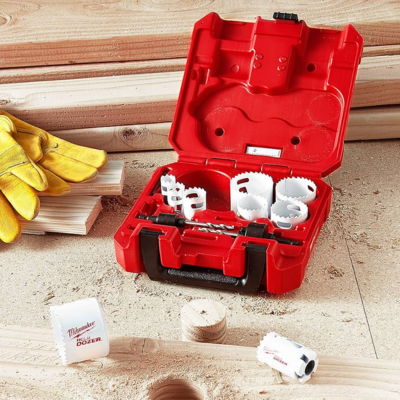


Choosing drilling accessories is not simply a matter of selecting the largest kit or the drill bits with the highest number of pieces. The right accessory depends on the material being drilled, the type of hole required, the drilling machine being used, the frequency of use and the finish you expect from the work.
A small DIY project may only require a useful selection of general-purpose wood, masonry and metal bits, whereas regular renovation work can justify dedicated accessories such as impact-rated screwdriver bits, SDS-Plus masonry bits, hole saws, step drills and specialist metal-cutting bits. Professional users may also benefit from accessories designed around specific materials and high-frequency applications.
Before buying, consider the complete job rather than the accessory in isolation. A technically excellent drill bit can still be the wrong choice if its shank does not fit the drill, its diameter is unsuitable, its cutting geometry is intended for another material, or the tool is not designed to withstand the torque produced by the machine.
Twist drill bits are among the most versatile accessories for drilling holes in metal and other suitable materials. Standard high-speed steel, commonly abbreviated to HSS, is widely used because it offers a practical balance between hardness, heat resistance and cost.
For harder metals or more demanding applications, cobalt-alloyed HSS bits can be worth considering. They are intended for applications where increased heat resistance and durability are important. Coated versions may also be available, with coatings intended to reduce friction, improve wear resistance or extend useful working life under suitable conditions.
When comparing metal drill bits, look beyond the diameter range. Point geometry, flute design, material, coating, shank construction and recommended operating conditions can all affect performance.
Wood requires a different cutting approach from metal. Wood drill bits are commonly designed with a pointed centre that helps locate the hole and cutting edges intended to produce a clean result in timber and wood-based boards.
For ordinary DIY work, general-purpose wood bits may be sufficient. Flat bits can be useful when speed and larger holes are more important than achieving the finest possible finish. Brad-point bits are often preferable where accurate positioning and cleaner entry are priorities.
For deeper holes, specialist wood-boring designs may be more appropriate. The correct accessory depends on whether you are drilling softwood, hardwood, plywood, MDF, chipboard or another engineered board.
Masonry bits are designed for materials such as brick, block and some types of concrete. They generally use a cutting tip intended to withstand abrasive mineral materials rather than the sharp cutting geometry used for conventional metal drilling.
For light masonry work with a conventional hammer drill, standard masonry bits may be suitable. More demanding concrete drilling is a different application and can call for an SDS system and purpose-designed carbide-tipped accessories.
Do not assume that every masonry bit is suitable for every type of concrete. Material hardness, drilling mode, hole diameter and required depth all influence the appropriate choice.
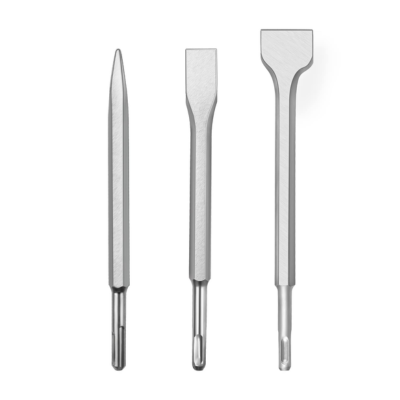
SDS systems are designed for compatible rotary hammers and combination hammers. SDS-Plus is widely encountered in general building, renovation and installation work, while SDS-Max is intended for larger and heavier-duty applications.
An SDS accessory should never be selected purely because its diameter appears correct. The shank system must match the tool, and the accessory must be suitable for the drilling or hammering mode being used.
For occasional household drilling, a conventional chuck system may provide all the flexibility required. For repeated masonry and concrete work, an appropriate SDS system can provide a substantially different level of capability.
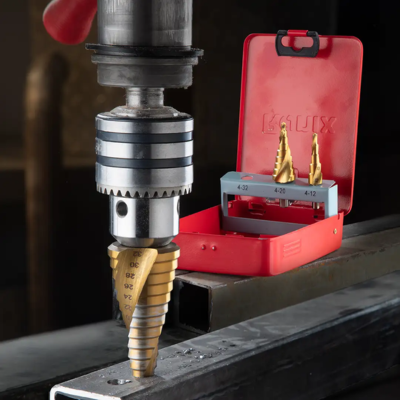
Step drills use a series of increasing diameters on one bit. They are particularly useful for producing or enlarging holes in thin sheet materials where multiple conventional bits would be inconvenient.
The main advantage is convenience: one accessory can cover several hole sizes within its specified range. However, a step drill is not automatically a substitute for a conventional drill bit in thicker materials or every type of metalworking application.
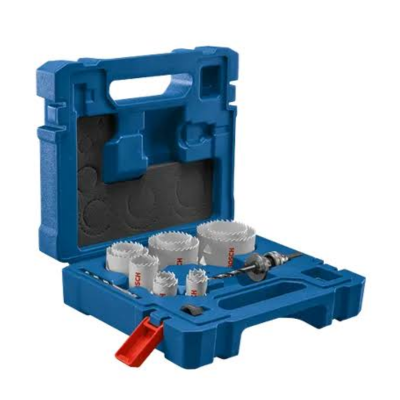
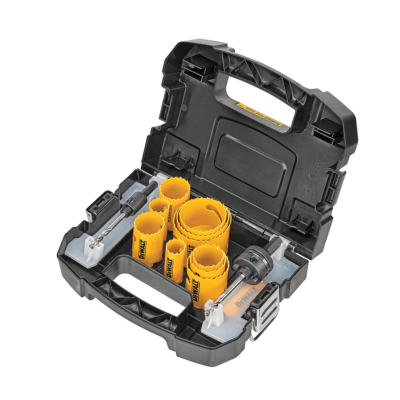
Hole saws are designed for larger circular openings than ordinary drill bits can conveniently produce. They are commonly used for applications such as cable routing, pipework, ventilation openings and installation work.
Hole saw construction varies considerably. Some are intended for wood and general building materials, while others are designed for metal or particularly abrasive materials. The cutting material and tooth configuration should therefore be matched to the workpiece.
Check the required arbor and pilot drill arrangement before purchasing. A hole saw may have the correct cutting diameter but still be incompatible with the arbor or drill available.
Countersinking creates a tapered recess that allows a suitable screw head to sit flush or below the surrounding surface. This can improve appearance and reduce the likelihood of a protruding fastener catching on another object.
Counterboring is different because it creates a cylindrical recess rather than a simple tapered one. The choice depends on the fastener, material and desired finished appearance.
Screwdriver bits are drilling accessories in the broader sense because they are frequently used alongside drills and combination tools for installation work. Common drive profiles include Phillips, Pozidriv, Torx and hex.
Matching the bit profile precisely to the fastener is important. A poor fit can increase the risk of cam-out, damage the screw head and reduce control.
Impact-rated bits are specifically designed for use with compatible impact drivers and applications involving repeated torque loading. A standard screwdriver bit should not automatically be treated as equivalent to an impact-rated accessory.
HSS is a common material for metal-cutting drill bits. It offers a useful combination of hardness, heat resistance and affordability, making it a practical option for general workshop and DIY drilling.
Cobalt-alloyed HSS is used where greater heat resistance and durability are required. These bits can be particularly useful for demanding metal-drilling applications, although correct drilling technique remains important.
Carbide is valued for its hardness and resistance to wear. Carbide-tipped masonry and construction accessories are commonly used where the cutting edge needs to withstand abrasive mineral materials.
Carbide is not automatically the best material for every job. Its advantages become most relevant when the application matches the properties for which carbide is designed.
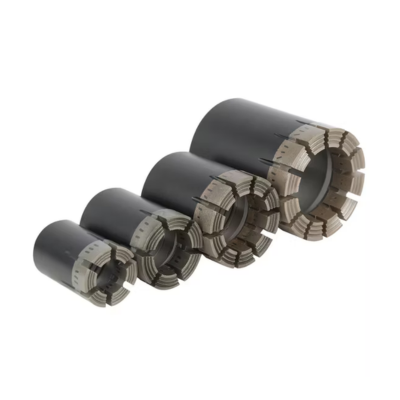
Diamond-based cutting surfaces can be used for particularly hard and abrasive materials. Specialist diamond accessories may be appropriate for certain tiles, stone and other difficult materials, but they should be selected according to the manufacturer's intended application.
Some drill bits use surface coatings designed to improve wear resistance or reduce friction. Titanium-based coatings are commonly encountered in consumer and professional ranges, but the presence of a coating should not be treated as proof that one bit is universally better than another.
Compare the complete specification, including the underlying material, geometry and intended application, rather than choosing solely on the name of a coating.
Two bits with identical diameters can behave very differently because of their cutting geometry. Point angle, cutting-edge design, flute shape and overall construction all influence how efficiently material is removed.
The point determines how readily the bit starts cutting and how well it remains centred. Different materials benefit from different point geometries, which is why a bit designed for metal should not automatically be substituted for a wood or masonry bit.
Flutes provide a path for chips and drilling debris to leave the hole. Efficient chip evacuation becomes increasingly important as drilling depth increases, particularly in materials that generate substantial amounts of waste.
The shank is the part held by the drill chuck or inserted into a compatible tool holder. Common shank arrangements include round shanks, reduced shanks and specialist systems such as SDS.
Always check the shank specification before buying a set. A kit containing an impressive selection of diameters is of limited value if the accessories cannot be securely and correctly fitted to your equipment.
Compatibility is one of the easiest details to overlook when comparing drilling accessories online. Before considering the number of pieces in a kit, establish what your drill or driver can accept.
Wood is generally forgiving, but the choice of accessory still affects accuracy and finish. Brad-point bits are useful where precise hole placement matters, while flat bits can provide a faster option for larger openings.
Hardwood can place greater demands on cutting edges than softwood. A sharp, correctly specified bit and controlled drilling technique are more important than simply choosing the most expensive accessory.
Engineered boards can behave differently from natural timber. Clean cutting geometry is particularly valuable where the visible face needs to remain neat. Excessive pressure or a worn accessory can increase the likelihood of a poor finish.
Use a masonry accessory suited to the material and drilling equipment. Consider whether ordinary rotary drilling or hammer action is appropriate for the job and follow the tool and accessory manufacturer's instructions.
Concrete drilling can require substantially more capable equipment and accessories than ordinary masonry work. SDS-compatible carbide-tipped accessories are commonly used for demanding applications, with the precise specification depending on the tool and material.
Metal drilling requires attention to bit material, cutting geometry, speed, pressure and heat management. HSS is a common general-purpose choice, while cobalt-alloyed options may be appropriate for more demanding work.
When drilling metal, forcing a blunt bit through the workpiece is rarely a sensible approach. A sharp, correctly specified accessory and suitable drilling conditions can make a much greater difference than simply buying a larger kit.
Tile drilling requires accessories specifically intended for the tile type and installation task. Ceramic tile, porcelain and natural stone can have different levels of hardness and different cutting requirements.
Check the accessory's intended material and operating instructions carefully, particularly when drilling finished surfaces where chipping or cracking would be costly to repair.
A larger accessory set is not necessarily better value. A 100-piece kit can contain many duplicate or rarely used sizes, whereas a smaller set with carefully selected diameters and accessory types may be considerably more useful.
Compare exactly what is included. A useful kit might combine several material-specific drill types, while another may count storage components, duplicate sizes or screwdriver bits towards its headline piece count.
Think about the holes you actually expect to drill. A kit covering the sizes commonly used for your projects is generally more practical than one offering a very broad range containing sizes you are unlikely to need.
For metalworking, compare HSS, cobalt-alloyed HSS and coatings where relevant. For masonry, look for appropriate carbide construction. For wood, consider whether the geometry suits the finish and hole sizes you require.
A good storage case is more than a cosmetic extra. Clearly labelled positions can make it easier to identify the required size, reduce misplaced accessories and protect cutting edges during transport or storage.
For occasional household projects, versatility and sensible value are often more important than specialist performance. A carefully chosen selection of wood, masonry and metal bits can cover a wide variety of common tasks.
There is little benefit in paying for specialist accessories that will remain unused. Focus on the materials you regularly encounter and the hole sizes you actually need.
Regular renovation projects can justify expanding beyond a basic set. Hole saws, countersinks, step drills, longer masonry bits and dedicated screwdriver bits can reduce the need to improvise with unsuitable accessories.
Frequent users typically place greater value on consistency, durability, compatibility and application-specific performance. The cost of replacing worn accessories and losing working time can make a higher-quality specialist accessory worthwhile even when its initial purchase price is higher.
Professional users should also consider whether a system from a manufacturer such as Bosch Professional, DeWalt, Makita, Milwaukee or Festool integrates effectively with the equipment already used on site.
Brand reputation can be useful when narrowing down a purchase, but it should not replace specification checking. Different manufacturers have different product ranges, and a brand that is excellent in one accessory category may not necessarily be the ideal choice for every application.
When comparing brands, consider the exact accessory rather than relying solely on the manufacturer's reputation. Check the material, dimensions, compatibility, intended application and manufacturer's technical guidance.
More pieces do not automatically mean greater value. If most of the accessories are unsuitable for your projects, the headline quantity becomes largely irrelevant.
Wood, metal, masonry and tile require different cutting approaches. A general-purpose bit may be convenient for limited applications, but it should not be treated as a universal solution.
A bit can have the perfect diameter and still be unusable with your drill if the shank or interface is incompatible.
The cheapest accessory may be appropriate for occasional light-duty work, but frequent users should consider cutting performance, durability, consistency and replacement requirements as part of the overall value equation.
The accessory and drill must be considered as a system. A specialist SDS accessory, for example, requires a compatible SDS tool rather than an ordinary keyed or keyless chuck.
Recommended materials, drilling modes, operating conditions and safety precautions vary between products. Manufacturer guidance should take precedence over generic advice when the two differ.
Accessory quality is only one part of drilling performance. Technique, tool condition and workpiece preparation can have a substantial effect on the final result.
Drill bits should be stored so that their cutting edges do not repeatedly strike other tools. Damage to the point or cutting edge can affect accuracy and increase the effort required during drilling.
Remove accumulated material and debris after use where appropriate. Metal particles, masonry dust and wood debris should not be allowed to build up unnecessarily on accessories or inside storage cases.
Look for bent shanks, chipped cutting edges, excessive wear, damaged coatings and other visible defects. Do not use an accessory if its condition makes safe operation questionable.
Returning accessories to labelled positions makes it easier to identify the correct diameter and reduces the chance of accidentally selecting an unsuitable bit.
There is no universal replacement interval because accessory life depends heavily on material, frequency of use, drilling technique, tool condition and accessory quality.
Signs that a bit may need replacement or professional assessment include visibly damaged cutting edges, a bent body or shank, persistent wandering, unusual vibration, excessive heat, poor cutting performance or a need for substantially greater pressure than previously required.
For accessories with replaceable or interchangeable components, check whether the manufacturer specifies replacement parts rather than replacing the complete system unnecessarily.
Drilling creates rotating components, sharp cutting edges and potentially hazardous dust or debris. Appropriate personal protective equipment and safe working practices should be selected for the material and task.
You may need masonry bits for brick or block walls, wood bits for timber components and screwdriver bits for fastening. The exact selection depends on the wall construction and fastener system.
The key consideration is the wall material. A masonry accessory may be appropriate for brick or block, while plasterboard installations require a different fixing strategy. The drill bit should be selected for the material actually being penetrated rather than simply for the visible surface.
Furniture assembly usually benefits from a good selection of screwdriver bits and small drill bits. Pozidriv and Torx profiles are particularly common in modern furniture and fastening applications, but the correct profile should always be determined by the fastener.
Installation work can require larger holes, which makes hole saws and specialist boring accessories useful. Always establish what is behind the surface before drilling and use an accessory appropriate for the material and installation method.
A mixed accessory collection can be valuable for renovation because projects frequently involve several materials in the same room. A practical selection might include wood bits, masonry bits, metal bits, screwdriver bits, countersinks and a suitable hole-saw system.
Budget accessories can make sense for occasional low-demand work where the user only needs a small number of holes. The important consideration is whether the product specification matches the job rather than assuming that a low price automatically means poor performance.
Mid-range options often provide a useful balance for regular DIY users. They can offer broader material coverage and more durable construction without requiring a specialist professional accessory for every task.
Premium accessories are most compelling when they solve a specific problem, provide greater consistency or are expected to withstand frequent use. For professional users, durability and reduced replacement frequency can be more important than the initial purchase price.
Not every premium feature is useful to every buyer. Pay for features that directly improve the work you actually perform.
Marketing terminology can make an accessory sound more advanced than it is. Coatings, unusually high piece counts and broad claims about universal compatibility should be examined in the context of the complete specification.
A technically appropriate basic bit can outperform a more expensive specialist-looking accessory when it is used in the material and conditions for which it was designed.
If you are unsure where to start, work through the decision in this order.
A versatile DIY toolkit commonly benefits from a selection of wood, masonry and metal drill bits together with commonly used screwdriver bits. Depending on the work you undertake, countersinks, step drills and hole saws can also be useful additions.
They can be worthwhile when the accessory is used frequently, when the material is demanding or when consistent results matter. For occasional light-duty work, a well-specified mid-range accessory may provide a more sensible balance.
No. Masonry bits are designed around mineral-based materials and are not a substitute for a suitable metal-cutting drill bit. Select an accessory specifically intended for the material you are drilling.
A metal drill bit may physically cut some wood, but that does not make it the best accessory for the task. Wood-specific geometry is generally preferable when hole positioning, cutting behaviour and finish matter.
SDS is a family of tool-holder systems, while SDS-Plus is a specific format within that system. Always check the exact interface specified by the drill and accessory before purchasing.
They are different shank systems designed around different classes of rotary hammer equipment and applications. The accessory must match the tool's holder rather than being selected purely by diameter.
Neither is universally better. Cobalt-alloyed HSS can offer advantages in demanding metal-drilling applications, particularly where heat resistance is important, while standard HSS remains a practical choice for many general-purpose applications.
A suitable coating can provide useful wear or friction characteristics, but the coating should be considered alongside the underlying bit material, geometry and intended application. A coating alone does not determine overall performance.
There is no ideal number for everyone. Start with the materials and hole sizes you commonly encounter. A smaller selection of frequently useful sizes can be more practical than a large kit containing many rarely used accessories.
Yes, where you regularly drill different materials. Dedicated accessories are designed around the cutting characteristics of their intended material and can provide better results than attempting to use one general-purpose accessory for everything.
Yes. Cutting edges gradually wear through use, particularly when drilling abrasive or hard materials. Heat, excessive pressure and unsuitable operating conditions can accelerate wear.
Heat can result from friction, unsuitable speed, excessive pressure, a worn cutting edge, poor chip evacuation or drilling conditions that are inappropriate for the material. Follow the manufacturer's recommendations for the specific accessory and tool.
The cause may be an incorrectly tightened chuck, an unsuitable shank, a damaged shank or a tool-holder compatibility issue. Check the accessory and drill manufacturer's specifications before continuing.
A good set should contain useful sizes, appropriate accessory types, suitable materials and a compatible shank system. Clear storage and sensible organisation are also valuable for users who regularly switch between sizes.
Many are, provided the accessories are used for their intended applications and the user follows the drill, accessory and material manufacturer's safety guidance. Beginners should prioritise straightforward, clearly specified accessories rather than buying a large collection of specialist bits they do not yet need.
The best drilling accessories are not necessarily the most expensive, the most heavily marketed or the set with the greatest number of pieces. The strongest choice is the accessory that matches your drill, material, hole size, drilling method and expected frequency of use.
For general DIY, prioritise versatility and useful sizes. For metalworking, pay closer attention to HSS or cobalt construction, geometry and heat management. For masonry and concrete, focus on the correct masonry or SDS system. For larger openings, compare hole saw construction and arbor compatibility. For fastening work, match screwdriver-bit profiles precisely and consider impact-rated construction when using an impact driver.
Before purchasing, compare the complete specifications, check compatibility with your existing tools, consider the materials you actually work with and assess whether every component in a kit will be useful. This approach is usually more reliable than choosing based on piece count, branding or price alone.