

♥ Wishlist
Compare 18 verified Makita Screwdriver Bits products in United Kingdom. Reviews, ratings, pros, cons and buying advice updated for October 2026.


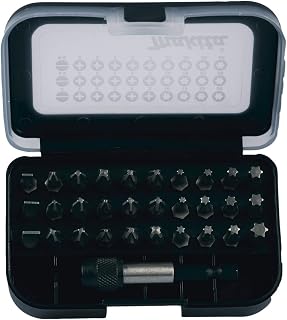


Choosing screwdriver bits is not simply a matter of selecting the largest set or the cheapest pack. The right bit depends on the fastener profile, screw size, tool being used, material being driven into, expected torque and the amount of work you intend to carry out. A bit that performs well for occasional furniture assembly may be a poor choice for repeated fastening with an impact driver.
Makita offers screwdriver bits in several profiles, lengths and configurations, including options designed for impact applications. When comparing products, look beyond the number of pieces in the box. A smaller set containing the sizes you regularly use can be more useful than a large assortment filled with profiles that rarely leave the case.
The screwdriver bit must match the screw head accurately. Owning a Makita drill or impact driver does not mean that every Makita bit will be appropriate for every fastening job.
The most important rule is simple: match the bit profile and size to the fastener specification. A familiar-looking bit is not necessarily the correct bit.
One of the most important distinctions when comparing modern screwdriver bits is whether they are intended for impact-driver use. An impact driver subjects the bit to rapid pulses of torque as well as rotational force. That operating environment can be considerably more demanding than conventional drilling and screwdriving.
Impact-rated bits are designed around this type of loading. Many incorporate a deliberately engineered torsion area that allows controlled flexing under load rather than concentrating all of the stress at the tip. This does not make an impact bit indestructible, but it can make the construction more appropriate for high-torque fastening.
Standard bits should not automatically be treated as equivalent to impact-rated versions simply because both have a 1/4-inch hex shank. The shank dimension tells you about tool compatibility; it does not, by itself, tell you how the bit is engineered to withstand impact loading.
A screwdriver bit is a small component, but its geometry has a significant effect on how it behaves under load. A rigid bit may transmit considerable force directly towards the tip. A bit designed with a torsion section can provide a degree of controlled flexing, helping distribute stresses created during demanding fastening.
This is particularly relevant when using an impact driver. Instead of viewing a torsion zone as a marketing feature on its own, consider it as one part of a wider design that includes the steel, heat treatment, tip geometry, shank construction and overall dimensions.
It is also worth remembering that controlled flexing is not the same as looseness. A correctly engineered torsion section is intended to behave predictably under load. Excessive bending, visible deformation or a bit that no longer seats correctly in the fastener are signs that it should be removed from service.
The tip has to transfer torque through a relatively small contact area. If the bit is the wrong size, poorly seated or subjected to excessive force, the contact surfaces can become damaged. Once the tip begins to round or deform, the problem can accelerate because the bit no longer engages the fastener as effectively.
For this reason, durability is not solely about how hard the steel is. A good screwdriver bit needs an appropriate balance between hardness, toughness, geometry and resistance to wear.
Two screwdriver bits can look almost identical while behaving differently in use. The underlying steel and manufacturing process influence resistance to wear, deformation and breakage.
Heat treatment is particularly important because a bit needs enough hardness to maintain its working profile while retaining sufficient toughness to cope with repeated loading. Excessive hardness without adequate toughness can make a component more susceptible to fracture, while insufficient hardness can allow the working end to deform prematurely.
For buyers, the practical lesson is that a specification describing the material or manufacturing process can be more useful than a generic claim that a product is simply “heavy duty”. Where a manufacturer provides detailed technical information, use that information alongside the intended application.
One of the easiest mistakes to make when buying screwdriver bits in the UK is confusing Phillips and Pozidriv. The two profiles look similar at a glance, but they are not interchangeable in every application.
A correctly matched Pozidriv bit should engage a compatible Pozidriv screw more effectively than a Phillips bit of a similar apparent size. Using the wrong profile can increase the likelihood of slipping, damaging the screw head or damaging the bit.
If your work regularly involves screws supplied with UK furniture, cabinetry, timber products or general construction materials, check the marking on the screw packaging or fastener head before selecting a large bit set.
A bit that is too small may engage only part of the fastener profile. A bit that is too large may fail to seat properly. Both situations can increase the risk of cam-out, where the bit slips out of the screw head as torque is applied.
The best approach is to use the largest correctly fitting bit that is specified for the fastener, rather than assuming that a visually similar size will work.
Torx fasteners have become increasingly common across construction, manufacturing, automotive applications and general maintenance. Their multi-point engagement can provide a secure interface between the fastener and bit when the correct size is used.
Torx bits are identified using designations such as T10, T15, T20, T25 and larger sizes. These numbers should not be treated as interchangeable. A T20 bit is not an alternative to a T25 simply because both are Torx.
If your work includes modern timber screws, outdoor construction products or machinery, a set containing several Torx sizes can be more useful than a set concentrating heavily on one Phillips size.
Length is another specification that is easy to overlook. Short insert bits are compact and convenient, but longer power bits can provide useful access when the screw is recessed or difficult to reach with a conventional bit holder.
Do not assume that longer is automatically better. For routine fastening, a shorter bit can be easier to control. Choose additional length because the job requires it rather than simply because the specification looks more substantial.
Many power-tool screwdriver bits use a 1/4-inch hex shank, making them compatible with suitable quick-change holders and many impact drivers. However, compatibility should always be checked against the tool and accessory manufacturer's specifications.
The fact that two accessories share the same nominal shank size does not mean they are equally suitable for every application. Check whether the bit is intended for insert holders, direct chucking, impact drivers, drills or another specific tool arrangement.
Also check the retention system. A bit that fits the nominal shank specification but does not lock securely into the holder is not a suitable choice for practical use.
A set can be excellent value when you need several profiles and sizes, but buying individual bits can be more efficient when your work is highly specialised.
For a typical DIY toolkit, a carefully chosen mixed set is often the most versatile starting point. For repetitive trade work, however, a smaller collection of frequently used individual bits may make more sense.
There is no universal ideal number of bits. A large piece count can be useful, but the number alone says little about whether a set is appropriate.
Before buying, consider the fasteners you actually encounter. Someone who mainly installs timber screws may have very different requirements from someone working on machinery, electronics, cabinetry or automotive components.
For general DIY, versatility is usually more valuable than extreme specialisation. A sensible selection should cover the screw types you are most likely to encounter around the home, workshop and garden.
Look for a set that combines useful profiles with sensible size coverage rather than one that achieves a high piece count through duplicates. Storage also matters because a well-organised case makes it much easier to identify the correct bit before starting a job.
If an impact driver is part of your DIY toolkit, prioritising bits specifically designed for impact use is sensible for demanding fastening. For light assembly tasks performed at modest torque, a conventional screwdriver bit may be entirely adequate.
Professional users should place greater emphasis on repeatability and durability because accessory failure has a direct effect on productivity. A bit that needs frequent replacement, slips regularly or takes too long to identify can be more costly in practical terms than its purchase price suggests.
Trade users should consider how many fasteners are installed during a typical day, the type of driver being used, the most common screw profiles and whether longer or specialist bits are regularly required.
Makita is not the only established manufacturer producing screwdriver and impact-driver accessories. Buyers may also encounter products from brands such as Bosch, DEWALT, Milwaukee, Wera, Wiha and other specialist accessory manufacturers.
The best comparison is not based on brand reputation alone. Compare the actual accessory specification, including the bit profile, size, length, impact rating, construction, quantity and intended application.
Different manufacturers can use different names for their impact-accessory ranges, so avoid assuming that two products are identical simply because both are marketed as impact bits. Look at the technical details rather than relying solely on packaging terminology.
Price alone cannot establish how long a screwdriver bit will last. A premium accessory can be worthwhile when its construction and application match demanding work, but an expensive specialist bit can be unnecessary for occasional low-torque DIY.
The better question is whether the accessory provides the characteristics your work requires. For frequent impact-driver use, durability and impact suitability can matter considerably more than the initial purchase price. For occasional assembly, the additional performance of a premium bit may not provide enough practical benefit to justify choosing it over a suitable standard option.
Value should therefore be assessed across the expected use of the accessory rather than by comparing the price of one packet with another.
Cam-out is one of the most common frustrations when driving screws. It occurs when the bit moves out of the fastener recess instead of remaining securely engaged.
The causes can include an incorrect bit profile, incorrect size, insufficient downward pressure, excessive torque, poor alignment, a worn bit or a damaged screw head.
For better results, keep the driver aligned with the screw, use the correct bit, select an appropriate speed and torque setting where available, and avoid continuing to drive once the bit begins repeatedly slipping.
With an impact driver, technique is particularly important. High torque can rapidly damage a screw head when the bit is not properly seated. More power does not compensate for an incorrect accessory.
An impact driver can deliver substantial rotational force, so accessory selection and technique both matter. Use bits explicitly intended for impact applications when the accessory manufacturer specifies them for that purpose.
A conventional drill driver provides more controlled rotational driving than an impact driver and can be preferable for delicate fastening. The clutch can also help limit the amount of torque applied to the fastener.
For furniture assembly, cabinetry and other applications where surface damage or over-tightening is a concern, controlled torque can be more important than maximum driving power.
The correct bit remains essential. A drill driver does not eliminate the need to match the bit to the screw.
Screwdriver bits are consumable accessories, but sensible care can help preserve useful working life and make faults easier to identify.
There is no single replacement interval because wear depends heavily on the fastener material, screw size, tool, torque, working technique and number of fastening cycles.
Replace a bit when the tip becomes visibly rounded, chipped or deformed, when it repeatedly slips from correctly matched fasteners, or when its engagement is noticeably poorer than a new bit of the same type.
Do not wait for a bit to fail completely during an important job. Keeping replacement high-use bits in the toolbox is a simple way to reduce interruptions.
Good storage is particularly useful when you own multiple profiles and sizes. A mixed pile of loose bits makes identification slower and increases the chance of selecting the wrong accessory.
When comparing two products, read the specifications in a consistent order. This prevents attractive packaging or a high piece count from distracting from the characteristics that actually matter.
Woodworking often involves repetitive fastening, making the correct bit particularly important. Timber can offer substantial resistance as a screw enters the material, and long screws can demand considerable torque.
For this type of work, choose a bit that matches the screw manufacturer or fastener specification and consider an impact-rated design if an impact driver is being used regularly.
For visible furniture and cabinetry, precision and control can be more important than maximum torque. A correctly fitting bit, suitable driver setting and controlled technique can help reduce damaged screw heads and surface marks.
Outdoor construction can place greater demands on screwdriver bits because of repeated fastening, long screws and tougher materials. The right accessory should be selected according to the fasteners being used and the driver employed.
Impact-rated bits can be particularly relevant where an impact driver is being used for repetitive high-torque fastening. It is also sensible to carry spare copies of the most frequently used bit because a worn accessory can slow down a large installation.
Outdoor environments also make storage important. Keep accessories clean and dry when they are not being used and inspect them after prolonged exposure to damp or dirty conditions.
Furniture assembly usually rewards control rather than brute force. A powerful impact driver can make quick work of fastening, but excessive torque can damage fasteners, fittings and sometimes the material surrounding the screw.
For this application, prioritise the exact bit profile required by the furniture fasteners and use a controlled driving setting. A conventional drill driver with an appropriate clutch can be useful when the fastening process requires greater control.
Automotive and mechanical applications can involve specialist fasteners, unusual access requirements and a wide variety of profiles. A general-purpose screwdriver bit set may therefore be less useful than a carefully selected assortment that reflects the fasteners you actually encounter.
Check the fastener specification before selecting the bit. For recessed or awkwardly positioned screws, extended bits can improve access, but they should still be used with suitable support and alignment.
Never substitute a screwdriver bit for a socket or other accessory when the fastener requires a different interface. Using the wrong accessory can damage both the fastener and the tool.
Customer reviews can provide useful information, but they should not be treated as a substitute for technical specifications. A review from someone using a screwdriver bit for occasional household repairs may tell you very little about its suitability for repetitive commercial fastening.
When reading verified customer feedback, look for recurring observations rather than isolated comments. Pay particular attention to reviews that identify the type of tool used, the fasteners involved, the working environment and the approximate nature of the workload.
Also distinguish between complaints about the bit itself and complaints about incorrect application. A reviewer reporting that a bit failed after being used with an unsuitable tool or fastener does not necessarily establish a manufacturing defect.
A good all-round set should reflect the fastening tasks you actually perform. For general UK DIY, that normally means useful coverage of common cross-head and star-drive profiles rather than an unnecessarily large collection of obscure sizes.
The ideal set should also make the individual bits easy to identify and remove. If you regularly use an impact driver, impact suitability should be treated as a core requirement rather than an optional extra.
For professionals, the definition of an all-round set changes. Fasteners vary considerably between trades, so a general set may work best as a secondary kit while frequently used specialist bits are carried separately.
Compatibility depends on the individual accessory. Makita produces different screwdriver-bit ranges and configurations, so the correct approach is to check the specification for the particular bit rather than assuming every Makita accessory is intended for every Makita impact driver application.
Where a bit is specifically identified as impact-rated and uses the appropriate shank arrangement, it is designed with impact-driver applications in mind. Always follow the accessory manufacturer's stated application and compatibility information.
Many screwdriver bits use standardised shank dimensions, meaning an appropriate Makita bit may also be physically compatible with a suitable tool or holder from another manufacturer. However, physical fit and recommended application are not identical concepts.
Before using an accessory with another brand, confirm the shank, holder, impact suitability and tool manufacturer's instructions. This is especially important with high-torque impact tools.
The same principle applies in reverse: a Bosch, DEWALT, Milwaukee or Wera bit should be assessed according to its own specifications rather than simply assumed to be equivalent to a Makita accessory.
A bit holder can make changing short insert bits quick and convenient, while longer power bits may be preferable when reach is important. The choice depends on the work rather than one system being universally superior.
If you frequently change between several screw profiles, a well-designed holder and organised selection can improve workflow. If you mainly use one or two long bits, carrying those individually may be simpler.
Always use screwdriver bits according to the manufacturer's instructions and the requirements of the power tool. Wear appropriate eye protection where the application creates a risk of flying debris, particularly during demanding construction or workshop work.
Inspect bits before use. Do not continue using accessories that are cracked, badly worn, deformed or otherwise damaged. Make sure the bit is properly retained by the tool or holder before applying torque.
Keep hands clear of rotating components and do not attempt to hold a loose fastener directly in the driving path. For powered fastening, use suitable workholding and follow the tool manufacturer's safety guidance.
The screw, bit and driver should be considered as one system. Changing only one component can alter the way the fastening behaves.
For example, moving from a conventional drill driver to an impact driver can increase the demands placed on the bit. Changing from a Phillips fastener to a Pozidriv or Torx fastener requires a corresponding change in bit profile. Increasing screw length can also increase the driving load.
This systems-based approach is more reliable than asking which screwdriver bit is “strongest” in isolation.
If you are choosing between two Makita sets, create a simple comparison based on actual usage. First remove every profile and size that you are unlikely to use. Then compare the remaining useful accessories.
This approach can produce a better buying decision than simply selecting whichever set has the highest advertised number of components.
A higher-specification screwdriver bit is most likely to justify its cost when it is used frequently, subjected to substantial torque or required to maintain reliable performance over a long working period.
Professional tradespeople and serious DIY users may therefore benefit more from premium impact-rated accessories than someone who installs only a handful of screws each month.
Premium does not mean universally appropriate, however. A specialist long bit is not necessarily a better choice for ordinary cabinet assembly, and an impact-rated accessory does not eliminate the need for correct technique.
Budget-oriented accessories can make sense for occasional, low-demand work when the correct profile and size are available and the tool is operated within an appropriate range.
For infrequent DIY, the most sensible purchase may be a modest set covering the fasteners you actually use rather than a professional-grade assortment containing more accessories than you need.
The key is to avoid confusing a lower price with suitability for demanding work. If the bits will be used repeatedly with a high-torque impact driver, prioritise accessories specifically designed for that environment.
The best Makita screwdriver bits depend on the fasteners and tools you use. For demanding impact-driver work, prioritise suitable impact-rated bits. For general DIY, choose the profiles and sizes that match your most common screws.
They are designed for a different operating environment. Impact-rated bits are intended to cope with the repeated loading produced by impact drivers, whereas a conventional bit may be intended for ordinary drilling and screwdriving. Choose according to the tool and application.
There is no single size that suits every project. The most useful size is the one that correctly matches the fasteners you use most frequently. Many buyers will encounter common cross-head and Torx sizes, but the correct selection depends on the specific screws in your work.
No. Phillips and Pozidriv are different profiles. Use the bit specified for the screw to achieve the intended engagement and reduce the risk of slipping or damaging the fastener.
Length alone does not determine durability. Longer bits solve access problems, while durability depends on factors such as material, heat treatment, geometry, application and loading.
An impact-rated bit may physically fit a suitable drill driver, but compatibility should be confirmed from the accessory and tool specifications. Impact-rated construction does not make an accessory universally suitable for every fastening task.
Look for rounding, chipping, deformation or a noticeable deterioration in engagement. Repeated slipping with a correctly matched screw is another reason to inspect and potentially replace the bit.
Only if you will use the additional profiles and sizes. A smaller set with the correct high-use accessories can be more useful than a larger assortment containing many redundant pieces.
Makita produces screwdriver-bit ranges aimed at different applications, including impact-driving accessories. Professional users should select the particular range and specification appropriate for their workload rather than choosing solely on the Makita name.
Yes, provided the selected accessory matches the screw, tool and application. Occasional DIY users should generally prioritise versatility, correct profiles and ease of storage.
Check the exact model or product reference, bit profile, sizes, lengths, quantity, shank specification and impact suitability. Compare the manufacturer's specification with the retailer's listing and verify that the product you are considering is the exact configuration you require.
Compare the price against the number of genuinely useful bits, the number of duplicates, the construction and the intended application. Also check current retailer listings because accessory prices, bundles and availability can change.
The strongest buying decision is rarely based on the largest set, the lowest price or the most impressive-sounding durability claim. Start with the fasteners, then choose the correct profile and size. After that, decide whether the application requires impact-rated construction, additional length, specialist profiles or spare high-use bits.
For occasional DIY, a versatile set containing the profiles you actually encounter should provide a sensible foundation. For frequent construction and trade work, prioritise impact suitability, consistent engagement, appropriate materials and easy access to replacement bits.
Before purchasing, compare the complete specification rather than relying on a product title alone. Check the exact sizes, lengths, quantities and intended applications, then consider current customer feedback as an additional source of practical information.
Most importantly, choose the bit for the fastener and job rather than choosing the job around the bit. Correct profile, correct size, suitable tool settings and good alignment will often make a greater practical difference than simply moving to a more expensive accessory.