

♥ Wishlist
Compare 41 verified Bosch Screwdriver Bits products in United Kingdom. Reviews, ratings, pros, cons and buying advice updated for October 2026.









Choosing screwdriver bits is not simply a matter of picking the largest or most heavily marketed set. The right Bosch bit depends on the screw head, drive size, tool being used, working environment and the amount of torque involved. A bit that performs well for assembling furniture or installing fittings may not be the right choice for repetitive construction work with an impact driver.
Bosch's screwdriver-bit range includes general-purpose Extra Hard bits as well as more robust Impact Control options. Bosch Professional describes its Extra Hard bits as being made from modified S2 steel with an optimised heat-treatment process, while Impact Control bits use a longer torsion zone intended to cope with demanding applications and impact-driver use.
For buyers comparing the best Bosch screwdriver bits in the UK, the most useful approach is therefore to match the bit specification to the job rather than assuming that a larger multi-piece set is automatically better.
The screw head should determine the bit profile you buy. Common options in Bosch's range include Phillips, Pozidriv, Torx, security Torx, hex and slotted profiles. Bosch also offers mixed sets containing several drive types, which can be more practical for general household and workshop use.
One of the easiest mistakes when buying screwdriver bits is treating Phillips and Pozidriv as interchangeable. They may appear similar when viewed from a distance, but the geometry is different. Using the wrong profile can reduce contact between the bit and screw and increase the likelihood of the bit slipping out of the recess.
For UK DIY, it is often sensible to keep both PH and PZ bits available rather than relying on a single cross-head profile. Bosch's mixed Impact Control set, for example, includes PH1, PH2, PH3 and PZ2 alongside slotted and Torx options.
There is no universal winner because the two ranges address different requirements. Extra Hard is positioned by Bosch as a universal-use option for rotary drills and drivers, with modified S2 steel, heat treatment and a tapered torsion zone. Impact Control is designed for more demanding applications and incorporates an extended torsion zone for additional robustness.
Extra Hard is a sensible starting point for general-purpose screwdriving. Bosch specifies modified S2 steel and an optimised heat-treatment process, while the tapered torsion zone is intended to cope with torque peaks. The range is available in different profiles and lengths rather than being limited to one standard configuration.
That makes Extra Hard particularly relevant to buyers who use a drill/driver for routine maintenance, furniture assembly, woodworking, installation work and general DIY.
Impact Control is the more relevant Bosch family when an impact driver forms a significant part of your workflow. Bosch describes these bits as highly robust and suitable for use with impact drivers, with an extended torsion zone intended to improve durability under demanding loads. Bosch also specifies modified S2 steel and an optimised heat-treatment process.
That distinction matters because impact drivers deliver repeated bursts of torque rather than the smoother driving action associated with many conventional drill/drivers. A bit designed with that working environment in mind can be a more appropriate choice than a basic general-purpose bit.
Length is often overlooked when comparing screwdriver bits, yet it can have a major effect on accessibility. A short 25 mm bit is compact and useful for many standard applications, while a longer 50 mm, 65 mm, 89 mm or 152 mm configuration can make it easier to reach screws located inside recesses or behind obstructions.
Bosch's Extra Hard range illustrates the breadth of available lengths. Its three-piece PH set is offered in 25 mm, 89 mm and 152 mm configurations, with the same PH1, PH2 and PH3 profile combination across those variants.
A longer bit is not automatically a stronger bit. Buyers should consider length and application separately from material quality and impact suitability.
Many Bosch Professional screwdriver bits use a 1/4-inch external hex shank. Bosch states that this shank format provides a strong connection and torque transmission in compatible three-jaw chucks and 1/4-inch internal-hex tool holders. Bosch also identifies ISO 1173 drive standards on its listed bit specifications.
Before buying, check the interface on your drill, driver, impact driver or bit holder. A 1/4-inch hex bit is particularly convenient when moving between compatible power tools and dedicated bit holders, but the tool's chuck or holder still needs to accept the relevant shank arrangement.
Buyers may encounter C6.3 and E6.3 references when comparing Bosch screwdriver-bit specifications. These refer to standardised screwdriver-bit drive geometries rather than indicating a different screw-head profile.
Bosch lists C6.3 and E6.3 configurations across its Extra Hard range. For example, its 51 mm PH1 and PH2 variants are listed with a 1/4-inch external hex shank and ISO 1173 C6.3 drive, while a 89 mm PH3 variant is listed with an E6.3 drive.
S2 is a tool-steel designation commonly associated with screwdriver bits and other impact-resistant tooling. In Bosch's product information, both Extra Hard and Impact Control screwdriver bits are described as using modified S2 steel together with heat treatment.
The important buying point is that the steel grade alone does not tell you everything about a bit. Heat treatment, geometry, torsion-zone design, manufacturing quality and the intended application all contribute to how a screwdriver bit behaves in real use.
This is why simply searching for the hardest possible bit is not necessarily the best strategy. A bit must combine sufficient hardness with the ability to tolerate the type of torque and loading produced by the intended tool.
The torsion zone is one of the more meaningful technical features to examine when comparing screwdriver bits for power-tool use. Rather than treating the bit as a completely rigid component, a torsion zone allows a degree of controlled deformation under high torque.
Bosch describes the Extra Hard range as having a tapered torsion zone designed to cope with torque peaks. Impact Control goes further with an extended torsion zone aimed at demanding applications and impact-driver use.
This does not mean every Impact Control bit is automatically the right choice for every job. If most of your work involves low-load household assembly, a general-purpose Extra Hard set may provide a more sensible balance of bit selection and application suitability.
A mixed Extra Hard set is worth considering if your work covers a broad range of ordinary screwdriving tasks. A compact set can provide a practical selection of PH, PZ and Torx profiles without requiring a large storage case.
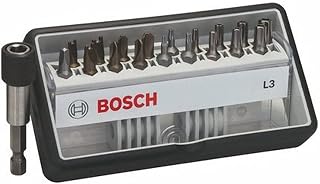
Bosch offers compact Extra Hard sets containing multiple screwdriver-bit profiles and a magnetic universal holder, making this type of configuration useful for buyers who want a portable selection rather than a large workshop assortment.
Woodworking frequently involves repetitive driving, countersunk screws and substantial torque. The most important considerations are correct bit profile, accurate sizing, secure engagement and suitability for the driver being used.
For routine work with a conventional drill/driver, Extra Hard can be a logical range to investigate. For repeated heavy-duty work involving an impact driver, Impact Control is the Bosch range that deserves closer consideration.
When the job involves repeated high-torque screwdriving, the bit should be selected for the tool and workload rather than simply by price or number of pieces in the package. Impact Control is specifically positioned by Bosch for robust, heavy-duty applications and impact-driver use.
Furniture assembly usually rewards versatility and accessibility more than extreme impact resistance. A compact mixed set with commonly encountered PH, PZ and Torx profiles can be more useful than a specialist heavy-duty collection.
For maintenance work, prioritise breadth of profiles, sensible bit lengths, organised storage and the ability to replace frequently used sizes individually. A large set can be useful, but only if it contains the profiles you actually encounter.
There is no advantage in buying dozens of rarely used bits simply because the package has a high piece count. The more useful question is whether the set contains the right profiles and sizes for your work.
A large Bosch screwdriver-bit set can offer excellent coverage, but the headline piece count should not be the main purchasing criterion. Some sets count holders or accessories alongside bits, while others may contain multiple versions of closely related profiles.
Bosch offers both compact sets and larger Pick and Click configurations. Its Extra Hard 44+1-piece set is described as a comprehensive collection for standard screwdriving tasks and includes a magnetic screwdriver handle and storage case.
Bosch's Pick and Click system is relevant to buyers who want to build a more tailored collection rather than purchasing a fixed assortment. Bosch describes certain Impact Control and Extra Hard sets as part of the Pick and Click system, allowing customisable bit-pack collections.
Storage matters more than it first appears. A good case can keep bits separated by profile and size, making it easier to identify the correct bit before starting a job. It can also reduce the likelihood of losing small components in a toolbox.
Double-ended bits can be useful when two commonly required profiles can be kept on the same bit. Bosch's Impact Control double-ended sets are described as highly robust and intended for heavy-duty applications, with an extended torsion zone and a 1/4-inch hex shank.
The principal advantage is convenience rather than simply doubling performance. A double-ended bit can reduce the number of individual pieces required in a portable kit, although conventional single-ended bits may be preferable when a particular job demands a specific length or access arrangement.
A PH2 bit is not a universal replacement for PZ2, and a Torx bit cannot substitute for a different Torx size simply because the recess looks close. Correct geometry and size are essential.
A bit should be matched to the drill, driver or impact driver being used. If your primary tool is an impact driver, investigate bits specifically designed for that environment rather than assuming that every standard screwdriver bit is equally suitable.
A 40-piece set is not necessarily better value than a compact 10-piece set if most of its contents are irrelevant to your work.
Very short bits are convenient, but longer bits can solve access problems that a standard-length bit cannot. Conversely, buying only very long bits can make some confined-space tasks less convenient.
Bit performance involves a balance between hardness, toughness, geometry and application. Bosch's use of modified S2 steel, heat treatment and torsion-zone designs illustrates why material selection should be considered alongside the overall engineering of the bit.
A visibly worn or damaged bit should not be treated as equivalent to a new one. A worn tip can compromise screw engagement and make slipping more likely, particularly when significant torque is applied.
Screwdriver bits are small components, but good storage can make a noticeable difference to their useful life. Keep them in a dry toolbox, case or bit holder rather than loose at the bottom of a tool bag where they can become contaminated or damaged.
After demanding work, inspect the driving tip for rounding, deformation, chipping or other visible damage. A bit that no longer fits the screw recess properly should be replaced rather than repeatedly reused.
It is also worth keeping frequently used bits accessible. If PH2, PZ2 or a particular Torx size is used repeatedly, storing those bits where they can be reached immediately is more practical than repeatedly opening a large assortment.
When comparing individual Bosch bits or complete sets, use the following criteria rather than relying on a single headline specification.
Before ordering, compare the product information line by line. Bosch's own listings demonstrate why apparently similar screwdriver bits can differ in length, profile, shank specification, packaging quantity and intended application.
Bosch Professional explicitly identifies some Extra Hard sets as fitting tools from most brands, reflecting the widespread use of standardised 1/4-inch hex interfaces.
However, compatibility should be checked at the tool-and-holder level rather than assumed from the brand name. The important factors are the shank format and the receiving chuck or holder. A Bosch bit can be suitable for a non-Bosch tool when the interface and application requirements match.
Price should be considered alongside the cost of replacing worn bits, the consequences of poor screw engagement and the type of work being undertaken. For occasional light DIY, an inexpensive set may appear sufficient. For repetitive work, however, the consistency of the bit profile, material specification and manufacturing quality can become more important.
This does not mean every Bosch bit is the right choice for every buyer. The useful comparison is between the specification of the Bosch product and the specification of the alternatives being considered. Avoid making a decision solely on brand reputation, piece count or packaging.
A set is usually the more practical option when you regularly encounter several screw profiles. It can also make sense for a new toolkit where you need to establish a basic collection from scratch.
Individual or small replacement packs become more attractive when you already know which sizes you use most frequently. This approach can reduce unused inventory and allow you to keep several replacements of a high-use size.
Start by confirming that the bit is intended for impact-driver use. Bosch specifically describes its Impact Control screwdriver bits as suitable for impact drivers and highlights their extended torsion zone and robust construction.
Next, select the correct drive profile and size. Finally, consider whether a standard single-ended bit, double-ended bit or multi-piece set better suits the job. Bosch's Impact Control range includes both individual configurations and double-ended or multi-bit options.
For conventional drill/driver use, Extra Hard is a natural range to investigate because Bosch positions it for universal use with rotary drills and drivers.
Choose the profile first, then the size and length. If the application is straightforward and does not involve repeated impact loading, there may be little reason to select the most heavy-duty option available.
Customer reviews can be useful, but they are most valuable when read for specific evidence rather than star ratings alone. Look for comments that explain the type of tool used, screw profile, workload, bit size and failure mode.
This approach provides considerably more useful buying information than treating every five-star review as proof that a bit is suitable for every application.
Yes, Bosch offers screwdriver-bit ranges intended for general-purpose use as well as more demanding applications. Its Extra Hard range is positioned for universal use with rotary drills and drivers, making it a relevant option for general DIY and maintenance.
Yes. Bosch specifically describes Impact Control screwdriver bits as suitable for use with impact drivers and highlights their extended torsion zone for demanding applications.
Extra Hard is positioned as a universal-use range with modified S2 steel, heat treatment and a tapered torsion zone. Impact Control is designed for more demanding applications and incorporates an extended torsion zone, with Bosch explicitly identifying it for impact-driver use.
No. PH2 and PZ2 represent different drive geometries. Use the profile that matches the screw head rather than choosing whichever cross-head bit happens to fit loosely.
There is no single universal size. The correct size depends on the screw. PH2 and PZ2 are common profiles in many general applications, but the correct choice should always be determined by the actual screw head.
Not necessarily. Length primarily affects access and reach. Durability depends on factors including material, heat treatment, geometry, torsion design, tool loading and how the bit is used.
Many Bosch Professional screwdriver bits use a 1/4-inch external hex shank, and Bosch identifies compatibility with suitable three-jaw chucks and 1/4-inch internal hex holders. The receiving tool or holder should still be checked before purchase.
No. A smaller set containing the profiles and sizes you actually use can be more useful than a much larger assortment containing numerous rarely needed bits. Compare the individual contents rather than the headline piece count.
Choose a set if you need several profiles or are building a toolkit. Individual bits or smaller packs can make more sense when you already know which sizes you use most often and need replacements.
Check the exact part number, profile, size, length, shank specification, tool compatibility, intended application and contents of the pack. Bosch's product listings show that apparently similar bits can be offered in substantially different lengths and configurations.
The best Bosch screwdriver bit is ultimately the one that matches the screw, tool and workload rather than the one with the largest piece count or most impressive marketing description. For general drill/driver work, Bosch Extra Hard provides a broad range of profiles, sizes and lengths. For demanding applications involving an impact driver, Bosch Impact Control deserves closer consideration because its design is specifically aimed at robust, impact-oriented use.
Before making a purchase, compare the exact specifications of the shortlisted products, check the included sizes, confirm the shank and tool compatibility, and consider whether you actually need a comprehensive set. It is also sensible to check current retailer pricing, availability and verified customer reviews immediately before buying because these details can change.
For most buyers, the strongest purchasing decision is not simply choosing the most expensive Bosch set. It is choosing the correct drive profile, size, length and bit family for the work you actually do, while keeping a few commonly used replacement bits available for future jobs.