

♥ Wishlist
Compare 4 verified Makita Bit Set for Drilling, Driving & Routing products in United Kingdom. Reviews, ratings, pros, cons and buying advice updated for October 2026.


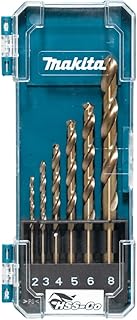
The right Makita bit set is not necessarily the one with the highest piece count. For most users, the more useful question is whether the set contains the correct bit types, sizes and lengths for the fasteners encountered most often. A compact set containing the right Phillips, Pozidriv, Torx and slotted bits can be considerably more useful than a large assortment filled with sizes that rarely leave the case.
Makita's accessory range includes conventional driver-bit sets as well as impact-oriented options. For example, the Makita E-03109 is specified as a 90-piece driver bit kit containing 87 Impact Black bits in 25 mm and 50 mm lengths, two sockets and a bit holder. The E-13552 is a smaller 31-piece Impact Premier torsion set with a 1/4-inch hex shank and a selection of slotted, Phillips, Pozidriv and Torx bits. These examples illustrate why piece count should always be considered alongside the actual contents of the case.
Before buying, look at the screws used in your typical projects. A joiner, kitchen fitter, electrician, furniture assembler and general DIY user may all need quite different combinations of bits.
Product specifications can look similar at first glance, but several details have a direct effect on usability. When comparing Makita bit sets, pay particular attention to the following characteristics.
Phillips and Pozidriv bits are not interchangeable simply because their shapes look similar. Using the wrong profile can result in poor engagement, damaged screw heads and premature wear. Torx fasteners are increasingly common in construction, woodworking, automotive applications and general maintenance, so a set with several Torx sizes may be more versatile for mixed work.
Slotted bits still have a place in maintenance and older installations, although they are less forgiving of poor alignment than many modern drive systems. A sensible mixed set therefore provides coverage rather than concentrating entirely on one profile.
Length is an important specification that is often overlooked. Standard 25 mm bits are convenient for compact drivers and holders, while longer bits can make recessed, awkward or obstructed screw locations easier to reach.
Longer does not automatically mean better. A long bit can introduce additional flex and may be less convenient in confined spaces. For everyday work, having both standard and longer options is often more useful than buying a case containing only one length.
Most modern screwdriver and impact-driver accessories use a 1/4-inch hex interface, but the exact holder arrangement still matters. Check that the bits and holder supplied in the set are compatible with the tool being used and with any quick-change system already in your workshop.
A 1/4-inch hex shank is not, by itself, a guarantee that every accessory is intended for every application. The manufacturer's stated application and impact compatibility should also be checked.
Impact-rated accessories are designed with the repeated loading associated with impact drivers in mind. This makes impact compatibility an important consideration if a bit will regularly be used with an impact driver rather than a conventional drill driver.
Do not assume that every bit in a large mixed accessory box has the same intended application. Check the manufacturer's specification for the individual set, particularly where high-torque or impact-driver use is involved.
Makita uses different accessory ranges, so the name printed on the box is only one part of the buying decision. The Impact Black range includes sets intended for driver applications, while Impact Premier sets are also offered in torsion-oriented configurations.
The Makita E-03084, for example, is specified as a 31-piece Impact Black set supplied in a battery-shaped plastic case. Its listed contents include PH1, PH2 and PH3, PZ1, PZ2 and PZ3, several Torx sizes and a 60 mm magnetic quick-change bit holder. This is a useful illustration of how a smaller set can still provide broad everyday coverage.
When comparing different Makita ranges, focus on the contents and intended application rather than assuming that a newer-sounding or more expensive range will automatically be the best choice for your work.
A 90-piece bit set sounds substantially more comprehensive than a 31-piece set, but the headline number may include duplicates, holders and multiple sizes or lengths of the same profile. A smaller case may actually provide better coverage of the fasteners you encounter most frequently.
For example, a professional who predominantly installs PZ2 screws may get greater practical value from a set containing multiple PZ2 bits and a reliable holder than from a huge assortment containing many rarely used profiles.
When comparing piece counts, ask four questions:
The material and construction of a driver bit affect how it behaves under load. Impact-driver accessories must cope with repeated torque pulses, while ordinary drilling and screwdriving can place different demands on the accessory.
Torsion-oriented bits are designed to accommodate a degree of controlled flex under demanding loads rather than behaving like an entirely rigid shaft. That does not make a torsion bit indestructible, and no bit should be treated as a substitute for using the correct torque, speed and drive profile.
Coatings and surface treatments can also differ between accessory ranges. They may contribute to durability or corrosion resistance, but buyers should avoid judging quality from colour or finish alone. The manufacturer's stated construction and intended application are more meaningful than appearance.
The holder can have almost as much practical influence on the experience of using a bit set as the bits themselves. A good holder should retain the bit securely while allowing quick changes when moving between fasteners.
Magnetic holders are particularly convenient for routine screwdriving because they can help keep the bit seated during positioning. However, magnetic retention does not eliminate the need for correct alignment and sufficient pressure.
When comparing sets, check whether the holder is included in the advertised piece count and whether its length is suitable for your usual applications. The Makita E-03084, for instance, lists a 60 mm magnetic quick-change bit holder among its contents.
A compact set is usually preferable when portability, speed of access and everyday essentials matter more than maximum variety. It can be easier to keep in a tool bag or drawer and quicker to inspect before starting a job.
Compact sets are particularly attractive for DIY users and tradespeople who repeatedly use a limited selection of screw profiles.
A larger set becomes more useful when the work changes frequently or when you need to deal with unfamiliar fasteners. More sizes and lengths can reduce the likelihood of being caught without the correct accessory.
The trade-off is that a larger case takes more storage space and can make it harder to identify the most useful bits quickly. More pieces also do not necessarily mean that every component is equally valuable.
If the intended tool is an impact driver, look specifically for an accessory set identified by the manufacturer as suitable for impact applications. This is more reliable than selecting a conventional screwdriver-bit set based purely on appearance.
The E-03109 is one example of a Makita set explicitly specified with Impact Black screw bits, while the E-13552 is identified as an Impact Premier torsion screw bit set. The latter contains 31 pieces and uses a 1/4-inch hex shank.
For regular impact-driver use, prioritise:
A conventional cordless drill driver gives the user greater control over speed and clutch settings than an impact driver, which can make it suitable for delicate fastening tasks. A general-purpose Makita bit set can therefore be a sensible choice for household repairs, furniture assembly and lighter workshop work.
Even in this situation, bit quality and fit remain important. A clutch setting can limit torque, but it cannot compensate for a badly fitting bit. Selecting the correct drive profile and size should remain the first priority.
Makita is not the only established manufacturer worth considering. Buyers comparing premium or trade-oriented driver bits may also encounter Bosch Professional, DeWalt, Milwaukee, Wera and Wiha.
The most useful comparison is not simply which logo appears on the case. Compare the actual assortment, drive profiles, bit lengths, impact compatibility, holder design, case organisation and replacement practicality.
The strongest purchase decision comes from comparing equivalent sets rather than brands in isolation. A smaller set from one manufacturer may be better suited to a particular job than a larger set from another.
More pieces can be useful, but only when those pieces add meaningful coverage. Check the actual contents before treating a high piece count as evidence of better value.
Buying a set without checking whether it contains the required PZ, PH or Torx sizes can lead to unnecessary duplication and poor compatibility with the screws already in use.
Impact drivers place different loads on accessories. Always check the manufacturer's application guidance rather than assuming that any 1/4-inch hex bit is appropriate for impact use.
A set containing only standard-length bits may be frustrating when working inside deep recesses or around obstructions. Conversely, a collection dominated by long bits may be unnecessarily cumbersome for routine fastening.
A well-organised case is useful, but it should not outweigh the technical contents. Treat the storage system as a usability feature rather than the primary measure of bit quality.
Makita sells multiple sets with similar descriptions and different contents. Always compare the precise model or product code, because a familiar product-family name does not guarantee identical contents.
Even a high-quality bit can wear quickly if it is repeatedly used with the wrong fastener, excessive pressure or unsuitable torque. Correct technique is therefore part of getting value from a bit set.
A worn bit may start by slipping occasionally before the problem becomes obvious. Look for rounded edges, chipped tips, deformation, unusual movement in the fastener head or repeated cam-out during otherwise normal use.
Continuing to use a damaged bit can make the screw itself harder to remove later. It can also increase the likelihood of damaging the surrounding material or losing control of the driver.
For professional users, keeping spare high-use sizes can be more practical than buying an entirely new set whenever a frequently used bit reaches the end of its useful life.
A bit case should make it obvious where each size belongs and allow frequently used accessories to be retrieved quickly. Clear labelling is especially useful where several visually similar Torx, Phillips or Pozidriv bits are stored together.
Consider the physical environment in which the case will be used. A workshop drawer may favour a compact case, while a mobile tradesperson may prefer a more portable arrangement that can withstand regular movement in a tool bag.
Do not assume that a larger case is necessarily more durable. Inspect the hinges, closure, bit retention and internal layout when retailer photographs and manufacturer specifications provide enough information to do so.
For general DIY, the best choice is usually a balanced set rather than the largest available assortment. Look for common PH, PZ and Torx sizes, a dependable holder and enough variation to cover routine furniture, timber, household maintenance and installation work.
A compact set can be preferable if you already know which sizes you use regularly. A larger set makes more sense if your projects vary considerably and you do not want to purchase individual bits for occasional requirements.
Professional users should place greater emphasis on the intended application, repeat-use durability, impact compatibility, useful size coverage and ease of replacing frequently worn bits.
The most suitable set depends heavily on the trade. A construction worker who drives large quantities of structural screws has different requirements from a kitchen installer, electrician or maintenance technician. Rather than choosing a generic 'professional' set, match the accessory assortment to the fasteners used on the job.
For an impact driver, start by narrowing the choice to sets that are explicitly specified for impact applications. Then compare the bit profiles and sizes you actually need, the construction of the bits, the available lengths and the quality of the supplied holder.
Makita's Impact Black and Impact Premier ranges provide examples of different approaches to impact-oriented accessories. The important point is to compare the exact product specification rather than assuming that all Makita bit sets offer identical performance or contents.
Some are specifically designed for impact applications, while buyers should not assume that every Makita bit set has the same intended use. Check the exact product specification and look for explicit impact compatibility before using a set with an impact driver.
It can be, depending on the work. A 31-piece set with useful profiles, sizes, lengths and a suitable holder may be more practical than a much larger set containing accessories you rarely use.
Not automatically. A larger set offers broader coverage, but the best option depends on whether those additional pieces are relevant to your work. The Makita E-03109, for example, contains 90 pieces, including 87 Impact Black screw bits in two lengths, two sockets and a bit holder.
There is no universal list because screw usage varies, but a sensible general-purpose collection should cover the common drive profiles and sizes encountered in household repairs, furniture assembly and woodworking. PZ, PH and Torx are useful profiles to consider.
No. Although the profiles look similar, they are designed differently. Use the correct bit for the screw head to achieve proper engagement and reduce the risk of damaging the fastener.
Some do and some do not. Check the exact contents before buying. For example, both the E-03109 and E-03084 specifications list a bit holder among their contents.
It describes the hexagonal shank interface used by many modern driver bits and holders. The Makita E-13552, for example, specifies a 1/4-inch hex shank. Compatibility should still be checked against the tool and holder being used.
There is no fixed replacement interval. Replace a bit when its tip becomes damaged, rounded or unreliable, or when it no longer engages the fastener properly. Heavy professional use can consume frequently used sizes considerably faster than occasional DIY use.
Brand matching is not normally the deciding factor for a standard driver-bit interface. What matters is compatibility with the tool and holder, the bit's intended application and whether the set contains the profiles and sizes required. Always check the manufacturer's specifications.
The most sensible way to compare Makita bit sets in 2026 is to treat the accessory assortment as a working system rather than a collection of numbers. Start with the fasteners, identify the profiles and sizes that matter, decide whether impact use is involved, and then compare construction, lengths, holder design and storage.
Makita's current UK specifications demonstrate that its sets vary substantially in size and configuration. The E-03109 provides a large 90-piece assortment, while the E-13552 offers a much smaller 31-piece Impact Premier configuration, and the E-03084 concentrates everyday profiles into a 31-piece Impact Black case. Those differences make direct comparison of the exact contents more useful than relying on the number printed on the front of the packaging.
For the final purchase decision, compare the exact specifications, check current availability with trusted UK retailers, read verified customer feedback and make sure the chosen set matches the drill or impact driver and fasteners you actually use. A carefully matched set will generally be more useful than simply buying the largest assortment available.