

♥ Wishlist
Compare 44 verified Makita Chisels and Points products in United Kingdom. Reviews, ratings, pros, cons and buying advice updated for October 2026.


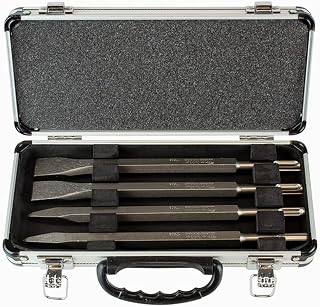








Choosing a Makita chisel or point is less about finding the most expensive accessory and more about matching the steel, shank system, profile and working length to the hammer and material involved. A chisel that is well suited to light brickwork can be a poor choice for sustained concrete demolition, while a heavy-duty point can be unnecessarily cumbersome for small chasing or tile-removal jobs.
For buyers comparing Makita chisels and points in the UK, the first specification to establish is the tool's chuck or shank system. Compatibility should always take priority over the apparent size or shape of the accessory. SDS-PLUS, SDS-MAX and larger hex-shank systems are not interchangeable simply because the accessories look similar.
It is also worth separating the purpose of a point from that of a cutting chisel. A point concentrates impact into a relatively small contact area, making it useful for breaking, penetrating and starting into masonry or concrete. A cold or flat chisel spreads the impact along an edge and is generally more appropriate when the aim is to split, cut, chase or remove material across a wider line.
The shank is the part of the accessory that locks into the hammer, so it determines whether the chisel can be used safely and correctly. Before comparing tip shapes, check the exact accessory system specified for your Makita machine.
The safest approach is to identify the exact Makita tool model first, then select accessories listed for that shank system. Do not rely solely on a retailer's photograph or a generic description such as "SDS chisel".
Not every hammer is designed for sustained demolition. Some rotary hammers have a dedicated hammer-only or chiselling setting, while others are primarily intended for drilling and offer more limited impact capability. The manufacturer's specification should therefore be checked before buying a large demolition accessory.
Using an accessory that is technically compatible with the chuck but inappropriate for the machine can produce disappointing performance and may place unnecessary stress on both the tool and accessory.
Impact energy is more important than simply choosing the largest-looking chisel. A large breaker can deliver considerably more force than a compact SDS-PLUS hammer, and its accessories are correspondingly designed for heavier work.
For lighter renovation work, a smaller chisel can provide better control and easier handling. For demanding concrete or structural demolition, the machine and accessory need to be considered as one system rather than as separate purchases.
A pointed chisel, often called a point or bull point, has a narrow tip designed to concentrate the hammer's impact. This makes it particularly useful for breaking up hard material, penetrating concrete and masonry, starting fractures and working into confined areas where a broad cutting edge would be less effective.
The pointed profile is also useful when material needs to be attacked progressively rather than removed across a wide surface. Once a crack or weak point has been established, a different accessory may be more efficient for enlarging the opening or removing the loosened material.
A point is therefore not automatically the "strongest" or "best" chisel. It is simply a different geometry intended for a different type of work.
A flat or cold chisel changes the way impact is transferred into the workpiece. Instead of concentrating force into a single point, its edge creates a more defined line of attack. This can make it more suitable for breaking away sections of masonry, cutting channels and separating material after a point has opened the area.
The exact profile should be chosen according to the task. A narrow edge can offer greater concentration and control, while a wider edge can remove material more quickly over a larger area. Wider does not necessarily mean better, particularly where accuracy is important.
Heavy chiselling and surface scraping are different jobs. A demolition point is designed to deliver concentrated impact, whereas a scraper-style or scaling accessory is intended to work across a surface. Using a point to perform a scraping task can leave an unnecessarily uneven surface and may make the job slower.
Scaling chisels are particularly useful where the material being removed is relatively shallow and spread across a surface. Typical examples can include dried residue, surface build-up and other material that needs to be lifted rather than deeply penetrated.
The wider working area can make these accessories more productive for surface preparation, but they are not a substitute for a point when deep penetration is required.
When comparing scaling chisels, consider the width and overall length together. A very wide accessory may cover more material per stroke, but a narrower profile can provide better access around corners and confined areas.
Length is one of the most overlooked specifications when buying demolition accessories. A longer chisel provides additional reach, which can be useful where access is restricted or the operator needs to remain further away from the immediate working area. However, longer does not automatically mean more effective.
Shorter accessories can be easier to control and are often convenient for general renovation tasks where reach is not a problem. Their compact dimensions can also be useful when working in confined spaces.
Medium-length options are often a practical compromise between reach and control. They can suit a broad range of general demolition and masonry work, provided their shank and specification match the hammer.
Longer accessories can be useful when extra reach is genuinely required. They can also allow the operator to approach certain areas without placing the hammer as close to the workpiece. The trade-off is that a longer accessory can feel less nimble, particularly during precision work.
Do not select length based solely on the assumption that longer means better. The best length is the shortest one that provides the access required for the job while remaining appropriate for the hammer.
Demolition accessories experience repeated shock loading, so the steel and heat treatment are important. A suitable chisel needs to tolerate repeated impact without becoming excessively brittle or deforming prematurely.
When comparing products, look for clear manufacturer information about the steel, heat treatment or construction rather than relying on vague descriptions such as "industrial quality" or "extra strong". Marketing terminology is less useful than a clearly stated specification.
A chisel that is extremely hard is not automatically the best chisel. The accessory has to balance hardness with toughness because repeated hammer impacts can create severe stress at the working end and shank.
This is particularly important for demolition applications. The tip needs to remain effective while the overall accessory must tolerate repeated impacts without inappropriate cracking, deformation or excessive mushrooming.
With repeated use, the working end of a conventional chisel can change shape. The rate of wear depends on the material being worked, hammer energy, operator technique, accessory quality and working conditions.
A chisel that begins to deform should not simply be assumed to be "wearing normally". Inspect the working end and shank regularly and follow the manufacturer's guidance on acceptable wear, dressing and replacement.
Self-sharpening designs are intended to maintain an effective working profile through their construction and wear characteristics rather than requiring the same type of manual reshaping associated with some conventional chisels.
The main attraction is reduced interruption during demanding work. If an accessory can maintain a productive profile for longer, it may reduce the need for frequent intervention. That can be especially relevant for professional users where downtime matters.
However, "self-sharpening" should not be interpreted as "never wears out". All impact accessories are consumable items. Their working life depends heavily on the application, hammer, material and operating conditions.
Concrete is one of the most demanding applications for a chisel, and the correct accessory depends on whether the objective is penetration, breaking, cutting or surface removal.
Reinforced concrete deserves additional caution. Steel reinforcement can change the nature of the task considerably, and an ordinary masonry chisel should not be treated as a substitute for an accessory or method specifically suited to cutting reinforcement.
Brick and block can generally be less demanding than dense concrete, but the correct profile still depends on the intended result. For removing a small section, chasing or opening an area, control can be more important than maximum impact.
Pointed accessories can be useful for starting a break, while flatter profiles can help remove the remaining material. Using the correct geometry can therefore reduce the temptation to apply excessive pressure to the hammer.
Older, brittle masonry also requires care. Excessive impact can cause surrounding material to break away beyond the intended area, so a smaller accessory and controlled technique can sometimes produce a better result than simply choosing the most powerful available setup.
Tile removal calls for a different approach from heavy concrete demolition. The objective is usually to separate tile and adhesive from the substrate while limiting unnecessary damage to the surface underneath.
A broad, relatively thin profile can be useful for getting underneath tiles and lifting material across a surface. A large demolition point is generally better suited to breaking than controlled tile removal.
For floors, the working angle is also important. Holding the accessory too vertically can encourage deeper penetration into the substrate, whereas a suitable shallow working angle can help the blade travel underneath the tile.
Chasing requires more control than straightforward demolition. The aim is to create a channel of suitable dimensions without unnecessarily damaging the surrounding masonry.
A narrower cutting profile can be preferable where the channel needs to remain relatively controlled. A point may be useful for starting the opening, but using a point for the entire task can produce an irregular result.
Before chiselling into walls, floors or other structures, establish whether there are concealed electrical cables, pipes, reinforcement or other services. The choice of chisel does not remove the need for proper site assessment and safe working procedures.
SDS-PLUS is associated with smaller and lighter rotary hammers and is widely used for drilling and lighter chiselling applications. Its compact format makes it suitable for many domestic renovation and general building tasks.
SDS-MAX is a larger accessory system intended for more substantial rotary hammers and demolition equipment. The larger shank and accessory format are suited to machines capable of delivering considerably greater impact energy.
An SDS-PLUS chisel should not be selected simply because it is cheaper or easier to find if the machine requires SDS-MAX. Conversely, fitting a large SDS-MAX accessory is not an appropriate way to make a smaller hammer perform like a demolition breaker.
Always check the tool's exact specification before purchasing replacement accessories.
Makita is not the only manufacturer producing professional demolition accessories. Bosch Professional, DeWalt, Milwaukee and other established tool brands also offer compatible chisels and points in different shank systems and profiles.
For a fair comparison, avoid judging accessories by brand name alone. Compare the following specifications instead:
A Bosch or DeWalt chisel can be a sensible alternative where the shank system is compatible, but the correct choice should be based on application and specification rather than assuming that accessories from different brands are universally interchangeable.
A multi-piece set can look attractive because it provides several profiles in one purchase. This can be useful for users who regularly switch between penetration, cutting and surface-removal tasks.
However, buying a set is not automatically better value. If most of the work involves one particular operation, an individual high-quality accessory may be more useful than a collection containing profiles that rarely leave the toolbox.
This is the most fundamental mistake. Always confirm SDS-PLUS, SDS-MAX or the relevant hex system before comparing prices.
A longer accessory can provide useful reach, but it can also be less convenient for controlled work. Choose length according to access requirements.
Two points can have the same nominal length while differing in steel construction, working profile, heat treatment and intended application. Specifications matter.
A point is versatile, but it is not the ideal accessory for every job. Flat, cold, scaling and specialist profiles exist because different materials and tasks require different contact geometries.
The accessory and machine should be treated as a matched system. A very large chisel does not turn a compact rotary hammer into a heavy-duty breaker.
Consumable accessories can represent a relatively small proportion of the overall cost of a demolition job, yet an unsuitable accessory can waste time and increase operator effort. Compare specification, expected application and construction rather than choosing the lowest price automatically.
Makita part numbers can look similar across accessory categories, so the product description should be checked carefully before ordering.
If a retailer's listing omits an important specification, it is sensible to verify the part number against manufacturer information before purchasing.
There is no single replacement interval that applies to every user. A chisel used occasionally for small renovation jobs can have a very different service life from one used every working day on dense concrete.
Instead of relying on a calendar-based replacement schedule, inspect the accessory regularly. Look for excessive wear, deformation, cracking, unusual damage around the working end and damage to the shank.
The manufacturer's instructions should take precedence when defining acceptable wear and maintenance limits. If an accessory is visibly damaged or its condition is uncertain, continuing to use it simply because it has not reached a particular number of hours is poor practice.
The shank enters the hammer's chuck and should be kept clean and in suitable condition. Dirt, concrete dust and other debris can interfere with proper engagement and accelerate wear.
Some hammer systems require appropriate lubrication of the accessory shank. Follow the instructions for the specific Makita machine rather than assuming that any general-purpose grease is suitable.
Chisels should be stored where their working ends are protected from unnecessary knocks and moisture. Keeping accessories organised also makes it easier to identify the correct profile and shank before starting work.
Operator technique can have a significant effect on productivity. A hammer is designed to deliver impact through the accessory, so excessive downward pressure is not necessarily the route to faster work.
Allow the tool's impact mechanism and chisel geometry to do the work. Excessive pressure can reduce the freedom of the mechanism to operate as intended and can increase fatigue.
For deeper demolition, working progressively can be more effective than forcing a point continuously into one location. Open a fracture, remove loosened material, reposition and continue. This approach can also make it easier to control the shape of the demolition area.
Chiselling concrete, brick and masonry can produce flying fragments, dust and substantial noise and vibration. Appropriate personal protective equipment and site controls should be used for the material and environment involved.
Particular care is required when chiselling older buildings or unknown materials. Paints, coatings, insulation, mortar and other construction materials can present hazards that are not apparent from the surface.
For occasional DIY work, versatility and control are often more useful than selecting the largest accessory available. Consider the jobs you are realistically going to undertake over the next few years rather than buying for an extreme demolition task that may never occur.
A general-purpose point and an appropriate flat or cutting chisel can cover a useful range of renovation tasks when paired with a compatible hammer. If tile removal is a frequent requirement, a suitable wider profile can be more useful than simply adding another heavy-duty point.
DIY buyers should also pay attention to storage. A small set containing the profiles that are actually used can be more practical than a larger collection of specialist accessories.
Professional buyers should place greater emphasis on productivity, consistency and total operating cost. The cheapest accessory is not necessarily the least expensive option once downtime, replacement frequency and operator effort are considered.
For regular demolition, it can make sense to keep several profiles available so the operator can switch between penetrating, cutting and surface-removal work without attempting to make one accessory perform every task.
Professional users should also maintain a clear inspection routine. Accessories are consumables, and replacing a damaged item before it becomes a larger problem can be preferable to continuing to use it until performance deteriorates significantly.
When comparing several options side by side, use the same criteria for every accessory. This prevents a lower price or more prominent product photograph from influencing the decision more than compatibility and application.
Makita accessories are an obvious choice for owners of Makita hammers because the manufacturer's product range makes it easier to match part numbers and accessory systems. Nevertheless, a buyer should not assume that every Makita chisel fits every Makita hammer.
The same principle applies when considering Bosch Professional, DeWalt, Milwaukee or other established manufacturers. Brand compatibility is secondary to the actual shank standard and the tool manufacturer's intended application.
For buyers comparing different brands, the strongest approach is to shortlist accessories that are genuinely compatible first, then compare profile, length, construction and intended use.
A good chisel is one that matches the machine, material and task while maintaining a suitable working profile through its intended service life. There is no universal specification that makes one accessory best for every situation.
For heavy demolition, durability and suitability for high impact energy become especially important. For renovation and chasing, control and geometry may matter more. For surface work, the width and shape of the working end can be more significant than maximum penetration.
The best buying decision therefore starts with the job rather than the product name.
Before purchasing, identify the exact Makita hammer model and shank system, decide what material you will be working on and establish whether you need penetration, cutting, surface removal or controlled demolition. Then compare the appropriate accessory profiles by length, width, construction and intended application.
For occasional DIY use, prioritise versatility and ease of handling. For regular renovation work, consider keeping complementary profiles available. For demanding professional demolition, focus on the relationship between the hammer's impact capability and the accessory's construction rather than choosing solely on price.
It is also sensible to check the current manufacturer specification and the exact part number before ordering. Retailer descriptions can vary, and similarly named accessories may have different dimensions or shank systems.
Ultimately, the best Makita chisel is not necessarily the longest, widest, hardest or most expensive option. It is the accessory whose shank, profile, dimensions and construction are appropriate for the hammer and the material being worked.
For breaking and penetrating concrete, a compatible pointed or bull-point accessory is often the appropriate starting point. For cutting or removing material along a wider line, a flat or cold chisel may be more suitable. The correct choice depends on the hammer, concrete and precise task.
A point concentrates impact at a narrow tip and is intended primarily for penetration and breaking. A cold chisel has a cutting edge that spreads the working action over a wider area and is better suited to cutting, splitting and controlled material removal.
No. SDS-MAX and SDS-PLUS are different accessory systems. Always use the shank type specified for the hammer.
Some accessories can be cross-compatible when they use the same standard shank system and are suitable for the same class of hammer. Compatibility should be confirmed from the specifications rather than assumed from the brand.
Not necessarily. A longer chisel provides additional reach but can be less convenient for controlled work. Select the shortest length that provides the access you need.
A set can be useful if you regularly perform different types of chiselling. If one particular profile covers nearly all your work, buying an individual accessory can be more practical.
Inspect the working end and shank for excessive wear, deformation, cracking or other damage. Follow the manufacturer's guidance for wear limits and replacement rather than relying on a fixed number of hours or jobs.
It can break tiles, but it is usually not the most controlled profile for lifting tiles from a substrate. A suitable wider tile or scaling profile can provide better surface coverage and control where the objective is separation rather than deep penetration.
Compare the exact part number, shank system, profile, length, construction, quantity and intended application. A cheaper accessory is not necessarily better value if it is unsuitable for the job or needs replacing sooner.
Keep them clean, dry and protected from unnecessary impact to the working ends. Inspect the shank before fitting the accessory to the hammer and follow the manufacturer's maintenance recommendations.