

♥ Wishlist
Compare 19 verified DeWalt Drill Bit Sets for Wood, Metal, Masonry and More products in United Kingdom. Reviews, ratings, pros, cons and buying advice updated for October 2026.


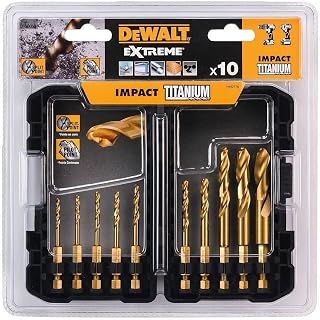




Choosing a DeWalt drill bit set is less about finding the largest box and more about matching the bits to the materials, drill modes and hole sizes you actually use. A compact set containing the right specialist bits can be considerably more useful than a much larger mixed kit containing sizes and accessories that rarely leave the case.
DeWalt's current UK drilling-accessory range includes dedicated metal, masonry, wood and multi-material options, as well as mixed drill-and-drive sets. That makes the intended application an important starting point when comparing sets rather than treating the number of pieces as the main measure of value.
The first question should be simple: what are you normally drilling? Wood, metal, masonry and multi-material work place very different demands on a drill bit. A bit optimised for one application should not automatically be treated as a universal substitute for another.
One of the easiest buying mistakes is assuming that a high piece count means a larger selection of drill bits. Many combination kits include screwdriver bits, nut drivers, holders and other accessories alongside drilling accessories. A set can therefore contain dozens of pieces while offering relatively few actual drill-bit sizes.
For example, DeWalt's 19-piece DT7921-QZ is described as a combination set containing drill and screwdriver bits for applications involving metal, wood, plastic and masonry. By contrast, the EXTREME 2 HSS-G 29-piece set contains 29 HSS-G metal drill bits ranging from 1 mm through 13 mm, making it a very different proposition despite both being sold as sets.
Before comparing prices or reviews, count the actual drill bits included. Then check which diameters are present and whether those sizes correspond to the fixings, pilot holes and materials used in your projects.
High-speed steel, usually abbreviated to HSS, is one of the most important material categories when comparing metal drill bits. It is designed to retain useful hardness at the temperatures encountered during drilling and is widely used for drilling metal and other compatible materials.
Within HSS products, however, construction and finish can differ. DeWalt's UK range includes HSS-R, HSS-G and black-oxide HSS options, so the abbreviation on the packaging is worth checking rather than assuming all HSS bits are equivalent.
The R and G designations generally refer to how the drill is manufactured. Rolled HSS and ground HSS can differ in geometry, surface finish and manufacturing precision. Ground HSS is commonly associated with more precisely formed cutting geometry, which can be advantageous when hole accuracy and repeatability matter.
DeWalt's HSS-G 29-piece set, for instance, uses precision-ground twist drill geometry and provides a broad 1 mm to 13 mm size selection. This type of set can be particularly attractive where a user needs a comprehensive range of metal-drilling diameters rather than a handful of general-purpose sizes.
Black oxide is a surface treatment rather than a completely different base material. It can provide increased resistance to corrosion and is used on drill bits intended for demanding general metal-drilling applications.
The DeWalt DT5912-QZ black-oxide HSS-R set contains 13 sizes from 1.5 mm to 6.5 mm and is specified for applications including steel, cast iron, nickel, brass and other compatible materials.
Do not assume that a darker coating automatically means a drill bit is more durable than every uncoated or differently coated alternative. The complete construction, geometry, intended material and correct drilling technique all influence useful service life.
The shape of the cutting tip affects how easily a bit starts, how accurately it centres and how much pressure is required. This becomes increasingly important with smaller diameters and harder materials.
Some DeWalt metal-drilling sets use a 118-degree split-point configuration, while the EXTREME 2 HSS-G 29-piece set specifies a Pilot Point design. These are useful specifications to compare when two sets appear similar on paper.
Masonry drilling is a separate category from ordinary metal and wood drilling. Brick, block, concrete and stone can generate substantial impact and abrasion, so masonry bits typically use a hardened cutting tip designed for the application.
DeWalt's standard five-piece masonry set includes 4 mm, 5 mm, 6 mm, 8 mm and 10 mm bits and is specified for percussion drilling. Its EXTREME masonry set uses the same five nominal diameters but adds a carbide-head design, reinforced body construction and an anti-slip shank.
A standard masonry set can be sensible for routine plug, fixing and clearance-hole work where the drill and material are within the intended application. A more heavily engineered masonry set may be worth considering when the work is more demanding or when bit durability is a higher priority.
DeWalt describes its EXTREME masonry set as suitable for masonry, brick, stone, tiles and light concrete, and specifies a hardened steel body with core reinforcement. Always check the manufacturer's application guidance before using a conventional masonry accessory on particularly hard concrete or other demanding substrates.
If the drill uses an SDS-Plus or SDS-Max chuck, ordinary round-shank masonry bits are not interchangeable with the relevant SDS accessories. The connection system is a fundamental compatibility requirement.
This is especially important for buyers who already own a rotary hammer and assume that any DeWalt masonry bit will fit. Check the tool's chuck specification before ordering replacement bits or a larger set.
Multi-material bits can be appealing because they reduce the need to switch between different accessory types during mixed-material projects. DeWalt's current UK range includes individual multi-material bits and multi-material drill-and-drive sets.
The attraction is convenience rather than a guarantee that one bit will outperform a specialist bit in every application. If most of your work is exclusively metal, a dedicated metal set may offer a more appropriate range. If your projects frequently move from timber to plastic to masonry, a suitable multi-material set can simplify the toolkit.
The shank is the section held by the drill chuck or tool holder. It deserves more attention than it usually receives because an incompatible connection can make an otherwise excellent drill bit useless for your particular tool.
Traditional round shanks are common on conventional drill bits and can be suitable for standard keyed or keyless chucks. The exact diameter and chuck capacity still need to be checked.
Hex-style and anti-slip designs can help prevent rotation within compatible holders or chucks. DeWalt specifies three-flat anti-slip shank features on certain accessories, including some of its metal and masonry products.
A drill bit that physically appears to fit a tool is not automatically suitable for use in an impact driver. Accessories intended for impact applications should be clearly identified by the manufacturer as compatible with that tool type.
This distinction is particularly important when comparing drill-and-drive sets, because screwdriver bits and drilling accessories may have different connection requirements and impact ratings.
More pieces do not necessarily mean better value. A 29-piece metal set can be useful when you regularly need many diameters, whereas a five-piece masonry set may be more practical when your work mainly involves common wall-plug sizes.
A compact combination set can cover a broad range of household jobs without requiring a large accessory case. Prioritise useful diameters, material compatibility and storage over an impressive headline piece count.
A mixed set containing wood, metal, masonry and screwdriver accessories can be convenient if your projects vary considerably. It can also reduce the need to purchase individual bits immediately after discovering that a particular size is missing.
Frequent users may benefit more from application-specific sets. A tradesperson who spends most of the day drilling steel has different requirements from someone primarily installing fixings in brickwork or assembling timber structures.
In professional use, the availability of replacement sizes can also matter. A comprehensive system becomes more useful when individual commonly used bits can be replenished without replacing an entire mixed kit.
Manufacturers can count different components differently across accessory categories, so piece count should always be treated as one specification rather than a direct measure of value.
When comparing two sets, make a simple inventory of the contents:
This approach gives a much clearer picture of what you are actually buying than comparing a headline such as 45-piece, 85-piece or 109-piece.
A drill-bit set is only useful when you can quickly identify and retrieve the correct accessory. Poor storage can lead to misplaced bits, damaged cutting edges and unnecessary duplication.
Some DeWalt accessory sets use ToughCase or ToughCase+ storage systems, with designs intended to organise accessories and, in some cases, connect with other compatible storage components. The DT70763-QZ 85-piece set, for example, is described as using a modular ToughCase+ system with stackable and connectable cases.
A large set may contain useful extras, but it can also include accessories that do not match your work. A smaller application-specific kit may deliver better practical value.
Drill bits are engineered for particular materials, drilling methods and tools. Always read the stated application rather than assuming that a bit is suitable because it physically fits the chuck.
Check the connection type before buying, particularly when moving between conventional drills, impact drivers and SDS rotary hammers.
Ratings can help identify patterns in customer satisfaction, but they do not replace technical specifications. A highly rated masonry set may still be the wrong purchase for someone who mainly drills stainless steel.
Two sets with similar piece counts can have completely different size coverage. For drilling metal, a set spanning 1 mm to 13 mm is materially different from a compact set concentrated around smaller household diameters. DeWalt's DT7926-XJ is one example of a 29-piece HSS-G set covering that broad range.
Standard rotation and percussion drilling are not interchangeable. Using the wrong mode can reduce performance and potentially damage the accessory or workpiece. Follow the bit manufacturer's instructions and the tool manufacturer's guidance.
A useful comparison should examine the entire specification rather than focusing on one headline feature. The following framework can be used when comparing any DeWalt drill bit set currently available in the UK.
Prioritise a dedicated HSS set with the diameter range you actually use. If accurate hole production and a broad range of sizes are important, compare ground HSS construction and point geometry rather than simply selecting the cheapest set.
The DeWalt EXTREME 2 HSS-G 29-piece set is specified with 29 HSS-G metal drill bits from 1 mm to 13 mm and a Pilot Point head design, making this type of configuration particularly relevant for users who need extensive metal-drilling coverage.
For ordinary fixing and plug holes, a compact masonry set covering common diameters can be sufficient. If your work is harder or more frequent, compare carbide-head construction, body reinforcement, shank design and stated material compatibility.
A combination or multi-material kit is often the most convenient choice when the same drill is used for several different tasks. The advantage is breadth rather than specialist performance in every material.
A dedicated metal set with many incremental sizes can reduce the need to buy individual replacements and gives greater flexibility when selecting the appropriate hole diameter. A 29-piece set covering 1 mm to 13 mm provides substantially more incremental sizing than a small general-purpose kit.
Remove dust, swarf and material residue after use. Particular attention should be given to cutting edges and flutes, where debris can remain trapped and affect subsequent drilling.
Look for chipped carbide, rounded cutting edges, excessive wear, discolouration or other visible damage. A damaged bit should not simply be kept in the case because it might be useful later.
Excessive heat can accelerate wear and damage the cutting geometry. Correct speed, pressure, bit selection and suitable cutting practice are important when drilling metal. Follow the manufacturer's recommendations for the particular material and accessory.
Returning every bit to its labelled position makes it easier to identify missing sizes and prevents loose accessories from rubbing against one another. This becomes increasingly important with larger sets containing many similar-looking diameters.
There is no single replacement interval that applies to every drill bit. Service life depends on the material being drilled, drilling speed, pressure, cooling, tool condition, frequency of use and the quality of the accessory.
Consider replacing a bit when it is visibly damaged, no longer cuts effectively, overheats unusually quickly, wanders excessively, produces poor-quality holes or requires substantially more force than normal despite correct technique.
For professional users, it can be useful to monitor the performance of frequently used diameters and keep replacement bits available for sizes that are critical to everyday work.
Always follow the safety instructions supplied with the drill, driver and accessory. Wear appropriate eye protection when drilling, secure the workpiece properly and make sure the bit is correctly installed before operating the tool.
Be particularly careful when drilling walls or other structures where concealed electrical cables, plumbing or other services may be present. Use appropriate detection equipment and follow established safe-working procedures before drilling into an unknown surface.
For metal, masonry and other demanding applications, make sure the accessory is rated and intended for the material and drilling mode being used. Never exceed the manufacturer's stated limitations.
Prioritise simplicity, useful sizes, clear storage and broad compatibility. A well-organised combination set can be more practical than a specialist collection when you are still building an accessory toolkit.
Start matching the bit type to the material rather than relying on one general-purpose set. A mixed toolkit containing dedicated masonry, wood and metal accessories can improve flexibility and reduce compromises.
Durability, repeatability, replacement availability, tool compatibility and application-specific performance become more important. The most economical set is not necessarily the one with the lowest purchase price; the relevant consideration is how effectively it supports the work and how easily worn sizes can be replaced.
Consider whether you need a complete range of diameters or simply a selection of common sizes. A specialist set can make sense for a workshop where one material dominates, while a mixed set can reduce the number of separate cases required for varied projects.
There is no universal answer. The value of a more advanced set depends on how often it will be used, what materials it will encounter and whether its additional features solve a genuine problem for the buyer.
A professional metalworker may benefit from a broad HSS-G set with many incremental sizes, while someone drilling a handful of holes into brick each year may have little reason to purchase a large metal-drilling collection.
The same principle applies to mixed sets. Paying more for additional screwdriver bits, holders or storage components only makes sense when those extras are useful to your projects.
Product listings can change, and different retailers may display different combinations or packaging descriptions. Before purchasing, cross-check the exact model number and confirm the contents against the manufacturer's current specification.
DeWalt sells multiple sets with similar names but materially different contents. Searching only for a phrase such as “DeWalt drill bit set” can therefore make two unrelated products appear comparable.
Model numbers provide a much more precise way to distinguish products. For example, DT5912-QZ identifies the 13-piece HSS-R black-oxide metal set, DT7926-XJ identifies the EXTREME 2 HSS-G 29-piece set, and DT6956-QZ identifies the EXTREME masonry five-piece set.
When checking retailer listings, make sure the model number corresponds with the photograph, description and stated contents. This is particularly useful when several DeWalt sets have similar packaging or overlapping terminology.
There is no single best set for every user. The right choice depends primarily on the material being drilled, required diameters, drill compatibility and frequency of use. A dedicated metal set can be preferable for workshop drilling, while a masonry or mixed-material set may be more appropriate for other jobs.
DeWalt produces a broad range of drilling accessories aimed at different applications, including dedicated metal, masonry, wood and multi-material products. Suitability for professional work depends on the particular accessory and the demands of the job rather than the brand name alone.
Not necessarily. Compatibility depends on the shank or connection, chuck capacity and the tool's intended application. Conventional round-shank bits, hex accessories and SDS accessories should not be treated as universally interchangeable.
Not automatically. The 29-piece set may provide a much wider selection of sizes, but a five-piece masonry set can be the better choice when those five sizes cover the user's actual fixing requirements. Compare the contents and intended application rather than the piece count alone.
Look at dedicated HSS products and compare the construction, point geometry, diameter range and stated material compatibility. DeWalt's UK range includes both HSS-R and HSS-G metal-drilling options, including sets designed for broad diameter coverage.
Use a masonry-specific bit designed for the drilling method and substrate. DeWalt's masonry range includes carbide-tipped options specified for materials such as masonry, brick and stone.
No. A masonry bit is designed around a different cutting application and should not be substituted for a metal-drilling bit. Choose an accessory whose manufacturer specification explicitly covers the material you intend to drill.
Some metal drill bits may be specified for additional materials, and certain DeWalt products explicitly list wood and plastic alongside metal. However, a dedicated wood bit may provide a more appropriate cutting geometry for a particular woodworking task. Always check the manufacturer's stated applications for the exact model.
Prioritise the materials you work with most, useful diameters, compatibility with your drill, sensible storage and a sensible number of genuinely useful accessories. A compact set that covers your regular jobs is often more practical than a much larger kit containing specialist pieces you rarely use.
Compare the actual contents, not just the headline count. Check drill-bit quantity, size range, materials, point design, shank type, additional accessories, storage system and intended applications. Two sets with the same nominal piece count can be designed for completely different work.
A mixed set can be convenient when you frequently alternate between drilling and fastening. It is less compelling if you already own a comprehensive screwdriver-bit collection and specifically need more drill-bit sizes. DeWalt's range includes combination sets as well as dedicated drilling collections, allowing buyers to choose according to their toolkit.
Keep them clean and dry, return them to their case after use, inspect cutting edges regularly and replace bits that are visibly damaged or no longer perform correctly. For metal drilling, appropriate speed, pressure and heat management are particularly important.
Before choosing a DeWalt drill bit set, run through this checklist:
The strongest way to compare DeWalt drill bit sets is to work backwards from the job. Identify the material, hole sizes, drilling method and tool first, then choose the set that provides the appropriate bit construction and coverage.
A broad HSS-G set can be a logical option for someone who needs many metal-drilling diameters. A compact carbide-tipped masonry set can make more sense for routine wall fixings. A multi-material or drill-and-drive kit can be preferable when convenience and versatility matter more than specialist coverage.
Above all, do not let piece count, packaging or a generic “professional” description make the decision for you. The most useful DeWalt drill bit set is the one whose specifications genuinely match your tools, materials and working requirements.