

♥ Wishlist
Compare 39 verified Festool Drill Bit Sets products in United Kingdom. Reviews, ratings, pros, cons and buying advice updated for October 2026.


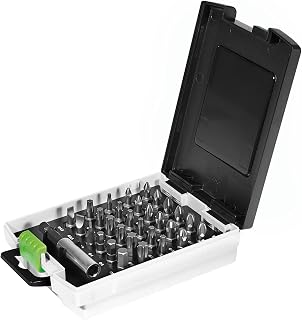


Choosing a Festool drill bit set is less about buying the largest assortment and more about matching the drill bits to the materials, hole sizes and type of work you actually undertake. A compact woodworking set can be a better choice for furniture assembly than a much larger general-purpose assortment, while metalworking, masonry and heavy construction require completely different cutting geometries and tool interfaces.
For Festool users, the CENTROTEC system is an important consideration. Compatible CENTROTEC accessories can be fitted directly into the appropriate CENTROTEC tool chuck, helping reduce the length of the drilling or screwdriving assembly and making tool changes particularly convenient. However, not every Festool drill bit is designed for the same material or application, so compatibility with the drill, chuck and intended workpiece should be checked before purchase.
The most important specification is usually not the number of pieces in the case but the material for which the bits are designed. Wood drill bits, HSS metal drill bits and SDS-Plus masonry bits have different cutting geometries because they need to remove different types of material.
CENTROTEC is particularly relevant when selecting accessories for Festool cordless drills and cordless percussion drills equipped with the appropriate FastFix tool reception and WH-CE CENTROTEC tool chuck. Festool's current accessory information shows dedicated CENTROTEC drill-bit ranges for wood and metal applications, as well as combination assortments containing drilling and screwdriving accessories.
One advantage of the system is rapid accessory changing. Certain CENTROTEC drill bits can be inserted directly into the CENTROTEC tool chuck rather than requiring a conventional separate bit holder. This can reduce the overall working length and can be useful where access is restricted or when switching repeatedly between drilling and screwdriving.
Compatibility should nevertheless be treated as a specification rather than an assumption. Before ordering, check the exact interface, drill model and accessory designation. A Festool-branded accessory is not automatically suitable for every Festool drill.
The same nominal drill diameter can be available in several different accessory formats. A 6 mm wood drill, for example, may look similar to another 6 mm drill at first glance, but its shank and intended chuck system can be completely different.
Woodworking places different demands on a drill bit from metalworking. A useful wood drill should enter the material accurately, cut efficiently and evacuate chips without unnecessarily tearing the surrounding fibres.
Festool's BKS SYS3 D3-10 CE/W is an example of a dedicated six-piece CENTROTEC wood-drill assortment. The current UK specification lists 3, 4, 5, 6, 8 and 10 mm diameters, with the drills made from high-alloy ball-bearing steel. The design incorporates a centre point and two cutters, while the manufacturer describes two chamfers rather than conventional pre-cutting blades as part of the geometry. It is intended for wood, glued solid wood, MDF and acrylic glass.
This type of assortment makes sense when the majority of drilling involves common woodworking diameters. The selection covers several frequently required sizes without adding a large number of rarely used pieces.
A centre point helps establish the drilling position before the main cutting edges engage with the material. This is particularly useful when accurate positioning matters, such as fitting hinges, handles, brackets, drawer components or other furniture hardware.
It can also make the starting phase of drilling more controlled than using a general-purpose bit that is not designed specifically for timber. Nevertheless, correct technique remains important: excessive feed pressure, a blunt cutter or an unsuitable drill speed can still produce poor results.
Long drill bits are not automatically better. When working inside cabinets, near corners or behind panels, a shorter accessory can provide much better control.
The Festool BKS SYS3 D3-8 K CE/W combines short spiral wood drills with screwdriver bits. Festool specifies short drills with a 65 mm overall length and a 25 mm spiral length, with diameters of 3, 4, 5, 6 and 8 mm, including two 5 mm drills. The manufacturer specifically positions the compact format for work such as drilling in panel materials and narrow spaces, including use with angle attachments.
For installers and furniture professionals, this illustrates an important buying principle: accessory length should be selected according to access requirements, not simply maximum drilling depth.
If metal drilling is part of the job, a dedicated HSS assortment deserves consideration. HSS, or high-speed steel, is commonly used for general-purpose drilling of steel and non-ferrous metals, but the result still depends heavily on correct technique.
Festool's HSS D3-10 CE/10 is a ten-piece CENTROTEC drill-bit case covering 3, 3.5, 4, 4.5, 5, 5.5, 6, 6.5, 8 and 10 mm diameters. Festool describes the assortment for drilling steel and non-ferrous metals and specifies a replaceable drill-bit arrangement using a CENTROTEC holder and hex key.
This type of set is particularly relevant when regularly drilling several different hole sizes rather than repeatedly using one or two diameters. The closely spaced sizes from 3 to 6.5 mm can also be useful where fastener selection and pilot-hole sizing require more precision.
One feature worth examining is whether a CENTROTEC HSS drill uses a replaceable cutting bit. Festool's HSS D 5/52 CE/M-Set, for example, consists of a CENTROTEC holder with a 5 mm HSS drill and replacement drill bits, with the manufacturer stating that the bit can be replaced using a hex key. It is specified for steel and non-ferrous metals and intended for compatible Festool cordless drills and cordless percussion drills.
A replaceable-bit system can be attractive to users who value reduced replacement waste or want to keep a compatible holder in service while replacing the cutting element. For occasional users, however, a conventional fixed drill-bit assortment may be simpler. The better option depends on frequency of use, working conditions and the cost and availability of replacement components.
Forstner bits occupy a different category from ordinary spiral wood drills. They are designed for larger, controlled holes and are particularly relevant to furniture manufacture, hardware installation and applications where a flat-bottomed or accurately positioned hole is required.
When comparing a Forstner assortment, consider the diameter range first. A set dominated by large diameters may be unnecessary for general assembly, while a furniture maker may find those same sizes essential for hinges, cable openings or other fittings.
Festool also offers CENTROTEC Forstner accessories and replacement components. Its replacement set for compatible CENTROTEC Forstner drills includes centring components intended for through holes, angled holes and other drilling applications.
For furniture assembly and installation work, the most useful set may not be a conventional drill-bit assortment at all. A broader accessory system can combine drilling, countersinking, centring and screwdriving so that the operator can move from one operation to another without repeatedly searching for separate tools.
Festool's SYS3 M 89 ORG CE-SORT is an example of this broader approach. The current UK specification describes an extensive CENTROTEC accessory assortment containing wood drills from 3 to 10 mm, a centring bit, drill countersinks, a depth-stop drill bit, deburring countersinks, screwdriver bits, bit holders and other accessories.
For a professional installer, this type of system can be more practical than a narrowly defined drill-bit set because the accessories correspond to a complete workflow rather than one isolated operation.
A 20-piece or 30-piece assortment can look better value than a six-piece set, but piece count is one of the easiest specifications to overvalue.
A large set can contain several profiles you rarely use, duplicate sizes, accessories intended for materials outside your normal work and storage components that add bulk. Conversely, a small set can become frustrating if it lacks the diameters you use most frequently.
Storage deserves more attention than it usually receives in drill-bit comparisons. A well-organised case can reduce time spent identifying sizes and helps prevent individual accessories from being misplaced.
Several Festool drill and bit assortments are designed around Systainer³ storage. The BKS SYS3 D3-10 CE/W, for example, is designed to fit Systainer³ models with lid compartments or to be used as a separate box. The drills are held in dedicated modules, with integrated magnets helping secure them during storage.
This can be particularly valuable for mobile tradespeople who transport tools between workshops and jobsites. However, users who do not operate within the Systainer ecosystem should also consider whether the storage format adds practical value or simply increases the overall size of the accessory system.
Some Festool assortments combine drilling accessories with screwdriver bits, so it is useful to distinguish a true drill-bit set from a wider drilling-and-screwdriving package.
Festool's BKS SYS3 50mm CE contains 12 screwdriver bits covering PH, PZ and TX profiles, with the bits designed to fit directly into a compatible CENTROTEC tool chuck. The manufacturer specifies a 50 mm length and highlights the shorter overall construction possible without a separate bit holder.
The BKS SYS3 100mm CE instead provides six extra-long bits in PZ and TX profiles. Festool specifies the 100 mm construction for applications such as fitting installation and screwdriving in bore holes or narrow spaces.
These should not be treated as interchangeable choices. Short bits are generally preferable where compactness and control are priorities, whereas extra-long bits can provide useful reach where access is restricted.
When comparing premium drill bits, look beyond branding and piece count. Geometry is central to how a drill enters material, cuts and evacuates waste.
A centre point helps establish the hole position, particularly in wood. It can reduce wandering when starting a hole and is useful for accurate furniture and installation work.
The cutting edges determine how the bit removes material. Wood-specific designs differ substantially from HSS metal-drilling geometries, so selecting the correct bit for the material is more important than choosing the most expensive assortment.
Flutes provide a route for chips and debris to leave the hole. Deep or poorly cleared holes can generate heat and increase resistance, making correct drilling technique particularly important.
The shank transfers torque from the machine to the cutting edge. A correct interface provides secure mounting and is essential for safe operation. Always follow the accessory and machine manufacturer's compatibility instructions.
More pieces do not automatically mean greater value. Identify the diameters and materials you actually use before comparing set sizes.
A drill bit can have exactly the required diameter and still be unsuitable because its shank or interface does not match the machine.
Wood, metal and masonry require different cutting designs. A general-purpose accessory should not be assumed to be the optimum choice for every substrate.
Longer is useful when additional reach is required, but shorter accessories can be easier to control in cabinets, panels and confined areas.
Frequent professional use can wear individual drill bits independently of the rest of the assortment. Check whether the particular system provides replacement components and whether those replacements are practical for your workload.
The purchase price is only one part of the comparison. Storage, interface, replacement options, material suitability, useful diameter coverage and the number of accessories you will genuinely use can all influence long-term value.
For a more meaningful comparison, create a shortlist based on the work rather than the marketing description. The following criteria provide a useful framework when comparing specifications from different retailers and manufacturer listings.
For general woodworking, a dedicated wood-drill assortment covering commonly used diameters is usually the most logical starting point. The BKS SYS3 D3-10 CE/W provides six CENTROTEC wood drills from 3 to 10 mm and is specified for wood, glued solid wood, MDF and acrylic glass.
For compact furniture assembly and restricted spaces, the shorter BKS SYS3 D3-8 K CE/W may be more appropriate because of its compact drill format and inclusion of screwdriver bits.
For furniture specialists who regularly install fittings, a broader CENTROTEC assortment containing centring and countersinking accessories may provide greater practical coverage than a simple six-piece drill set.
For regular drilling in steel and non-ferrous metals, the HSS D3-10 CE/10 is the more directly relevant type of assortment because its ten included drill sizes are specifically specified for metal machining.
For users who prefer a replaceable-bit arrangement, individual CENTROTEC HSS sets such as the HSS D 5/52 CE/M-Set provide a different approach, with a holder and replacement cutting elements rather than simply purchasing a conventional multi-diameter case.
If your work involves drilling, countersinking, centring, fitting hardware and screwdriving rather than drilling alone, a comprehensive assembly assortment can be more useful than a dedicated drill case.
The Festool SYS3 M 89 ORG CE-SORT illustrates this category by combining multiple drilling and screwdriving accessories with storage in a Systainer³ Organizer. Its stated applications include furniture and kitchen fitting, installation of doors and windows, woodworking, timber construction and general assembly work.
Such a package should be judged on how much of its contents will actually be used. For a specialist who needs only three or four drill diameters, the larger assortment may represent unnecessary expenditure and storage space.
Even high-quality drill bits can be damaged by unsuitable operating conditions. Maintenance begins with using the correct accessory for the material and machine.
Reduced cutting performance, excessive heat, unusual vibration, wandering at the start of a hole and increasingly poor surface quality can all indicate that the accessory is no longer performing as intended. These symptoms can also result from an unsuitable speed, excessive pressure, poor workpiece support or an incorrect accessory, so replacing the bit is not always the first step.
Always follow the safety instructions supplied with the drill, accessory and workpiece. Secure the material appropriately, select an accessory intended for the application and wear the recommended personal protective equipment.
Before drilling, check for hidden electrical cables, plumbing and other services where applicable. When drilling metal or other materials that may produce sharp swarf, use appropriate eye protection and ensure loose clothing and other hazards are kept away from rotating components.
For impact or masonry applications, only use accessories and machines that are designed for that operating mode. Do not assume that a conventional wood or metal drill can safely substitute for a hammer-drill accessory.
No. Compatibility depends on the machine, tool reception and chuck arrangement. Festool specifies particular accessory ranges for compatible cordless drills and cordless percussion drills equipped with the relevant FastFix and CENTROTEC interfaces. Always verify compatibility for the exact drill and accessory before purchase.
For general woodworking, 3, 4, 5, 6, 8 and 10 mm are useful sizes to consider, but the correct selection depends on the fasteners, fittings and materials used in your work. A set containing fewer sizes that match your normal applications can be more useful than a larger assortment.
It can be. A six-piece assortment covering common diameters may provide adequate coverage for general furniture and woodworking tasks. The key question is whether the included sizes correspond to your actual work rather than the total number of pieces in the case.
The principal advantage is system integration and fast accessory changes. Compatible accessories can be inserted directly into the CENTROTEC tool chuck, which can reduce the overall construction length compared with using a separate bit holder.
HSS bits are primarily intended for metal applications within the ranges discussed here. For routine woodworking, use a drill specifically designed for wood unless the manufacturer explicitly states another application.
Choose a drill-bit-only set when drilling is the main requirement and you already have suitable screwdriver and countersinking accessories. A mixed set can be more useful for installers and furniture makers who regularly switch between drilling, countersinking, centring and screwdriving.
Not necessarily. Long bits provide additional reach and may be necessary for deep holes, but shorter accessories can offer better control and access in confined areas. Select length according to the job.
Check the exact product number, included diameters, intended materials, accessory interface, overall lengths, number of actual drill bits, storage format and stated machine compatibility. Also compare the current specification rather than relying solely on an older product description or retailer title.
Use verified customer reviews as supporting evidence rather than as a substitute for technical specifications. Pay particular attention to comments concerning the exact application, material, machine compatibility, durability, storage and whether the reviewer used the accessory under conditions comparable with your own.
The strongest choice is the set that fits the work, rather than the set with the longest specification sheet. A professional furniture maker may benefit most from a carefully selected CENTROTEC woodworking assortment and specialist centring accessories, while someone drilling steel will have very different priorities and should focus on an appropriate HSS range.
For mixed installation work, the distinction between a conventional drill-bit set and a complete drilling-and-screwdriving system becomes especially important. Festool's current accessory range includes compact wood-drill cases, HSS metal assortments, longer and shorter screwdriver-bit cassettes, centring tools and broader CENTROTEC installation packages, giving buyers several ways to configure an accessory collection around their particular workflow.
The final comparison should therefore consider material suitability, diameter coverage, interface, working length, storage, replacement options and genuine frequency of use. Those factors provide a more reliable basis for choosing between Festool drill bit sets than piece count or price alone.