

♥ Wishlist
Compare 33 verified Abrasive Cutting Discs for Metal, Masonry & More products in United Kingdom. Reviews, ratings, pros, cons and buying advice updated for October 2026.
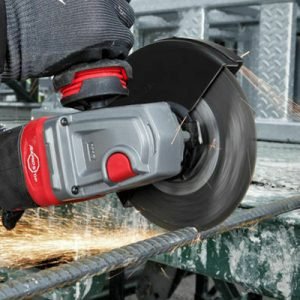


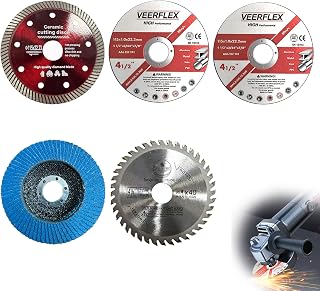


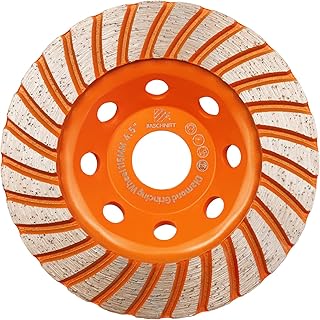

Choosing an abrasive cutting disc is not simply a matter of selecting the cheapest pack that fits an angle grinder. The disc has to match the machine, workpiece, application and operating conditions. Diameter and bore size determine physical compatibility, while disc thickness, abrasive type, reinforcement and material designation influence cutting behaviour, durability and finish.
For most buyers, the first question should be what material is being cut. Mild steel, stainless steel, cast iron and non-ferrous metals do not necessarily call for the same disc specification. A disc intended specifically for stainless steel may also be formulated to minimise contamination of the workpiece, while a general metal disc may be a more economical choice for routine mild-steel fabrication.
Before comparing brands or prices, check the specifications of the grinder or cut-off machine. The disc diameter must be suitable for the machine and the bore must match the spindle or approved mounting arrangement. The disc's maximum permitted operating speed must also be compatible with the machine's rated speed.
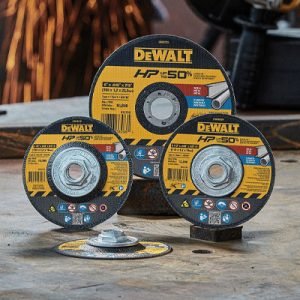
Manufacturers such as Bosch Professional and DEWALT offer cutting discs in several diameters, thicknesses and application-specific formulations, illustrating why the physical dimensions printed on the disc matter as much as the brand name.
The diameter is one of the easiest specifications to understand, but it has important consequences. A larger disc can provide greater cutting depth when used with a compatible machine, whereas a smaller disc is generally intended for smaller grinders and lighter-duty applications.
Common sizes encountered in UK workshops include 115 mm, 125 mm and 230 mm for angle grinders, although other diameters are available for specialist equipment. The correct size is determined by the machine manufacturer's specification rather than personal preference.
Disc thickness affects the way a cutting wheel behaves in the material. Thin discs are generally attractive when the objective is a quick, narrow cut with limited material loss. Thicker discs can provide a different balance of robustness, control and service life, depending on the product and application.
Ultra-thin does not automatically mean better. If the work involves repeated cuts in heavier material, the most appropriate choice may be a disc designed specifically for that workload rather than the thinnest available option.
The bore is the central opening of the disc. It must correspond to the machine's approved spindle and flange arrangement. A disc should never be forced onto a spindle, used with an unsuitable mounting arrangement or modified simply to make it fit.
The abrasive grain is one of the key components responsible for cutting performance. Different grain technologies can influence cutting speed, durability, heat generation and how the disc behaves as it wears.
Aluminium oxide is widely used in bonded abrasive cutting wheels for metalworking. Products from established manufacturers such as Bosch Professional and Norton use aluminium oxide formulations in various metal-cutting applications.
For general mild-steel work, an aluminium-oxide cutting disc can be a sensible starting point, provided the product specification explicitly identifies the intended material.
Premium cutting discs may use ceramic or other engineered abrasive grain technologies. These products can be designed to maintain cutting performance under demanding conditions and may be particularly relevant to frequent users who place greater value on productivity and disc life than on the lowest purchase price.
Bosch Professional, for example, lists ceramic-encapsulated abrasive grains on certain Best for Metal cutting discs. DEWALT also offers metal-cutting discs using diamond technology rather than a conventional bonded abrasive construction.
Diamond metal-cutting discs represent a different approach from conventional resin-bonded abrasive wheels. DEWALT's EXTREME METAL range, for example, uses a metal-cutting diamond edge on a steel disc. The manufacturer describes the technology as having a substantially longer stated cutting life than thin bonded cut-off wheels and retaining its diameter during use.
Such products should not be judged solely by their higher purchase price. The relevant comparison is cost and convenience over the amount of work performed. For occasional DIY use, a conventional bonded disc may remain the more straightforward choice. For frequent cutting, a longer-life technology can become more interesting if its application and machine compatibility are appropriate.
Mild steel is one of the most common materials encountered in general fabrication. Look for a disc explicitly rated for steel or general metal cutting and check the manufacturer's application guidance.
For occasional work such as cutting bolts, threaded rod, brackets, tube, box section or sheet material, an appropriately sized general-purpose metal cutting disc may be sufficient. Frequent fabrication work can justify comparing professional-grade discs on cutting rate, life, heat generation and consistency.
Stainless steel deserves more careful consideration. Stainless-specific or INOX discs are designed for stainless-steel applications, and some manufacturers formulate them to reduce the risk of contaminating the workpiece with unwanted constituents.
Norton specifically describes its Xpert Rapid INOX range as being formulated for stainless-steel fabrication and designed to avoid contamination associated with unsuitable conventional wheels. This is particularly relevant where corrosion resistance and the appearance of the finished stainless component matter.
Cast iron can behave differently from mild steel because of its composition and structure. A disc suitable for cast iron should be selected according to the manufacturer's material guidance rather than assuming that every metal-cutting disc is equally suitable.
Aluminium, brass and other non-ferrous metals may require specific wheel recommendations. Some products are explicitly marketed for non-ferrous materials, while others are designed primarily for ferrous metals. Always check the stated material compatibility before cutting.
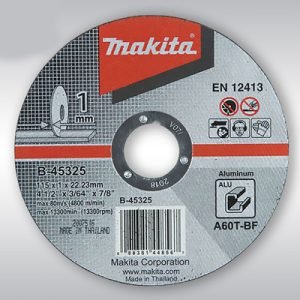
The printed information on a cutting wheel is more useful than many buyers realise. Treat it as a specification panel rather than decoration.
FEPA safety guidance recommends using bonded cutting wheels conforming to EN 12413 and checking that the expiry date has not been exceeded. HSE guidance also emphasises correct wheel selection, mounting, guarding and safe operation.
EN 12413 is an important standard to understand when comparing conventional bonded abrasive cutting wheels. It relates to safety requirements for bonded abrasive products, and reputable manufacturers commonly provide relevant conformity information on their products or packaging.
However, a standards marking should not be treated as a substitute for correct use. A correctly manufactured disc can still be dangerous if it is damaged, incorrectly mounted, operated above its permitted speed or used for an application for which it was not designed.
FEPA's abrasive-safety guidance specifically recommends checking for EN 12413 marking, inspecting wheels for damage, observing expiry information and following the machine manufacturer's instructions.
Conventional resin-bonded cutting discs commonly incorporate reinforcing material such as fibreglass. Reinforcement contributes to the structural integrity of the wheel and is one reason these products can be used for cutting applications when used with the appropriate equipment and guard.
Bosch Professional, for example, describes reinforced fibreglass construction on several of its metal cutting discs. The exact construction varies by product, so buyers should compare the manufacturer's specification rather than assuming that every disc has the same number or arrangement of reinforcing layers.
Flat cutting wheels are commonly associated with straight cutting applications where the wheel is used edge-on. They are widely available for angle grinders and other compatible cutting equipment.
Depressed-centre designs are shaped around the mounting area and are associated with particular machine and guard arrangements. Buyers should not confuse a depressed-centre grinding wheel with a cut-off wheel merely because both have a similar overall appearance.
Some specialist products are designed to perform both cutting and limited grinding operations. PFERD's DUODISC, for example, is specifically developed as a combination wheel for cutting and face grinding and is described by the manufacturer as meeting EN 12413 requirements for those applications.
Combination products can be useful where changing accessories repeatedly would be inconvenient, but they should still be used exactly as specified by the manufacturer. A conventional cutting-off wheel should never be treated as a general-purpose grinding disc.
Abrasive cutting discs operate at high rotational speed and can fragment if misused. Safe selection and operation therefore matter considerably more than small differences in purchase price.
Allow the machine and disc to come to a complete stop before placing the tool down or changing accessories. Remove and dispose of damaged or unsuitable wheels rather than attempting to reuse them.
Cutting metal creates more than sparks. The process can generate airborne particles, noise and vibration, while cutting certain construction materials can create significantly more serious dust hazards.
HSE guidance highlights the need to control dust generated by abrasive wheels. Where cutting or grinding concrete and other construction materials, respirable crystalline silica can be a major concern. This is different from ordinary metal-cutting work and requires appropriate dust-control measures for the material and process involved.
For workplace use, vibration exposure should also be considered. HSE guidance recommends reducing exposure through suitable equipment selection, maintenance, correct operation and control of trigger time rather than treating a maximum exposure value as a target.
The lowest price per disc is not necessarily the lowest cost per cut. A meaningful comparison should consider the amount of material removed, the number of usable cuts, cutting speed, operator effort, finish and the frequency with which the disc needs replacing.
Brand reputation can be a useful starting point, but it should never replace checking the specification of the exact disc. Major manufacturers offer several product tiers, meaning one brand may sell basic, professional and specialist wheels with substantially different characteristics.
The important point is to compare like with like. A premium ceramic-grain disc from one manufacturer should not be judged against an entry-level aluminium-oxide wheel from another purely on price.
A disc can have the correct diameter and still be unsuitable because its bore, speed rating, material application or machine requirements are wrong.
Cutting and grinding wheels are designed for different operating conditions. Do not substitute one for the other unless the manufacturer explicitly states that the particular product is suitable for both applications.
Stainless steel can justify a dedicated INOX disc, especially where contamination or finish quality matters. A general-purpose metal disc should not automatically be assumed to be the best choice.
Bonded abrasive wheels require appropriate storage and inspection. FEPA guidance recommends storing wheels on a flat, rigid surface away from damp, frost and large temperature variations and using stock on a first-in, first-out basis.
A very thin wheel may provide a narrow cut and fast progress, but the ideal thickness depends on the material, machine, access and application. Compare the manufacturer's intended use rather than selecting the smallest thickness available.
The maximum permitted wheel speed is a critical compatibility check. The machine must not be operated with a wheel whose permitted speed is unsuitable for that machine.
Correct storage helps preserve the condition of bonded abrasive wheels before they are used. Abrasive products should be protected from conditions that can damage their structure or packaging.
Even a high-quality cutting disc can perform poorly if the technique is unsuitable. Excessive pressure, poor workpiece support and attempting to make a cut that is too deep or awkward can increase wear and reduce control.
For cleaner results, support the workpiece securely and plan where the cut will finish. Let the wheel maintain its cutting action instead of forcing it through the material. If the disc begins to behave unusually, inspect the setup and the wheel rather than simply applying more pressure.
For repeated fabrication work, consistency is often more valuable than headline cutting speed. A disc that behaves predictably across many similar cuts can make it easier to maintain a repeatable workflow.
Ultra-thin discs are particularly attractive when the objective is fast, precise cutting with a narrow kerf and limited material removal. They can be useful for sheet metal, tube, bolts and other applications where access and cut width matter.
However, ultra-thin does not mean universally superior. The appropriate disc remains dependent on the manufacturer's application guidance, machine compatibility and the material being cut. For heavy fabrication, a different wheel specification may be more appropriate.
A diamond metal-cutting disc can make sense for users who perform a high volume of cutting and are prepared to consider a different cost model. The key attraction is potentially much longer service life compared with conventional bonded wheels, depending on the product and application.
DEWALT's EXTREME METAL diamond discs illustrate this category. The manufacturer states that its technology is designed for metal cutting across materials including steel, stainless steel, cast iron, rebar, sheet metal, aluminium and other non-ferrous metals.
For an occasional user, however, a conventional bonded disc may remain the simpler purchasing decision. Consider how frequently the tool is used and whether the additional upfront cost is justified by the expected workload.
Abrasive cutting discs do not require maintenance in the same sense as a power tool, but they do require sensible inspection, storage and replacement practices. The most important maintenance decision is knowing when not to use a disc.
Replace a wheel if it is visibly damaged, has deteriorated, is unsuitable for the intended application or has passed the manufacturer's specified expiry date. Do not attempt to repair a damaged abrasive disc.
The grinder itself should also be maintained according to its manufacturer's instructions. A worn spindle, damaged guard, faulty switch or other equipment problem can affect the safety of the entire cutting system regardless of how good the disc is.
When comparing two apparently similar cutting discs, work through the specification line by line rather than relying on product photographs or marketing names.
There is no single best disc for every metal-cutting job. The best choice is the one that matches the machine, material, diameter, bore, speed rating and application. For general mild steel, a suitable metal-cutting disc from a reputable manufacturer can be sufficient. Stainless steel may justify a dedicated INOX product, while frequent high-volume cutting can make premium or diamond technology worth comparing.
Not universally. Thin discs can provide a narrow kerf and fast cutting, while thicker products may offer a different balance of durability and robustness. The correct choice depends on the machine, material and manufacturer's intended application.
Do not use a conventional cutting-off wheel for grinding unless the manufacturer explicitly states that the particular product is designed for both operations. Cutting and grinding place different demands on abrasive wheels.
Some are specifically designed for stainless steel, while others are intended for general metal applications. Check the manufacturer's material specification. INOX-labelled or stainless-specific products can be preferable where contamination control is important.
EN 12413 is a European standard relating to safety requirements for bonded abrasive products. For buyers, it is one useful part of the product specification, but it does not replace correct machine compatibility, inspection, mounting, guarding and safe operating practice.
Compare the disc diameter and bore with the machine's permitted accessory dimensions, then check the disc's maximum operating speed against the machine. Also confirm that the machine and guard configuration are approved for cutting-off work.
There is no universal number of cuts because service life depends on disc construction, material, thickness, cutting technique, pressure, machine and workload. Rather than relying on a generic lifespan claim, compare manufacturer specifications and customer feedback for the exact product.
Bonded abrasive wheels can carry expiry information. FEPA guidance recommends checking that the expiry date has not been exceeded before selecting a wheel. Storage conditions also matter, so old stock should not be judged solely by appearance.
They can be, particularly for frequent users. Premium discs may use more advanced grain and reinforcement technologies and can be designed around faster cutting, longer life or specialised materials. For occasional DIY work, however, the extra expenditure may not provide enough practical benefit to justify the difference.
Bosch Professional, Norton, DEWALT, PFERD and Klingspor are among the established abrasive and power-tool accessory brands worth including in a comparison. Always assess the exact product specification rather than assuming every disc from a recognised brand has the same performance characteristics.
Multipacks can make sense for users who regularly perform the same type of work, but only when the discs are suitable for the application and can be stored correctly. Occasional users should avoid buying more discs than they can reasonably use within the manufacturer's storage and expiry guidance.
Do not use it. Damaged abrasive wheels should be removed from service and disposed of appropriately so they cannot accidentally be reused.
The strongest buying decision starts with compatibility and application rather than brand popularity. Establish the material, machine, diameter, bore and speed requirements first. Then compare disc thickness, abrasive technology, reinforcement, material-specific formulation and expected service life.
For occasional household work, a reputable general-purpose disc that correctly matches the grinder may be all that is required. Regular metalworkers can benefit from comparing professional-grade wheels on productivity and cost per cut. Stainless-steel users should pay particular attention to material-specific and INOX products, while high-volume users may find it worthwhile to investigate advanced ceramic or diamond cutting technologies.
Above all, treat the cutting disc as a precision safety-critical consumable rather than an interchangeable accessory. Check the markings, inspect the wheel, use the correct guard and mounting arrangement, follow the manufacturer's instructions and never use a disc outside its intended application.