

♥ Wishlist
Compare 35 verified Metabo Diamond Blades products in United Kingdom. Reviews, ratings, pros, cons and buying advice updated for October 2026.


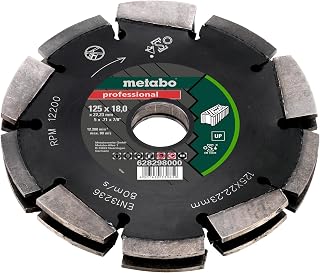


Choosing a Metabo diamond blade is less about finding the most expensive disc and more about matching the blade's construction to the material, cutting method and machine being used. A blade designed for tiles can behave very differently from one intended for reinforced concrete, while a universal blade may be the sensible choice when several materials need to be cut on the same project.
Metabo's diamond cutting-disc range includes different quality classes and material-specific designs. Its professional range includes options such as UP for universal applications, CP for concrete and TP for tiles, while other specialist discs are intended for particular hard or demanding materials. This distinction matters because diamond concentration, segment design, rim geometry and blade thickness all influence cutting speed, finish and service life.
Before buying, identify five things: the material, the required cut quality, the machine, the blade diameter and whether the work will be carried out dry or with water. These decisions normally narrow the suitable options far more effectively than choosing by price or customer rating alone.
The material being cut should be the starting point. Concrete, reinforced concrete, sandstone, granite, ceramic tiles, porcelain and natural stone do not place the same demands on a diamond blade.
Metabo describes its TP professional tile disc as a closed-edge blade for high-quality surfaces, including fine earthenware, tiles and natural stone slabs. Its CP professional concrete disc uses a segmented edge and is specified for hard materials including concrete, reinforced concrete, concrete pipes, kerbstones and hard sandstone.
Never select a diamond blade solely because its bore and diameter look close enough to the dimensions required by the machine. The disc diameter must be compatible with the manufacturer's specifications, guard arrangement and permitted rotational speed.
125 mm is a particularly common size in Metabo's accessory range and is used with suitable angle grinders and dedicated cutting systems. Metabo also lists 115 mm and 230 mm variants for particular applications. The 125 mm professional TP tile blade, for example, is one of the listed size variants of that product family.
A larger blade can potentially provide greater cutting depth, but that does not mean it is automatically better. The machine must be designed to accept it, and the maximum permitted disc speed must not be exceeded.
The bore is the central hole through which the spindle passes. A common Metabo diamond-disc specification is 22.23 mm, including several 125 mm professional discs. The CP 125 mm professional concrete disc, for example, is specified as 125 x 22.23 mm.
Do not confuse disc diameter with bore diameter. A 125 x 22.23 mm disc is 125 mm across with a 22.23 mm centre bore. Both measurements need to be compatible with the machine and its flange system.
Maximum speed is a safety-critical specification rather than a performance target to exceed. A disc must be operated within its marked or manufacturer-specified limits and in accordance with the power tool's instructions.
Metabo lists maximum speeds for individual diamond discs rather than treating all blades as interchangeable. For example, its 125 mm CP professional concrete disc is listed at up to 12,200 rpm, while the 115 mm TP professional tile disc has a different maximum-speed specification.
When comparing blades, therefore, check the exact product specification rather than assuming that every Metabo 125 mm diamond blade has identical speed limits.
One of the most useful ways to understand the Metabo range is to look beyond the word "diamond" and examine the quality class and intended application.
Metabo's UP designation refers to its Universal professional category. These blades are intended for situations where versatility is important and the user may need to cut more than one compatible mineral material.
A universal blade is particularly useful for general building and renovation work where the exact material changes from one task to another. It should not, however, be interpreted as meaning that one blade is the optimal choice for every material.
CP denotes the concrete professional category. The design is aimed at hard mineral materials and demanding concrete-cutting applications. Metabo's CP 125 mm model has a segmented edge, nine segments and 12 mm segment height, with laser-welded diamond segments.
For a contractor regularly cutting concrete, this type of specialist blade can be a more logical choice than a general-purpose disc because the cutting geometry is designed around the demands of hard construction materials.
TP denotes the tiles professional category. These blades are aimed at applications where controlling edge quality is important. Metabo describes its TP design as having a closed edge, an extra-thin steel blade with reinforced steel core construction and a geometry intended to produce fast, clean cuts.
This makes the category particularly relevant when cutting tiles or natural-stone slabs where excessive chipping can create additional finishing work or spoil a visible edge.
The choice between a universal and specialist disc comes down to the job pattern. If a blade will be used across several compatible materials, versatility can be valuable. If the same difficult material will be cut repeatedly, a specialist blade may offer a more appropriate balance of cutting speed, control and service life.
Do not judge the two solely by purchase price. A cheaper general-purpose blade can become less economical if it cuts slowly, produces poor edges or wears rapidly during the particular application.
Segmented blades have individual diamond-bearing sections separated by gullets. This construction is commonly associated with aggressive cutting of hard mineral materials because the spaces between segments can help with debris clearance and heat management.
Metabo's CP professional concrete blade is an example of a segmented design, with special turbo segments intended for aggressive cutting of hard materials.
Segmented discs are often worth considering where productivity and rapid cutting are more important than producing the finest possible decorative edge.
Turbo geometry uses a continuous or closely spaced patterned cutting edge designed to combine cutting speed with improved material clearance. It is commonly encountered on blades intended for masonry, stone and other mineral materials.
The exact behaviour depends on the blade construction, diamond specification and material being cut, so "turbo" should not be treated as a universal performance rating.
A continuous rim provides an uninterrupted cutting edge and is particularly associated with applications where clean edges matter. Metabo's TP professional tile blade uses a closed edge and is specifically described for clean cutting of high-quality surfaces.
For visible tile edges, the ability to control chipping can be more important than simply maximising cutting speed.
Blade thickness is an important specification that is sometimes overlooked when comparing diamond discs. A thinner blade can reduce the amount of material removed by the cut and may feel faster or more precise in suitable applications, while a more substantial construction can provide durability and stability under demanding conditions.
Metabo's TP professional tile range illustrates this principle: the listed variants include different thicknesses, with the 115 mm version specified with a 1.4 mm segment dimension and other sizes using different dimensions.
For delicate tiles, excessive side loading or forcing the disc through the material can undermine the advantage of a precision-oriented blade. For heavy masonry work, blade robustness and appropriate machine power become increasingly important.
Segment height is another specification worth checking when comparing similar products. It describes the height of the diamond-bearing cutting section rather than the overall blade thickness.
Metabo's TP professional tile blade is listed with a 10 mm segment height, while the CP professional concrete blade has a 12 mm segment height.
Segment height should not be used as a standalone indicator of quality. Diamond formulation, concentration, bond characteristics, segment geometry, cutting conditions and the material itself all affect real-world service life.
Before buying a diamond blade, establish whether your machine and application require dry cutting or allow wet cutting. Water can help control heat and dust in suitable applications, but not every tool, disc or work environment is intended for wet use.
Dry cutting is common with angle grinders and dedicated dry-cutting systems, particularly where portability matters. Metabo's T 13-125 CED diamond cutting system is described as a compact system for low-dust dry cuts in mineral materials and is supplied with a UP diamond cutting disc.
Where dry cutting is used, dust extraction and appropriate personal protective equipment are important considerations. A suitable extraction system can also improve visibility around the cutting line and reduce the amount of airborne dust.
A high-quality diamond blade cannot compensate for an unsuitable machine. Before purchasing, check:
Metabo's own machines demonstrate how application-specific the combination can be. Its MFE 40 wall chaser is designed around 125 mm cutting discs and lists specific diamond-disc accessories for concrete and universal applications.
The important lesson is that a blade should be selected as part of a machine-and-accessory system, not as an isolated purchase.
Diamond blades do not cut in the same way as conventional toothed saw blades. The exposed diamond particles perform the cutting action while the surrounding bond controls how the abrasive material is retained and released.
A good blade therefore needs a suitable relationship between diamond characteristics, bond behaviour, segment geometry and the material being cut. The hardest blade is not necessarily the fastest, and a disc that performs exceptionally well on concrete may be a poor choice for delicate ceramic tile.
The useful life of a diamond blade depends partly on how effectively fresh diamond is exposed as the cutting surface wears. If the bond holds the diamond too aggressively, cutting performance can deteriorate as the exposed abrasive becomes less effective. If the bond releases diamond too quickly, the disc may wear unnecessarily fast.
This is one reason application-specific blades exist. Different materials demand different relationships between cutting speed, abrasive action and segment wear.
When comparing two or more blades, use a specification-led approach rather than relying on the product name alone.
Purchase price is only one part of operating cost. A blade that costs less initially can be poor value if it produces slow cuts, poor edge quality or excessive wear for the intended application.
Universal does not mean optimal for every material. If the majority of your work involves a single demanding material, compare the appropriate specialist blade as well.
Never assume that a disc is suitable simply because the diameter fits. Maximum permitted rotational speed is a fundamental specification and must be checked against the machine.
A blade designed for aggressive concrete cutting may not be the right choice where a clean, low-chip tile edge is required. A specialist tile blade can be more appropriate for visible surfaces.
Excessive pressure can increase heat, vibration and wear and can compromise cut quality. Let the correct blade and machine combination do the work while maintaining controlled movement.
Mineral cutting can generate significant dust. Selecting the blade should therefore be part of a wider plan covering extraction, ventilation, personal protection and the working environment.
Even a professional diamond disc can be damaged or prematurely worn by unsuitable operating technique. Correct use begins with fitting the disc securely and checking the manufacturer's instructions for the particular machine and accessory.
Diamond blade wear is not always as obvious as wear on a conventional saw blade. Cutting may become progressively slower, the machine may require more pressure, or the blade may no longer produce the expected finish.
Changes in cutting performance can also indicate that the selected blade is poorly matched to the material or that operating conditions are unsuitable. A disc that becomes unusually hot, vibrates excessively or behaves differently from normal should not simply be forced to continue cutting.
A universal professional disc is worth considering for maintenance teams, general builders and renovation projects where the material varies and convenience matters. It can reduce the need to swap between specialist discs when working across compatible mineral materials.
The trade-off is that a universal product should not automatically be expected to outperform a specialist blade on every individual material. For repetitive production cutting, specialist accessories may provide a better application-specific solution.
Choose a specialist blade when the application has a clearly defined material and the consequences of poor cutting performance are significant.
This approach is generally more useful than attempting to identify one "best" diamond blade for every buyer.
Metabo diamond blades are best assessed according to the application rather than brand name alone. The range includes professional discs with different constructions and intended materials, allowing buyers to choose between versatility and specialist performance.
For a serious comparison, look at the exact Metabo order number, diameter, bore, segment dimensions, edge construction, maximum speed and recommended material. The manufacturer's specifications are more useful than assuming that every disc carrying the Metabo name is designed for the same work.
Occasional users may reasonably prioritise ease of selection and versatility. A suitable universal professional blade can be attractive when only a small number of compatible cutting jobs are expected.
Professionals who cut the same material frequently should place greater emphasis on productivity, service life, consistency and the cost of each completed cut. In that situation, the correct specialist blade can be more important than choosing the lowest initial purchase price.
Many Metabo diamond cutting discs are suitable for angle-grinder applications when the exact disc specification matches the machine. Metabo lists diamond cutting discs among the accessories for its 125 mm angle grinders, illustrating the importance of matching the accessory to the tool's disc diameter and configuration.
However, an angle grinder should not be treated as a universal cutting system. The guard, disc rating, operating speed and intended material all need to be considered before work begins.
Wall chasing presents different requirements from ordinary single-disc cutting because the machine may use two discs to create parallel grooves. Metabo's MFE 40 wall chaser is designed around 125 mm diamond discs and can accommodate specified groove widths using spacer rings.
For this type of work, accessory compatibility is particularly important. A blade should be selected for the wall chaser's specified diameter, application and configuration rather than simply choosing a standard 125 mm disc.
Diamond cutting discs operate at high rotational speeds and should be treated as professional cutting accessories rather than ordinary consumables. Always follow the instructions supplied with the particular machine and blade.
Instead of asking which Metabo diamond blade is universally the best, start with the job. If you are cutting porcelain tiles and need a neat finished edge, investigate the tile-focused professional range. If you are cutting hard concrete or reinforced concrete, investigate the concrete professional range. If you are moving between compatible mineral materials, compare the universal professional options.
Then verify the machine compatibility and technical specifications before comparing prices. This process produces a much more meaningful buying decision than choosing a blade solely from a ranked list.
For concrete, a blade specifically designed for concrete is generally the logical starting point. Metabo's CP professional category is intended for hard materials including concrete and reinforced concrete, and its 125 mm CP model uses a segmented cutting edge with laser-welded diamond segments.
For tile work, look at the TP professional range. Metabo describes its TP design as a closed-edge disc intended to produce clean cuts on high-quality surfaces, including tiles and natural stone slabs.
UP refers to Metabo's Universal professional category. It is intended for versatile professional cutting across suitable mineral materials rather than being restricted to one specialist application.
CP identifies the Concrete professional category. Metabo's CP 125 mm blade is designed for hard materials such as concrete and reinforced concrete and uses a segmented edge.
TP identifies the Tiles professional category. These discs are designed around tile and related fine-surface cutting applications, with the closed-edge construction intended to help produce clean results.
No. The diameter alone is not enough to establish compatibility. The bore, maximum disc speed, guard arrangement, machine specifications and intended application must all be checked.
It may be physically possible with some machines, but physical compatibility does not make it the best choice. If edge quality is important, a tile-specific closed-rim blade is generally more appropriate than selecting a disc designed primarily for aggressive concrete cutting.
A larger diameter can provide greater potential cutting depth, but the usable depth depends on the machine, guard and design. The disc must always be used within the tool manufacturer's permitted configuration.
It is critical. The machine must not drive the blade beyond its permitted rotational speed. Always compare the exact blade rating with the specifications of the tool being used.
Neither is universally better. Segmented designs are commonly suited to aggressive mineral cutting, while continuous-rim designs can be advantageous when a cleaner edge is required. The correct choice depends on the material and desired finish.
Choose universal when versatility is important and specialist when the same demanding material will be cut repeatedly. For a single application, the specialist option may provide a more appropriate cutting profile.
There is no universal replacement interval. Service life depends on the material, cutting depth, technique, machine, operating conditions and blade construction. Replace a disc when it is damaged or when its condition no longer permits safe and appropriate use.
The best Metabo diamond blade for 2026 is the one whose specifications genuinely match the work rather than the one with the most appealing headline. Start with the material, then select the appropriate blade category, diameter, bore and edge construction. After that, confirm the machine's speed and compatibility, consider the required finish and account for dust-control and operating conditions.
For general-purpose mineral cutting, compare Metabo's professional universal options. For hard concrete and reinforced concrete, examine the concrete professional range. For tile and fine-surface work, compare the professional tile discs. Where the material is especially demanding, consider whether a specialist blade is more appropriate than a universal alternative.
Finally, check the exact product specification and current retailer information before purchasing. Product ranges, packaging, specifications and availability can change, so the order number and manufacturer's current technical information should take priority over an old listing or generic product description.