

♥ Wishlist
Compare 28 verified DeWalt Diamond Blades products in United Kingdom. Reviews, ratings, pros, cons and buying advice updated for October 2026.






Choosing a diamond blade is less about finding the blade with the most impressive specification and more about matching the blade to the material, cutting method and machine. A blade designed for porcelain can behave very differently from one intended for concrete, brick, asphalt or highly abrasive masonry. The right choice can improve cutting speed, edge quality, blade life and overall control, while the wrong blade can lead to excessive wear, poor finishes, overheating or unnecessarily difficult cutting.
DEWALT's diamond accessory range includes different rim constructions, diameters and application-specific designs. Its current UK range includes segmented diamond wheels, continuous-rim diamond discs and blades intended for different masonry and hard-material applications.
The material being cut should normally be the first buying consideration. Concrete, reinforced concrete, brick, blockwork, paving, porcelain, ceramic tile, slate, granite and asphalt place different demands on a diamond blade.
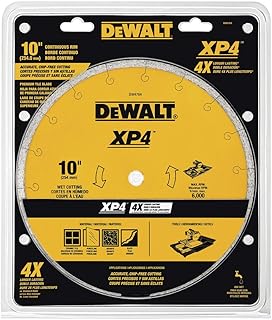
DEWALT's UK catalogue illustrates this application-specific approach. For example, its continuous-rim DT3738-XJ is described for porcelain, floor and wall tiles, slate, concrete tiles, bricks and terracotta, while other DEWALT diamond wheels are specifically identified for applications such as asphalt or general-purpose masonry.
The shape and construction of the cutting edge have a major influence on how a blade behaves. Three descriptions commonly encountered when comparing diamond blades are continuous rim, turbo rim and segmented rim.
A continuous rim forms an uninterrupted cutting edge around the circumference of the blade. This construction is particularly associated with tile and other applications where a clean edge matters more than simply removing material as quickly as possible.
Continuous-rim blades are worth considering for porcelain and ceramic tiles, especially where visible edges, corners and finished surfaces need careful treatment. DEWALT describes some of its continuous-rim sintered diamond discs as being designed to produce fine finishes and minimise chipping in tiles and ceramics.
However, a continuous rim should not automatically be interpreted as the best option for every hard material. The diamond formulation, blade thickness, machine, cutting technique and intended application all matter.
Turbo blades use a textured or serrated cutting edge rather than a completely smooth continuous rim. The design is intended to balance cutting speed with a reasonably controlled finish.
They can be useful when working with masonry and other hard construction materials where a balance between material removal and finish is required. Some DEWALT turbo blades are specifically designed for dry cutting masonry and use a thin kerf intended to increase cutting speed.
A turbo blade is therefore not simply a premium version of a continuous-rim blade. It is a different design with a different priority.
Segmented blades have separate diamond-bearing sections around the cutting circumference. They are commonly selected for demanding construction materials where fast cutting and efficient debris clearance are important.
DEWALT's UK range includes segmented diamond wheels for applications such as general-purpose masonry and asphalt, demonstrating why the segment pattern and blade specification should be assessed alongside the intended material.
For a decorative tile edge, a segmented blade may be unnecessarily aggressive. For rough masonry work, however, the priority can be substantially different.
Blade diameter is not an interchangeable specification. It must be compatible with the machine for which the blade is intended. A larger blade can provide a greater potential cutting depth, but only when the saw or cutter is designed to accommodate it.
Before buying, compare all of the following:
Do not select a blade solely because its bore appears to fit. The complete blade specification must be compatible with the tool.
For example, DEWALT lists a 125 mm DT3736-XJ with a 22.2 mm bore and a 230 mm DT3738-XJ with the same 22.2 mm bore, while their stated blade widths differ. This demonstrates why diameter, bore and thickness should all be checked rather than relying on one measurement.
The bore is the central opening through which the blade mounts to the machine. It must correspond to the tool's spindle arrangement and any approved adaptor system.
Never assume that an adaptor makes every blade suitable for every machine. Follow the machine and blade manufacturer's instructions and use only an arrangement intended for that equipment.
Kerf refers to the width of the cut made by the blade. A thinner kerf can remove less material and may help produce a faster-feeling cut in appropriate applications, but thin does not automatically mean better.
Blade thickness affects several practical considerations:
DEWALT's DT3736-XJ, for example, is specified at 1.6 mm product width, while the larger DT3738-XJ is specified at 2.1 mm. These figures should be treated as product specifications rather than universal recommendations about which thickness is superior.
The diamonds in a cutting blade do the cutting, but the way those diamonds are held and exposed is equally important. Diamond blades are engineered around a matrix that controls how the cutting particles are presented as the blade wears.
A useful way to think about blade performance is not simply “more diamonds equals better”. The interaction between diamond concentration, diamond quality, bond or matrix characteristics, segment design and material hardness determines how the blade behaves.
A blade that works extremely well in one material can be poorly matched to another because the rate at which the cutting edge exposes fresh diamond is not equally effective in every application.
Diamond blades gradually wear during use. The ideal wear pattern depends on the balance between the material being cut and the blade's matrix.
When comparing products, look beyond claims such as “long life” and ask whether the blade is actually designed for the material you intend to cut. A blade engineered for abrasive material may have very different priorities from one intended to produce a clean finish on porcelain.
The wet-versus-dry decision is one of the most important practical considerations when buying a diamond blade.
Water can be used to suppress dust and, depending on the equipment and application, help manage heat at the cutting area. Wet cutting is particularly relevant to masonry and other silica-containing construction materials.
The Health and Safety Executive warns that cutting materials such as concrete, sandstone, granite and brick can generate respirable crystalline silica. Its guidance identifies water suppression as an important control for suitable cutting tasks.
Wet cutting is not simply a matter of adding water to any blade. The blade, machine and work method must all be suitable for wet use. Electrical safety, water delivery, workpiece stability and the manufacturer's instructions must also be considered.
Dry cutting can be convenient where water is impractical, but convenience should never be confused with lower risk. Dry cutting masonry can generate significant quantities of fine dust.
The HSE specifically identifies cutting paving blocks, kerbs and flags as a task that can generate very high levels of silica-containing dust. Its guidance recommends effective dust controls and highlights water suppression and suitable respiratory protection as part of the control strategy where appropriate.
If dry cutting is permitted for the particular blade and application, follow the manufacturer's instructions precisely and use an appropriate dust-control method. Do not choose dry cutting merely because it appears quicker or easier.
Dust management deserves a prominent place in any UK diamond blade buying guide because cutting concrete, brick, paving and similar materials can create respirable crystalline silica.
The HSE explains that silica is found in materials including concrete, bricks, sand and natural stone, and that fine particles generated during cutting can be inhaled deeply into the lungs.
For professional work, dust control should be considered before cutting begins rather than as an afterthought.
The HSE's construction guidance also emphasises that dust controls need to be maintained and reviewed rather than installed once and forgotten.
Porcelain is one of the applications where blade selection can make a noticeable difference to the finished result. It is hard, dense and capable of chipping if the blade and cutting method are poorly matched.
For porcelain, examine the blade's application description and rim construction rather than simply choosing the most expensive option. A suitable continuous-rim diamond blade is often the logical starting point where the priority is controlled cutting and a clean edge.
DEWALT's DT3736-XJ and DT3738-XJ are examples of continuous-rim diamond cutting discs described for porcelain and ceramic applications. Their listed specifications also show why the exact diameter and thickness should be checked against the machine.
Concrete varies considerably. A general concrete block, cured structural concrete and reinforced concrete should not automatically be treated as the same cutting application.
When selecting a concrete blade, consider whether the concrete contains reinforcement, how deep the cut needs to be, whether the job is wet or dry, the machine being used and the amount of cutting involved.
For substantial professional work, application-specific guidance is particularly important. A blade designed for general masonry should not be assumed to have the same performance characteristics as a blade specifically intended for concrete.
Brick and block cutting can place substantial abrasive demands on a blade, particularly during repeated construction work. A suitable turbo or segmented diamond blade may be preferable when cutting speed and material removal are more important than producing a decorative edge.
DEWALT's HP 4-inch turbo blade, for example, is described as a dry-cutting blade for block, masonry siding and other masonry materials, with a thin kerf intended to increase cutting speed.
That does not mean every turbo blade is appropriate for every masonry product. Always check the exact application list before purchasing.
Paving products can contain concrete, natural stone, clay-based materials or other compositions, so identifying the material is more useful than relying on the generic term “paving”.
For professional paving work, the number of cuts can also change the buying decision. A homeowner making a small number of cuts may prioritise ease of use and finish, while a contractor making repeated cuts may place much greater emphasis on cutting rate, blade life and compatibility with the chosen saw.
The HSE specifically highlights paving blocks, kerbs and flags as a cutting task that can create substantial silica-containing dust, making dust-control planning an important part of the job.
When comparing two or more DEWALT diamond blades, use the specification sheet as the starting point rather than relying on product photographs or generic descriptions.
DEWALT is a recognised power-tool and accessory brand, but brand recognition does not remove the need to select the correct product. The right DEWALT blade for porcelain is not necessarily the right DEWALT blade for asphalt or reinforced concrete.
A larger blade is not automatically a better blade. The machine must be designed for the diameter, speed and guard arrangement, and the blade must be used within its stated specifications.
A blade can have the correct diameter but still be unsuitable because the bore does not correspond to the machine. Check both measurements.
Wet and dry cutting requirements differ. Check the manufacturer's instructions before using water with a blade that has not been specified for wet cutting.
A blade designed around clean tile cutting has different priorities from one designed for rapid masonry cutting. Using a fine-finish blade for aggressive construction work can be an inefficient choice.
The maximum permitted speed is a critical safety specification. Never exceed the blade's stated maximum rotational speed or the limits of the machine.
Excessive pressure can make cutting less controlled and place unnecessary load on the tool and blade. Let the appropriate blade and machine combination do the work at the manufacturer's recommended operating conditions.
The cheapest blade can become poor value if it is unsuitable for the material or wears quickly under the intended workload. Conversely, an expensive specialist blade may be unnecessary for occasional DIY work. Compare application, construction, dimensions and expected workload before comparing price.
A useful comparison should consider more than star ratings or a product title. Build a simple specification-led comparison around the actual job.
Customer reviews can be useful during commercial research, but they should supplement rather than replace technical specifications.
A review saying that a blade “cuts brilliantly” provides limited information unless the reviewer also explains what material was cut, which machine was used, whether cutting was wet or dry and how much material was processed.
Look for reviews that identify:
Be cautious about applying one user's experience to a completely different application. A blade can perform very well for occasional tile work while being an inappropriate choice for prolonged concrete cutting.
For a small home project, simplicity and compatibility may be more important than maximising blade life. Start by identifying the material, then select a blade from the manufacturer's range that explicitly covers that application.
Professional users should place greater emphasis on repeatability, cutting rate, blade life, machine compatibility and dust-control arrangements. A small difference in blade performance can become much more significant when the same operation is repeated dozens or hundreds of times.
For demanding work, compare application-specific professional blades rather than treating general-purpose blades as universal solutions. Consider the material's abrasiveness, reinforcement, cutting depth, machine power, wet or dry operation and expected workload.
Blade longevity depends on the blade, material, machine and cutting method. Even a high-quality blade can wear prematurely if it is used outside its intended application.
Diamond blades should be stored so that the cutting edge and blade body are not subjected to unnecessary impact or distortion. Keep blades in suitable packaging or storage areas where they will not be knocked against hard objects.
Before fitting a blade, inspect it for visible damage, distortion, cracks or other abnormalities. Check that the mounting area is clean and that the blade is installed in the correct orientation according to the manufacturer's instructions.
After wet cutting, follow the manufacturer's recommendations for cleaning and storage. Avoid storing equipment in a manner that encourages corrosion or damage to associated components.
Replacement should be based on the blade's condition and manufacturer's guidance rather than attempting to obtain every possible final cut from it.
Stop using a blade if it is damaged, distorted or otherwise unsafe. Excessive wear, abnormal cutting behaviour or deterioration of the cutting segments are also reasons to investigate whether the blade remains suitable.
Do not attempt to repair or modify a diamond cutting blade unless the manufacturer specifically provides an approved procedure.
Diamond cutting can involve several hazards, including rotating machinery, flying particles, noise, vibration and construction dust. The appropriate controls depend on the machine, material and workplace.
Silica exposure is particularly important when cutting concrete, brick, stone and similar materials. HSE guidance states that uncontrolled cutting can create very high levels of respirable crystalline silica and recommends effective control measures appropriate to the task.
For professional work, follow the relevant workplace risk assessment, COSHH requirements, equipment instructions and site procedures. Where respiratory protective equipment is required, it should be selected, fitted and maintained appropriately rather than treated as a substitute for effective engineering controls.
There is no single specification that determines which blade is best. The strongest candidate is the one whose complete design matches the job.
For example, a blade intended for a clean porcelain finish may be preferable when appearance is critical, whereas a construction-focused segmented wheel may be a better choice when rapid masonry cutting is the priority. DEWALT's own product range demonstrates this distinction through different continuous-rim, turbo and segmented designs.
This is why “best DEWALT diamond blade” should usually be interpreted as “best DEWALT diamond blade for a particular material and machine”.
The best DEWALT diamond blade depends on the material, machine, cutting method and desired finish. There is no single blade that is optimal for every application. Start with the material and select a DEWALT blade whose application guidance specifically covers it.
A suitable continuous-rim diamond blade is a strong starting point for porcelain when a clean, controlled cut is important. DEWALT lists continuous-rim diamond discs for porcelain and ceramic applications, including the DT3736-XJ and DT3738-XJ.
A continuous blade has an uninterrupted cutting rim and is commonly associated with applications where a controlled finish is important. A segmented blade has separate cutting sections and is commonly used where rapid material removal and construction cutting are priorities. The exact performance still depends on the blade formulation and application.
Some DEWALT diamond blades are designed for concrete and related masonry applications, but suitability depends on the exact model. Check the individual product specification rather than assuming that every DEWALT diamond blade is suitable for concrete.
Yes, suitable diamond blades are commonly used for brick and masonry cutting. Select a blade whose manufacturer specifically identifies brick or the relevant masonry material as an application.
Some diamond blades are specifically designed for dry cutting, while others are intended for wet cutting or particular wet/dry applications. Always check the blade instructions before choosing the cutting method.
Neither method is universally better. Wet cutting can provide important dust and heat-management advantages in suitable applications, while dry cutting can be useful where water is impractical. The correct method depends on the blade, machine, material and workplace controls.
Diamond blades and abrasive discs are different cutting accessories and should not be treated as interchangeable. Safety depends on using the correct accessory with the correct machine, operating method and protective controls. A diamond blade does not eliminate hazards associated with cutting machinery or construction dust.
Possible causes include using the wrong blade for the material, excessive blade wear, an unsuitable machine, incorrect cutting technique, inadequate water supply where wet cutting is required, or a blade whose cutting edge is not behaving as intended. Check the manufacturer's guidance before changing the cutting method.
Chipping can be influenced by blade type, material hardness, cutting technique, machine stability and blade condition. For porcelain and ceramic tiles, compare continuous-rim products designed for tile cutting and ensure the blade is correctly installed and used according to the manufacturer's instructions.
A larger diameter can provide greater potential cutting depth, but the actual usable depth depends on the machine, blade, guard and manufacturer's specifications. Never fit a larger blade simply because it appears physically possible.
Check the machine's approved blade diameter, bore, maximum speed and intended application, then compare those requirements with the exact DEWALT blade specification. All of these details should agree before purchase.
There is no universal service-life figure that applies to every diamond blade. Life varies with material, blade design, cutting depth, machine, cutting technique, dust or water control and workload. A blade used occasionally on a relatively easy material will experience very different wear from one used continuously on abrasive construction materials.
The most reliable way to choose a DEWALT diamond blade is to work backwards from the job. Identify the material, determine whether the cut needs to be clean or fast, establish whether wet or dry cutting is appropriate, confirm the machine's dimensions and speed requirements, and then compare DEWALT products that meet those criteria.
Do not assume that the highest-priced blade, largest diameter or most aggressive-looking segment design is automatically the best option. Application-specific compatibility is more important than headline marketing claims.
For UK buyers, dust control should also form part of the purchasing decision when cutting concrete, brick, paving, stone and other silica-containing materials. The HSE identifies these activities as potential sources of respirable crystalline silica and recommends appropriate control measures, including water suppression or suitable extraction where applicable.
Before purchasing, compare the exact DEWALT model number, blade diameter, bore, thickness, rim type, stated applications, wet/dry requirements and maximum speed. Then compare current retailer pricing and verified customer feedback against the technical specification. This approach is far more useful than choosing a blade based solely on a generic “best” label.