

♥ Wishlist
Compare 61 verified Metabo Abrasive Cutting Discs products in United Kingdom. Reviews, ratings, pros, cons and buying advice updated for October 2026.








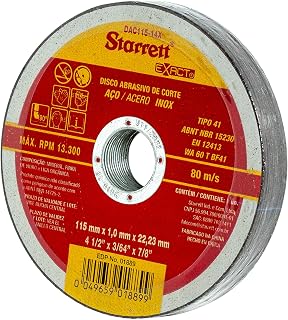


Choosing an abrasive cutting disc is not simply a matter of matching the disc diameter to an angle grinder. The material being cut, the thickness of the workpiece, the available grinder power, the required cutting speed and the type of finish all affect which disc is appropriate. A disc that works well on thin mild-steel sheet may be a poor choice for heavy structural sections, while a disc intended for stainless steel should not automatically be treated as a general-purpose option.
For buyers comparing Metabo cutting discs in the UK, the most useful approach is to start with the application and work backwards towards the specification. Diameter, thickness, bore size, abrasive type, hardness, disc construction and maximum permitted speed should all be checked before purchase.
The material should be the first consideration because abrasive discs are formulated for particular applications. Steel, stainless steel, aluminium and other non-ferrous metals can behave very differently during cutting.
Disc thickness has a direct effect on the cutting experience. Thin discs generally remove less material and can produce a narrow kerf, which can make them attractive for sheet metal, thin-walled tubing and other jobs where speed and minimal material loss matter. Thicker discs can offer a more substantial cutting edge and may be appropriate for heavier applications, but they are not automatically better.
For occasional DIY work, a thin disc can feel fast and responsive when cutting relatively light material. For repeated professional work, however, the best choice depends on the balance between cutting speed, disc life, machine load and the type of material being processed.
Do not choose a disc solely because it is thinner. The grinder, guard, material and manufacturer's intended application must all be compatible with the disc.
The disc diameter must match the grinder and its guard system. Common angle-grinder sizes include 115 mm, 125 mm, 150 mm, 180 mm and 230 mm, but the correct size is determined by the particular machine rather than by personal preference.
The centre bore is equally important. A disc may have the correct outside diameter but still be unsuitable if its bore does not match the machine's spindle and mounting arrangement.
Metabo's abrasive range includes different quality levels and product families, so the name printed on the disc can provide useful information about its intended position within the range. Buyers should still examine the individual product specification because two discs from the same broad family can have different dimensions, applications and performance characteristics.
Metabo's range includes families such as Flexiamant, Flexiamant Super, Flexiarapid, Flexiarapid Super and other specialist abrasive products. The important point is not simply choosing the highest-sounding product name, but understanding what the disc is designed to do.
A lower-cost disc can make sense when cutting occasionally or when disc consumption is low. A premium disc may become more attractive when cutting is frequent and productivity, cutting feel or service life matters more than the initial cost per disc.
For commercial users, it can be more useful to calculate the cost of completing a job rather than comparing pack prices alone. A disc that costs more but cuts efficiently and reduces interruptions may have a different overall value proposition from a cheaper disc that requires more frequent replacement.
For domestic users, the calculation can be different. If a disc is only being used for a small one-off project, paying substantially more for specialist performance may not provide meaningful value unless the application genuinely requires it.
Thin cutting discs are popular for precision metal cutting because they can create a relatively narrow kerf. This can be particularly useful when working with thin sheet, small-section steel, pipes and profiles.
Standard-thickness discs may be more appropriate for applications where robustness and general-purpose performance are more important than achieving the narrowest possible cut.
There is no universal rule that thinner always means better. A thin disc selected for an application beyond its intended range can be a poor choice regardless of how quickly it cuts light material.
Abrasive grain is responsible for the cutting action. Aluminium oxide is commonly associated with conventional metalworking discs, while more advanced abrasive technologies can be used to improve cutting performance, consistency or service life.
Some premium products use specialised abrasive grain technologies. Metabo also offers ceramic abrasive products within its wider abrasive range. These products are intended for particular demanding metalworking applications rather than being a universal upgrade for every cutting job.
When comparing discs, consider the complete specification rather than focusing on the abrasive grain alone. Grain type works together with the bond, disc construction, hardness and intended material.
Disc hardness can be confusing because a harder disc does not simply mean a better disc. Abrasive wheels are designed so that worn abrasive grains can release and expose fresh cutting edges. The correct balance depends on the workpiece and application.
A disc that is too hard for a particular job may not behave as expected, while a softer formulation may wear more quickly. This is one reason specialist discs exist for materials such as stainless steel and aluminium.
Stainless steel deserves particular attention when choosing a cutting disc. Look for products specifically identified for stainless-steel applications or products whose specification clearly states suitability for stainless steel.
Where contamination is a concern, check the manufacturer's specification for iron, sulphur and chlorine restrictions. Metabo offers specialist stainless-steel products with low levels of these elements, but the exact specification varies by product and should be checked before purchase.
This matters for fabrication work where the condition of the finished stainless component is important. Using an inappropriate general-purpose disc can introduce contaminants or produce a less satisfactory result than a disc designed for stainless-steel processing.
Abrasive-disc markings can initially look like a string of unrelated numbers and letters. In reality, they describe several useful characteristics.
Never select a cutting disc without checking its maximum permitted speed. The grinder's no-load speed must be compatible with the disc. A disc rated for a particular maximum rotational speed must not be operated above that limit.
For example, a smaller disc can have a higher permitted RPM than a larger disc because the outer edge travels a different distance during each revolution. The number printed on a disc therefore cannot be interpreted independently of its diameter.
Before fitting a disc, compare the marking on the disc with the specifications of the grinder. If there is any doubt, consult the grinder and disc manufacturer's instructions rather than relying on an assumption.
Disc shape can influence access and the way the grinder sits relative to the workpiece. Flat discs and offset discs are designed for different mounting and working arrangements.
Always use the disc configuration intended for the grinder and application. Do not modify the disc, use improvised spacers or alter the mounting arrangement in an attempt to make an incompatible product fit.
Abrasive cutting discs are engineered as composite products rather than simple blocks of abrasive material. Reinforcement helps the disc withstand the forces generated during normal operation.
This is particularly important because cutting discs are exposed to substantial rotational forces. A damaged, dropped, expired or incorrectly stored disc can present a serious hazard.
Inspect discs before use. Reject any disc showing cracks, chips, distortion, significant damage or other visible defects. Do not attempt to repair a damaged abrasive disc.
For box section and rectangular hollow section, a steel cutting disc of the correct diameter for the grinder is usually the starting point. A thinner disc can be useful for relatively light section, while a more robust specification may be preferable for heavier material or repeated work.
Consider the number of cuts you expect to make, the material thickness and whether speed or disc longevity is the bigger priority.
Pipe presents a slightly different challenge because the cutting operation moves through a curved surface and can require multiple passes depending on diameter. A disc suitable for the pipe material and grinder should be selected, with particular attention to disc diameter and maximum speed.
Thin sheet metal is one of the applications where a thin cutting disc can be particularly useful. A narrow kerf can reduce unnecessary material removal and make controlled cuts easier.
Support the sheet appropriately and avoid forcing the disc sideways through the cut. The cutting disc should be used for cutting rather than grinding or lateral material removal.
For stainless sheet, choose a product specifically intended for stainless steel and check its contamination-related specification where this matters. Thin stainless sheet can benefit from a disc designed for controlled cutting rather than a heavy general-purpose disc.
A suitable thin metal cutting disc can be convenient for cutting bolts, threaded rod and similar small sections. The correct diameter and RPM rating remain essential even for small jobs.
After cutting, inspect the newly created edge and use an appropriate deburring method if required. Do not use the cutting disc itself as a substitute for a grinding operation unless the product instructions specifically permit that use.
Metabo is not the only established abrasive brand available to UK buyers. Commercial and DIY users may also encounter products from 3M, Bosch Professional, Norton and Klingspor, among others.
The best comparison is specification against specification rather than brand name against brand name. A premium disc from one manufacturer may be more suitable for a particular application, while another brand may offer a better-value option for a different type of work.
When making a direct comparison, check diameter, thickness, bore, material suitability, maximum speed, disc construction and intended application before considering pack size or price.
The cheapest pack is not necessarily the cheapest option to use. Cost per disc is only one part of the equation.
A better comparison for regular users considers:
For occasional users, convenience and compatibility may outweigh small differences in theoretical running cost. For tradespeople and workshops, productivity can have a much greater effect on overall value.
A low unit price can be attractive, but an unsuitable disc can waste material, time and money. Always start with the application rather than the cheapest pack.
A disc needs to be compatible with the grinder's spindle and mounting system. Matching only the outside diameter is not sufficient.
A disc intended for steel should not automatically be used on stainless steel, aluminium or masonry. Check the manufacturer's stated application.
Two 125 mm discs can have very different thicknesses, bore sizes, applications and maximum speeds. Diameter alone does not describe the product.
Cutting discs are designed primarily for cutting. Do not use the edge or face of a cutting disc for grinding unless the manufacturer specifically states that the particular product is designed for that purpose.
Do not use abrasive discs that have been damaged, cracked or otherwise compromised. Storage conditions also matter. Keep discs protected from moisture, excessive heat and mechanical damage, following the manufacturer's storage recommendations.
Safety should be treated as part of product selection rather than an afterthought. A suitable disc is only one component of a safe cutting setup.
Even a high-quality cutting disc can behave poorly when the material is inadequately supported. Long lengths of sheet, pipe or section can move as the cut progresses, potentially closing the kerf around the disc or placing unwanted stress on the abrasive.
Support the workpiece so that the cut remains controlled throughout the operation. Think about where the material will move when it separates rather than simply where the initial cut will begin.
Disc life depends on more than the quality of the abrasive. Excessive pressure, incorrect cutting angles, unsuitable materials and poor workpiece support can all affect performance.
A cutting disc should normally be allowed to perform the abrasive work rather than being treated like a saw blade that must be forced through the material. Excessive pressure can increase heat and machine load and may make the cutting process less controlled.
For repeated work, consistent technique can be just as important as buying a premium disc. If several operators are using the same grinder, standardising the cutting method can also make disc consumption more predictable.
Correct storage is often overlooked when buying multipacks. Abrasive products should be stored according to the manufacturer's instructions and protected from conditions that could compromise their integrity.
The correct pack size depends on how often you cut and how predictable your workload is. A small pack can be sensible for occasional household projects, while larger packs can make more sense for workshops and trades where discs are regularly consumed.
Do not buy a large quantity simply because the per-disc price appears lower. Confirm that the product is appropriate for your usual materials and that you can store the discs correctly.
There is no single best Metabo abrasive cutting disc for every buyer. The strongest choice depends on the job.
Value should be judged by suitability, not simply by the lowest price. A good-value cutting disc is one that performs the intended task safely and efficiently while offering characteristics appropriate to the frequency and type of work.
For a homeowner making a handful of cuts, the most important attributes may be compatibility, predictable handling and reasonable cost. For a professional fabricator, cutting rate, consistency, disc consumption and downtime can become much more important.
This is why independent comparisons should consider different types of buyer rather than declaring one product universally superior.
The best choice depends on the steel section, thickness, grinder diameter and whether you prioritise cutting speed, disc life or purchase cost. A Metabo disc specifically classified for steel is the appropriate starting point, followed by a comparison of diameter, thickness, abrasive specification and maximum speed.
Yes, Metabo produces cutting discs specifically intended for stainless-steel applications. Check the individual product specification rather than assuming every Metabo metal disc is equally suitable for stainless steel.
Only use a disc where the manufacturer's specification states that it is suitable for aluminium or the relevant non-ferrous metal. Aluminium can behave differently from steel during abrasive cutting, so a dedicated non-ferrous-metal formulation may be preferable.
No. Thin discs can be advantageous for narrow cuts and thinner material, but the correct thickness depends on the application. A thinner disc should never be selected simply because it appears faster if the material or cutting conditions call for another specification.
Check the grinder's permitted disc diameter, spindle and bore requirements, maximum speed and guard configuration. Then compare those specifications with the markings and technical information for the disc.
Potentially, provided the disc is compatible with that grinder's diameter, bore, mounting arrangement, guard and maximum permitted speed, and the disc is approved for the intended operation. Compatibility should be established from the specifications rather than assumed because both products are designed for metalworking.
Compare equivalent products rather than brands in isolation. Look at the same diameter and thickness, intended material, abrasive type, maximum speed, disc construction, quality level and pack size. A disc designed for a different application is not a meaningful competitor simply because it has a similar price.
Multipacks can make sense for frequent users, while occasional users may prefer to buy a smaller quantity. The important consideration is whether the product is genuinely suitable for the work and can be stored appropriately.
Do not assume that a dropped abrasive disc is safe. Inspect it carefully and follow the manufacturer's guidance. If there is any visible damage or doubt about its condition, do not use it.
A cutting disc should not be treated as a general-purpose grinding wheel. Use a suitable grinding or finishing product for grinding operations unless the manufacturer specifically states that the particular abrasive product is designed for that use.
There is no universal replacement interval. Replace a disc when it reaches the manufacturer's wear limit or when its condition makes continued use inappropriate. Disc consumption also varies substantially with material thickness, cutting technique and workload.
Specification is more important than brand name. A respected manufacturer can offer several different discs for different materials and workloads. The correct product is the one whose technical specification matches the grinder and application.
The strongest way to compare Metabo abrasive cutting discs is to avoid judging products by packaging, headline claims or price alone. Start with the material, then confirm the grinder compatibility, disc dimensions, maximum speed and intended application. From there, compare abrasive technology, thickness, quality level, expected workload and total cost.
For buyers in the UK, product listings can change, so check the current manufacturer specification and the latest retailer information before ordering. Pay particular attention to the exact order number or product code when comparing apparently similar discs, as small differences in diameter, thickness, bore or application can result in substantially different products.
Most importantly, choose an abrasive disc that is explicitly suitable for the job and use it in accordance with the manufacturer's instructions. A well-matched disc is generally a better investment than an unnecessarily expensive specialist product—or a cheaper disc that is not designed for the material being cut.