

♥ Wishlist
Compare 46 verified Makita Sockets products in United Kingdom. Reviews, ratings, pros, cons and buying advice updated for October 2026.
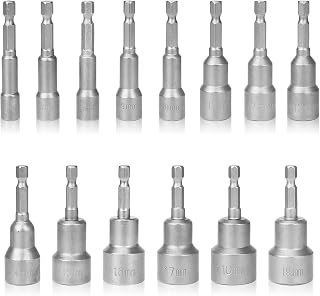




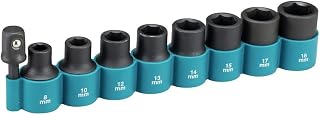


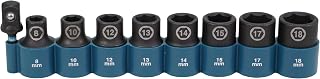


Choosing a Makita socket set is not simply a matter of selecting the largest set or the one with the most pieces. The right choice depends on the drive size, socket sizes, fastening applications, tool compatibility, construction quality and the type of work you expect to carry out.
Makita produces a broad ecosystem of cordless and power tools, while its accessories are designed for different fastening requirements. That makes compatibility particularly important when buying sockets for an impact wrench, impact driver, ratchet or hand-operated tool. Makita UK describes its product offering as covering power tools and associated accessories for both professional users and end users, so the accessory should be selected according to the job rather than the brand name alone.
For occasional automotive work, a compact set containing commonly used metric sizes may be more useful than a large professional assortment. For construction, mechanical maintenance or workshop use, a wider range can reduce the need to change sets or purchase individual sockets later.
The drive size is one of the most important specifications to check before buying. Common socket drive sizes include 1/4-inch, 3/8-inch, 1/2-inch and larger drives for specialist applications.
Do not assume that a socket will fit a tool simply because both products carry the Makita name. The square-drive size must correspond with the tool or be used with an appropriate adapter that is itself suitable for the intended application. When buying an impact socket set, check the tool manufacturer's instructions as well as the accessory specification.
A set advertised with a high number of pieces can appear attractive, but piece count alone is a poor measure of value. Some sets include accessories such as extension bars, adapters, universal joints or storage components in the headline number. The more useful question is which actual socket sizes are included.
For UK users, metric sockets are often the most practical starting point for modern vehicles, machinery, appliances and general maintenance. However, older equipment, imported machinery and certain specialist applications can require imperial sizes. If you already know the fasteners you regularly encounter, compare the included sizes against those requirements before considering the total number of pieces.
Socket depth can make a considerable difference when a fastener sits on a long threaded stud or inside a recessed assembly.
A deep socket is not automatically better than a standard socket. Its additional length can make access more difficult in confined spaces. Conversely, a shallow socket may bottom out before reaching the fastener properly when a long stud is present.
One of the most important distinctions when comparing sockets is whether they are intended for hand tools or impact tools.
Impact sockets are specifically designed for use with compatible powered impact equipment. They are generally manufactured with different material and dimensional considerations from ordinary chrome-plated hand sockets. The socket's ability to withstand repeated impact loading is therefore a critical consideration when it is being used with an impact wrench.
Standard hand sockets should not automatically be treated as interchangeable with impact-rated accessories. The forces generated by an impact tool are different from those encountered during ordinary hand tightening or loosening. Always check that the socket is explicitly intended for the tool and application in question.
Impact mechanisms subject accessories to repeated shock loading rather than a smooth application of torque. This means the socket needs to cope with rapid changes in force.
For buyers, the practical takeaway is simple: if the socket will regularly be used on an impact wrench, prioritise a socket set specifically designed for impact applications instead of choosing solely on appearance, finish or piece count.
Also check the manufacturer's instructions for the power tool. The tool, socket, adapter and fastener should all be appropriate for the intended task.
Material selection affects durability, deformation resistance and suitability for powered use. A socket that looks substantial is not necessarily appropriate for high-torque impact work, so buyers should look beyond surface finish.
Chrome vanadium steel is widely associated with general-purpose socket and hand-tool construction. It can provide a good balance of strength, durability and practicality for conventional mechanical work.
Its suitability depends on the particular socket's design and intended use, however. The presence of a particular steel designation should not be interpreted as proof that an accessory is impact-rated.
Chrome molybdenum, often abbreviated to Cr-Mo, is commonly associated with impact sockets because of its properties under repeated loading. It is frequently used for accessories intended to work with impact tools.
When comparing two socket sets, identifying the intended application and construction material can therefore be more informative than comparing the finish or number of pieces alone.
Traditional hand sockets often have a polished or chrome-style finish, whereas impact sockets are frequently identified by a darker finish. Colour alone, however, should never be used to determine whether a socket is impact-rated.
Always verify the actual specification. A dark-coloured socket is not automatically suitable for impact use, and a polished socket should not automatically be assumed to be unsuitable without checking the manufacturer's stated application.
The number of contact points inside the socket affects how it engages with the fastener.
A six-point socket engages the flats of a conventional hexagonal fastener. This configuration is often preferred where maximum contact with the fastener is desirable, particularly when dealing with higher torque or fasteners that may already be worn.
A 12-point socket can offer more engagement positions, which can be helpful where access is restricted and the tool can only be positioned at relatively small angular increments.
The trade-off is that a 12-point design may provide less surface contact with a conventional hexagonal fastener than a suitable six-point socket. For difficult or high-torque fasteners, the correct six-point socket can therefore be the safer choice.
A socket needs enough material to handle the intended load, but excessive external bulk can make access difficult.
This matters particularly when working around suspension components, engine bays, machinery housings and other areas where adjacent components leave very little clearance. A socket that fits the fastener but cannot physically reach it is of little practical use.
When comparing sets, consider not only the internal socket size but also the external dimensions, overall length and available access around the fastener.
A useful comparison should consider the complete accessory package rather than focusing on a single headline specification.
Automotive buyers should begin with the vehicles and fasteners they actually work on rather than selecting a set solely because it contains a large number of pieces.
For general vehicle maintenance, a useful kit may need a practical spread of metric sizes, suitable drive strength and a combination of socket depths. An impact-compatible set becomes particularly relevant if the sockets will be used with a cordless impact wrench for tasks where the tool manufacturer permits such use.
Wheel-related work deserves particular care. The correct socket size is essential, but so are the socket's application rating and the vehicle manufacturer's specified tightening procedure. An impact wrench can be useful for removing fasteners, but final tightening should follow the vehicle manufacturer's instructions and any required torque procedure rather than relying on the impact tool's setting alone.
If a socket set is being purchased specifically for wheel nuts, verify the exact socket size required by the vehicle and check whether the accessory is intended for impact use. Protective wheel sockets may also be relevant when working with alloy wheels or coated fasteners, particularly where cosmetic damage is a concern.
Engine bays frequently combine restricted access with a mixture of fastener sizes. A compact drive size, extension options and suitable socket depth can be more valuable than a very large set.
Suspension and chassis fasteners can require substantially more torque than small engine-bay fasteners. This is an area where the drive size, impact suitability and socket construction deserve particular attention.
Construction users often have different priorities from automotive enthusiasts. The ideal kit may need to withstand frequent transport, exposure to dust and general site conditions while providing rapid access to commonly used sizes.
A compact set can be preferable for workers who carry tools between locations, while a larger assortment may make more sense for a workshop-based user who needs a broader selection immediately available.
Storage becomes particularly important in mobile work. A case with clearly identified positions can make it easier to notice when a socket has been left on a job site or is missing from the kit.
For occasional DIY users, buying the largest professional-oriented set is rarely necessary. A smaller, well-selected set can cover common maintenance jobs without creating unnecessary duplication.
Consider the types of jobs you actually perform: furniture assembly, bicycle maintenance, garden machinery, household repairs, vehicle maintenance or general workshop tasks. Each category can call for a different selection of sizes and drive formats.
For infrequent use, clear size markings and sensible storage may be more valuable than specialist accessories that remain unused for years.
There is no universal ideal socket count. A 10-piece set can be more useful than a 50-piece set if the smaller kit contains every size you regularly use.
Conversely, buying a very small set can become frustrating if you repeatedly encounter fasteners that fall outside its range.
A sensible approach is to make a list of your common fastener sizes first. Then compare that list against each candidate set. This avoids paying for pieces that add little practical value while also reducing the likelihood of immediately needing additional sockets.
A larger number printed on the packaging does not necessarily mean a more useful set. Count the actual sockets and identify which pieces account for the total.
A socket can be the correct size for the fastener and still be incompatible with your tool. Check the square drive before buying.
This is one of the most important mistakes to avoid. Check that the accessory is specifically intended for powered impact use.
A standard socket may not work where a deep socket is required, while a deep socket can be inconvenient where space is restricted.
Makita is a recognised power-tool brand, but not every Makita accessory is designed for every Makita tool or every fastening application. Product specifications still need to be checked individually.
Worn, corroded or damaged fasteners require greater care. A socket that does not engage properly can increase the likelihood of rounding the fastener.
A socket set is much easier to manage when every piece has a defined location. This becomes increasingly important as the number of sockets grows.
When comparing two or more options, use the same criteria for each set. This creates a more meaningful comparison than relying on headline claims.
Torque is frequently misunderstood when choosing sockets. The torque capability of a power tool does not mean that every socket or accessory attached to it is automatically capable of handling that force.
The complete system matters: the tool, square drive, adapter if used, socket, fastener and application all need to be appropriate for the task.
For high-torque applications, avoid creating unnecessary weak points with unsuitable adapters or improvised combinations. If a task has a specified tightening torque, use an appropriate calibrated torque tool where required rather than assuming an impact wrench can substitute for it.
Adapters can make a toolkit more versatile by allowing accessories with different drive sizes to be connected. However, every additional interface introduces another component that needs to be suitable for the load and application.
For light-duty work, an appropriate adapter may be entirely practical. For high-torque impact applications, use only accessories specifically intended for that type of service and follow the relevant manufacturer's guidance.
A common mistake is to treat an adapter as a universal solution. It is not. The adapter's drive sizes, construction and intended use should all be checked before relying on it.
Good socket maintenance is straightforward but can significantly improve usability and help identify damage before the accessory is used again.
Wipe sockets after use, particularly after working around grease, oil, road dirt or construction dust. Contamination can make size markings harder to read and may prevent a socket from seating correctly.
Look for cracks, deformation, damaged drive openings, excessive wear and signs that the socket has been subjected to unsuitable loads.
Do not continue using a socket that shows obvious structural damage. Replacing one accessory is preferable to risking damage to the fastener, tool or operator.
Keep sockets organised in their intended holder or another suitable storage system. This makes it easier to identify missing pieces and reduces unnecessary movement between tools.
The square-drive connection should remain free from excessive dirt and debris. A clean interface helps the socket seat properly on the tool or compatible accessory.
Professional users generally place greater emphasis on repeatability, durability, size coverage, easy identification and replacement options because their tools are used more frequently.
DIY users may place more emphasis on versatility, storage, affordability and having the most commonly needed sizes in one convenient kit.
Neither approach is inherently better. The right set is the one whose specifications match the frequency and type of work it will actually perform.
No. Price can reflect construction, range, accessories, storage, intended duty and brand positioning, but it does not automatically determine whether a particular set is right for a specific user.
A professional-grade set can be unnecessary for someone who uses sockets a few times each year. Equally, repeatedly using an inexpensive general-purpose set in demanding impact applications can be false economy if the accessories are not designed for that workload.
Instead of asking whether the most expensive option is best, compare the specifications against the actual job requirements.
The best value often comes from buying a set that covers your regular work without unnecessary duplication. Before purchasing, inspect the socket sets already in your toolbox and identify which sizes are missing or repeatedly needed.
If you already own a comprehensive hand-socket collection, buying another general-purpose set may provide less benefit than adding a dedicated impact set. Likewise, if you already have impact sockets but lack deep sizes, expanding the range may be more sensible than purchasing another complete standard set.
This approach also helps prevent an increasingly cluttered toolbox filled with duplicate accessories.
A complete set makes sense when you regularly work with several different fastener sizes. It also provides consistent storage and can make it easier to transport a complete selection between jobs.
Individual sockets can be preferable when you have a specialised application or when a frequently used size has become damaged or lost. For professional users, the ability to replace individual accessories can be particularly useful because it avoids unnecessarily replacing an entire collection.
Socket selection should always be treated as part of a wider tool-safety system. Use the correct accessory for the tool, follow the manufacturer's instructions and wear appropriate personal protective equipment for the job.
Do not use damaged sockets, improvised extensions or accessories outside their intended application. Keep hands clear of moving components and ensure the fastener and workpiece are stable before operating a powered tool.
For tightening applications with specified torque requirements, follow the equipment or vehicle manufacturer's procedure. Where a precise final torque is required, use an appropriate torque-control method rather than assuming that an impact tool's setting provides an exact final torque.
If the sockets will be used with an impact wrench, choose accessories explicitly intended for impact applications and verify compatibility with the particular tool. Do not select a socket solely because its size fits the fastener.
The appropriate Makita socket depends on the specific accessory, drive size and intended application. Automotive users should prioritise correct sizing, suitable construction and compatibility with the tool being used.
For many UK users, metric coverage is a practical starting point, but the correct choice depends on the vehicles, machinery and equipment you maintain. If you regularly work on older or imported equipment, additional imperial coverage may be worthwhile.
Yes, when your work involves protruding studs or recessed fasteners that standard sockets cannot reach. They are less essential for users whose work consists mainly of conventional, easily accessible fasteners.
Neither is universally better. Six-point sockets can provide strong engagement with conventional hexagonal fasteners, while 12-point sockets can offer greater positioning flexibility in restricted spaces. Choose according to the application.
Not necessarily. Compare the actual sizes, drive formats, socket types and included accessories. A smaller set containing the sizes you need can be more useful than a larger set containing numerous pieces you rarely use.
Only when the adapter is suitable for the intended impact application and compatible with the relevant drive sizes. Avoid assuming that any generic adapter is appropriate for high-torque powered use.
Keep them clean, dry and organised so that individual sizes can be identified quickly. A case or organiser with defined positions also makes it easier to notice missing accessories.
A product ranking is most useful when it helps you understand why one socket set is better suited to a particular job than another. Before choosing from any shortlist, verify the current product specification, included socket sizes, drive size, intended application and retailer information.
Product configurations can change, and different retailers may describe accessories differently. For that reason, the manufacturer's current specification and the retailer's current listing should take priority over an old specification, cached description or third-party summary.
Customer reviews can provide useful information about recurring usability concerns, storage quality or compatibility experiences, but individual reviews should not be treated as laboratory testing or proof of a product's technical performance.
The best Makita socket set for you is ultimately the one that matches your tools, fasteners and workload. Start with drive compatibility, then consider socket sizes, impact suitability, construction, depth and access. Only after those essentials are satisfied should piece count, storage and price become deciding factors.
For occasional DIY work, prioritise useful sizes and convenient storage. For automotive maintenance, consider the combination of metric coverage, deep sockets and suitable impact accessories. For professional or demanding workshop use, place greater emphasis on construction, application suitability, range, durability and the ability to maintain the set over time.
Before purchasing, compare the current specifications and today's prices from trusted UK retailers, then check verified customer feedback for the exact model or set. This final verification step is particularly important because socket-set contents and retailer descriptions can change over time.