

♥ Wishlist
Compare 47 verified Festool Jigsaw Blades for Precise, Clean Cutting products in United Kingdom. Reviews, ratings, pros, cons and buying advice updated for October 2026.


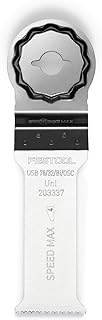







Choosing a Festool jigsaw blade is less about finding a single universally “best” blade and more about matching the blade construction, tooth geometry, length and cutting characteristics to the material and finish you need. A blade that is excellent for rapid cuts in softwood may be a poor choice for a clean laminate edge, while a fine metal blade can be unnecessarily slow and prone to loading when used for ordinary timber.
For the most reliable result, assess the material first, then the required cut quality, cutting speed, workpiece thickness and whether the cut is predominantly straight or curved. Festool organises its jigsaw blades into application-specific categories, including wood, metal, plastics and laminate, with different tooth patterns and blade materials within those groups.
The material being cut should determine the starting point for your selection. Festool's current range includes blades designed specifically for solid wood, plywood, coated boards, laminate, melamine-resin boards, aluminium, non-ferrous metals, steel and other applications. Using a blade designed for the material generally gives you a better balance between cutting speed, control, edge quality and service life.
The material from which a blade is manufactured has a major influence on where it should be used. It is therefore worth understanding terms such as HCS, bimetal and carbide before comparing individual blade specifications.
HCS refers to high-carbon tool steel. Festool uses HCS for a number of its wood jigsaw blades because the material is suited to softer materials such as wood and fibreboard. HCS blades are available in different tooth configurations, allowing the same basic blade material to be optimised for fast, universal, fine or straight cutting applications.
For general woodworking, HCS is often the sensible place to begin. However, the HCS designation alone does not tell you whether a blade will provide a coarse, fast cut or a finer, cleaner finish. Tooth pitch and tooth geometry remain equally important.
Festool's metal jigsaw blades include HCS bimetal construction. These blades are intended for demanding metal applications and are designed to withstand higher temperatures while providing increased wear resistance. The HS 75/1.2 BI/5, for example, is specified for aluminium, non-ferrous metals and steel, with a 1.2 mm tooth pitch and a recommended speed range of 1–3 with the pendulum stroke switched off.
Bimetal construction is particularly relevant when cutting metal because heat, friction and tooth wear can become much more significant than they are when cutting ordinary timber.
Carbide construction is used where resistance to heat and wear is particularly important. Festool's HM 90/3.3 is designed for laminate and melamine-resin boards and is also specified for applications including HPL laminated boards. Festool states that its carbide construction contributes to a very long service life.
This makes carbide particularly interesting for repeated work on abrasive or hard-faced sheet materials. It should not, however, be interpreted as meaning that a carbide blade is automatically the best choice for every woodworking task.
Tooth pitch is the distance between consecutive teeth, and it has a direct relationship with cutting behaviour. In broad terms, coarser teeth remove material quickly and are useful when speed is more important than an exceptionally fine edge. Finer teeth generally make more controlled cuts and are particularly useful for thin materials, metal or finish-sensitive applications.
Festool's specifications illustrate this range. The S 105/4/5 has a 4 mm pitch and is intended for fast cutting in wood where maximum precision is not the primary requirement. By contrast, the S 75/2.5/25 has a 2.5 mm pitch and is designed for fine, splinter-free cutting in wooden materials.
A common buying mistake is to assume that the smallest tooth pitch always produces the best result. A blade that is too fine for the application can cut slowly, generate unnecessary heat and make the job less efficient. The correct pitch is the one that provides sufficient cutting capacity without sacrificing the finish or control you require.
Blade length should be considered alongside the thickness of the material rather than in isolation. A longer blade can provide greater cutting capacity, but excessive blade length is not automatically beneficial for thin sheet material or detailed work.
Festool's published specifications demonstrate the difference between individual blades. The S 75/2.5/25 has a 75 mm cutting length and a stated maximum workpiece thickness of 30 mm, while the S 105/4/5 has a 105 mm cutting length and a stated maximum workpiece thickness of 60 mm. The HS 155/1.2 BI/5 is a much longer metal blade intended for composite panels and specified for workpieces up to 110 mm in the stated application.
These figures should be treated as manufacturer specifications for the stated applications rather than as a promise that every material of that thickness will produce the same result. Material density, support, cutting direction, blade condition and machine settings can all affect practical performance.
The S 105/4/5 is positioned as a fast-cutting WOOD BASIC blade. It uses HCS tool steel and cross-set teeth, and Festool specifies it for solid wood, coated chipboard, blockboard and plywood where high precision is not the main requirement. Its published specifications include a 105 mm cutting length, 4 mm pitch and 60 mm maximum workpiece thickness.
This type of blade is worth considering when productivity matters more than achieving the finest possible edge. It is particularly relevant to rougher woodworking cuts where the edge will subsequently be concealed, sanded or otherwise finished.
The S 75/4 FSG/5 is a more general-purpose woodworking option. Festool describes its HCS construction and cross-set teeth as providing a stable blade suitable for fast, straight cuts across relevant wood applications. The same blade is also included in Festool's mixed woodworking sets, reflecting its role as a general-purpose option rather than a specialist fine-finishing blade.
For someone who does a mixture of routine timber cutting and board work, a universal wood blade can make more sense than buying several highly specialised blades immediately.
The S 75/2.8/5 is designed for precise perpendicular cuts in wood. Festool highlights its sharp Japanese teeth, which are intended to score and then cut through the fibres cleanly. It has a 75 mm cutting length, 2.8 mm pitch and a stated maximum workpiece thickness of 30 mm.
This is the type of specification to examine when dimensional accuracy and a controlled straight cut matter more than simply getting through the material as quickly as possible.
The S 75/2.5/25 is intended for particularly fine woodworking cuts. Its conically ground HCS blade is designed to produce a clean, splinter-free cutting edge in suitable wooden materials. Festool lists applications including solid wood, coated chipboards, blockboards and plywood, and also notes suitability for plastics.
Its 2.5 mm tooth pitch makes it a distinctly different proposition from a coarse fast-cutting blade. If visible edge quality is one of your main priorities, this is the kind of blade specification worth comparing.
Metal requires a fundamentally different blade selection approach. Cutting steel, stainless steel, aluminium and other metals generates more heat and places different demands on the teeth than ordinary woodworking. Festool's metal blades use different geometry and bimetal construction for these applications.
The HS 75/1.2 BI/5 has a 1.2 mm tooth pitch and is specified for aluminium, non-ferrous metals and steel, including stainless steel and iron in its listed applications. Festool describes the rippled bimetal form as wear-resistant and suitable for straight cuts. Its published maximum workpiece thickness is 20 mm.
The manufacturer's recommended speed range is 1–3 with the pendulum stroke switched off. Following the manufacturer's application and machine-setting guidance is important when working with metal because excessive speed or inappropriate blade movement can increase heat and wear.
The HS 155/1.2 BI/5 is a substantially longer metal blade intended particularly for composite and sandwich materials. Festool lists applications including composite panels, aluminium, non-ferrous metals and steel, with a 155 mm cutting length, 1.2 mm pitch and stated maximum workpiece thickness of 110 mm.
This is a useful example of why blade length should be selected according to the actual workpiece rather than simply choosing the longest or most expensive blade available.
Decorative-faced boards can be considerably less forgiving than ordinary softwood. Laminate and melamine surfaces can chip, breakout can become highly visible, and abrasive faces can accelerate tooth wear.
Festool's HM 90/3.3 carbide blade is specifically designed for laminate and boards bound with melamine resin. The manufacturer also lists HPL laminated boards among its applications and specifies a 90 mm cutting length, 3.3 mm pitch and 30 mm maximum workpiece thickness.
For kitchen worktops, furniture panels and other visible faced boards, the correct blade should therefore be selected according to both the substrate and the surface finish. Do not assume that a general-purpose wood blade will provide an equivalent result simply because the core material is wood-based.
A mixed set can be particularly practical when your projects vary. Festool's STS-Sort/21 W/P/M, for example, combines different blade types for wood, plastics and metal, including WOOD FINE CUT, WOOD UNIVERSAL, WOOD STRAIGHT CUT, PLASTICS LAMINATE and METAL STEEL/STAINLESS STEEL categories.
The benefit of a mixed set is not simply the number of blades. It is the ability to match the cutting edge to the material rather than repeatedly using one general-purpose blade for every job.
Compatibility is one of the most important checks to make before ordering replacement blades. Festool's current jigsaw blade listings specify compatible machines for individual products, and many of the blades discussed above are listed for families including the PS 300, PS 400, PS 420, PSC 420 and related variants. Some blades are also listed for the PSC-E 18 or newer models, depending on the particular blade.
Do not rely solely on the general phrase “Festool jigsaw blade”. Check the exact blade's compatibility list against the exact model of your saw.
Write down the complete model designation of your jigsaw before shopping. Small differences in model family, generation or configuration can matter, so the manufacturer's compatibility information is a better reference than assumptions based on appearance.
Festool describes its jigsaw blades as using a T-shaft adapter for straightforward blade replacement. Nevertheless, always confirm the actual blade and machine compatibility information for your specific model before purchasing.
If you use guide rails, adapter tables, splinter guards or other jigsaw accessories, consider whether your chosen blade and setup are appropriate for that combination. Festool's guidance for its ADT-PS 420 adapter table, for example, specifically recommends its TRION S 75/4 FSG blades for straight cuts with a guide rail because of their stability.
A jigsaw blade has to do more than simply remove material. Its geometry affects how readily it follows a line, how stable it feels during a straight cut and how effectively it negotiates curves.
For straight cuts, stability and resistance to deflection are valuable. For curves, a blade that is too wide or too aggressively designed for straight cutting may resist turning. This is why Festool offers different wood blade categories rather than treating every woodworking application as identical.
When choosing a blade for curved work, pay attention to the manufacturer's intended application and do not assume that a shorter blade automatically becomes a specialist curve blade. Blade width, tooth arrangement, material and intended cutting direction all contribute to handling.
Many Festool jigsaws use pendulum action to alter the movement of the blade. The appropriate setting depends on the material, blade and desired result.
Festool's published guidance for its S 105/4/5 WOOD BASIC recommends a speed range of 4–6 and describes minimum pendulum stroke as favouring precision and maximum pendulum stroke as favouring speed. For its metal HS 75/1.2 BI/5, Festool instead recommends speed 1–3 with pendulum stroke switched off.
These differences demonstrate why blade selection and machine settings should be considered together. A blade cannot compensate indefinitely for an unsuitable speed or pendulum setting.
Use the manufacturer's recommended settings for the particular blade and material, prioritising control over maximum feed speed when edge quality is important. A suitable fine-cut blade can be undermined by overly aggressive machine settings.
Where the application permits, a coarse blade and more aggressive setting can improve cutting speed. The trade-off is that the resulting edge may be rougher and more prone to breakout.
Metal-cutting blades generally require slower cutting conditions and no pendulum action according to the cited Festool specifications. Avoid treating metal like timber simply because the same jigsaw can physically cut both materials.
Blade selection is only one part of producing a clean jigsaw cut. Material support, cutting direction, blade condition and machine settings can all influence the final edge.
There is no single replacement interval that applies to every Festool jigsaw blade. Service life depends on material, cutting frequency, feed pressure, machine settings, contamination, heat and the type of work being performed.
Instead of replacing blades solely according to elapsed time, pay attention to changes in cutting behaviour.
A worn blade can also encourage poor technique because the operator may compensate by pushing harder. Replacing a blade at the appropriate point can therefore improve control as well as cutting efficiency.
A 25-piece pack is not necessarily better value than a five-piece pack if most of the blades are unsuitable for your applications. Compare the types, specifications and intended materials rather than the number printed on the package.
Speed is only one measure of performance. If the finished edge is visible, a fast rough-cut blade may create additional sanding, trimming or rework.
This is an inappropriate substitution. Metal requires blade geometry and construction intended for metalworking. Festool's dedicated metal blades use bimetal construction and specific tooth pitches for these applications.
Compatibility lists vary by blade. Always compare the manufacturer's listed machines with the exact jigsaw model you own.
A blade may be physically long enough to enter a thick workpiece but still not be the appropriate choice for that application. Use the manufacturer's stated maximum workpiece thickness as a reference and allow for the actual material and cutting conditions.
The cheapest blade may not be the most economical option if it produces an unacceptable finish or wears quickly in the material you routinely cut. Conversely, a specialist premium blade can be unnecessary for occasional rough woodworking. The best value depends on application frequency and required finish.
When comparing two blades, work through the same criteria rather than relying on product names alone.
Material: Is the blade intended for the material you actually cut?
Blade material: Is it HCS, bimetal or carbide, and does that construction suit the application?
Tooth pitch: Is the pitch appropriate for the required balance of speed and finish?
Cutting length: Is the blade suitable for the thickness of your workpieces?
Maximum workpiece thickness: What does the manufacturer specify for the intended application?
Cutting width: Will the blade produce the type of cut you need?
Cut direction: Is it designed for fast, fine, straight or curved cutting?
Machine compatibility: Is your exact Festool jigsaw listed?
Machine settings: Does the recommended speed and pendulum behaviour fit your working method?
Pack size: Are you buying enough blades for your workload without paying for types you will rarely use?
Best for fast general wood cutting: Look towards the WOOD BASIC category, such as the S 105/4/5, when maximum precision is not the primary objective.
Best for general woodworking: A WOOD UNIVERSAL blade such as the S 75/4 FSG/5 is a practical category to compare for mixed timber and board work.
Best for fine wood cuts: The S 75/2.5/25 is specifically designed around fine, splinter-free woodworking cuts.
Best for precise straight wood cuts: The S 75/2.8/5 is designed for precise perpendicular cuts and uses Japanese-style tooth geometry.
Best for laminate and melamine: The HM 90/3.3 is specifically designed for laminate and melamine-resin boards and uses carbide construction.
Best for steel and stainless steel applications: Compare metal-specific bimetal blades such as the HS 75/1.2 BI/5, subject to the stated material and thickness limits.
Best for thick composite or sandwich panels: The HS 155/1.2 BI/5 is specifically designed for composite and sandwich materials and offers a substantially longer cutting length.
Best approach for mixed materials: A dedicated mixed set such as Festool STS-Sort/21 W/P/M can provide several application-specific blade types in one assortment.
Professional users should generally prioritise consistency, application suitability and productivity over simply minimising the purchase price of each blade. When a jigsaw is used frequently, the cost of poor blade selection can include slower cutting, additional finishing work, damaged material and unnecessary downtime.
For a trade workshop, a sensible blade inventory may include a general wood blade, a fine-cut wood blade, a straight-cut blade, a curve-oriented blade and specialist blades for any regularly processed laminate or metal. The exact combination should reflect the materials actually encountered rather than attempting to cover every possible application.
Festool's own mixed sets illustrate this application-specific approach by combining blades for different materials and cutting requirements rather than treating a single blade as universally suitable.
DIY users who only occasionally use a jigsaw do not necessarily need a large specialist collection. A small selection covering the materials most commonly encountered can be more useful.
For predominantly woodworking projects, start by comparing a universal wood blade with a fine-cut option. If you regularly install laminate or work with faced boards, add an appropriate specialist blade. Metal-cutting blades only need to become part of the core selection when metal cutting is a genuine requirement.
This approach avoids a common mistake: buying a large assortment and then using the same blade for every job regardless of its intended purpose.
When straightness and repeatability matter, the accessory system can become just as important as the blade. Festool provides an adapter table for certain PS(C) 400/420 and PSB(C) 400/420 machines that can be used with a guide rail for straight cuts. Festool specifically recommends TRION S 75/4 FSG blades for straight guide-rail work because of their stability.
This is a useful reminder that a “best blade” cannot be assessed independently from the intended cutting setup. If your priority is a highly controlled straight cut, consider the machine, adapter, guide system, blade and material as one system.
Correct storage helps keep blades organised and makes it easier to select the right specification before starting a job.
Always follow the operating and safety instructions supplied with your particular Festool jigsaw. Before changing a blade, isolate the machine from its power source in accordance with the manufacturer's instructions and allow components to cool if they have become hot during use.
Use the correct blade for the material and do not exceed the manufacturer's stated application or workpiece limits. Inspect the blade before use and keep hands clear of the cutting path. Appropriate eye protection and other personal protective equipment should be selected according to the work environment and material being cut.
Safety should not be treated as a substitute for correct blade selection. Using an inappropriate blade can create poor cutting behaviour, excessive heat, increased wear or loss of control.
The most economical blade is not necessarily the one with the lowest purchase price. Value comes from matching the blade to the job so that it cuts efficiently, produces the required finish and lasts appropriately under the conditions for which it was designed.
Before placing an order, run through this short decision process:
1. Identify your jigsaw: Record the complete model designation.
2. Identify the material: Decide whether you are cutting timber, plywood, coated board, laminate, plastic, aluminium, steel, composite material or another substrate.
3. Define the finish: Decide whether you need a fast rough cut, general-purpose cut, fine edge, precise straight cut or curved cut.
4. Measure thickness: Compare the workpiece with the manufacturer's stated maximum thickness.
5. Select blade construction: Compare HCS, bimetal and carbide according to the application.
6. Check tooth pitch: Choose a pitch appropriate to the material and desired cutting behaviour.
7. Check cutting length: Make sure it is appropriate for the workpiece.
8. Check machine compatibility: Verify the exact jigsaw model against the manufacturer's product information.
9. Compare pack contents: For sets, make sure the included blades are genuinely useful for your projects.
10. Compare current prices: Check trusted UK retailers and compare the price per useful blade rather than simply the headline pack price.
There is no single best blade for every type of wood cutting. For fast general cutting, compare WOOD BASIC options such as the S 105/4/5. For general woodworking, the S 75/4 FSG/5 WOOD UNIVERSAL is a relevant option. For a fine, splinter-conscious finish, the S 75/2.5/25 is specifically designed for fine wood cuts, while the S 75/2.8/5 is designed for precise perpendicular cuts.
Several Festool wood blades are specified for plywood, including the S 105/4/5, S 75/2.5/25 and S 75/2.8/5. The most suitable choice depends on whether your priority is fast cutting, a fine finish or precise straight cuts.
For laminate and melamine-resin boards, the HM 90/3.3 is specifically designed for this category and uses carbide construction for wear and heat resistance. Festool also lists HPL laminated boards among its applications.
Use a blade specifically designed for metal. The HS 75/1.2 BI/5 is a bimetal blade specified for aluminium, non-ferrous metals and steel, with applications including stainless steel. For thicker composite or sandwich materials, Festool also offers the longer HS 155/1.2 BI/5.
Compatibility depends on the individual blade and machine. Many current Festool jigsaw blades are listed for several PS, PSB, PSC and PSBC models, but the compatible-machine list varies by product. Always check the manufacturer's compatibility information for the exact blade and exact jigsaw model.
No. Fine teeth can be advantageous when edge quality and controlled cutting are important, but coarse teeth can remove material faster where a rougher cut is acceptable. The correct pitch depends on the material, thickness, required finish and cutting speed.
Individual blades are sensible when you have a clearly defined application and want a larger quantity of one particular specification. A mixed set can be more useful when you regularly switch between materials. Festool's STS-Sort/21 W/P/M, for example, combines wood, plastic/laminate and metal blade types.
There is no universal lifespan. Service life depends on the material, thickness, cutting conditions, machine settings, frequency of use and the amount of heat and wear generated. Replace a blade when its cutting performance, control or edge quality has deteriorated or when the teeth show damage.
Yes. As teeth wear, cutting efficiency can fall and the operator may compensate by applying additional pressure. A worn or damaged blade can therefore make controlled cutting more difficult, particularly in demanding or finish-sensitive applications.
HCS refers to high-carbon tool steel. Festool uses HCS tool steel for a range of wood blades intended for softer materials such as wood and fibreboard.
BI denotes the bimetal construction used on relevant Festool blades. The manufacturer's metal-blade specifications describe HCS bimetal as resistant to high temperatures and hard-wearing, making it suitable for demanding metal-cutting applications.
They can be, particularly for applications where heat and wear resistance are important. Festool's HM 90/3.3 is a carbide blade designed specifically for laminate and melamine-resin boards and is also specified for HPL laminated boards.
The strongest way to choose a Festool jigsaw blade is to ignore the idea of a universal winner and match the blade to the actual cutting task. Material, tooth pitch, blade construction, cutting length, maximum workpiece thickness, cut geometry and machine compatibility all matter.
For predominantly woodworking, a useful starting collection can consist of a general-purpose wood blade plus a finer blade for visible edges. Add a straight-cut or curve-oriented blade when those applications become important. For laminate and melamine, consider the dedicated carbide option rather than treating the material like ordinary timber. For metal, use the appropriate bimetal blade and follow the manufacturer's recommended machine settings.
Before buying, compare the exact Festool blade specification with your jigsaw model, material and workpiece thickness. Then compare pack contents and current UK retailer prices. This application-led approach is more useful than choosing solely from star ratings, piece counts or the highest-priced option.