

♥ Wishlist
Compare 39 verified DEWALT Saw Blades for Precision Cutting products in United Kingdom. Reviews, ratings, pros, cons and buying advice updated for October 2026.










Choosing a DeWalt saw blade is not simply a matter of selecting the blade with the highest tooth count or the most expensive specification. The correct blade depends on the material being cut, the type of saw being used, the required finish, the thickness of the workpiece and whether speed or precision is the priority.
For example, a blade designed for fast timber construction cuts is not necessarily the best choice for fine furniture work. Likewise, a blade intended for wood should not be treated as a general-purpose solution for cutting metal, masonry or other materials. Matching the blade to the application is one of the most important factors affecting cutting quality, safety, blade life and overall value.
The first decision should always be the material. DeWalt offers saw blades for different cutting applications, while other established manufacturers such as Bosch, Makita, Milwaukee, Evolution and Diablo also produce application-specific alternatives.
Compatibility is more important than brand preference. Before purchasing a blade, check the saw manufacturer's requirements and compare them with the blade's specifications.
A common buying mistake is concentrating on the blade brand while overlooking diameter, bore and machine compatibility. A premium blade is still the wrong purchase if its physical specifications do not match the saw.
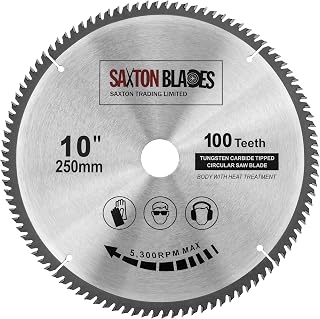
Tooth count is one of the most visible specifications on a circular saw or mitre saw blade, but it should not be considered in isolation. More teeth generally allow a blade to make a finer, more controlled cut, whereas fewer teeth can provide faster material removal and greater chip clearance.
Blades with relatively few teeth are commonly associated with rapid cutting and applications where maximum surface finish is not the primary concern. They can be useful for construction timber, ripping and other jobs where material removal speed matters.
The larger spaces between teeth provide more room for chips and sawdust to clear from the kerf. This can be advantageous during demanding cuts, although the resulting finish may be less refined than that produced by a higher-tooth-count blade.
Medium tooth counts can provide a useful compromise between cutting speed and finish. This makes them particularly relevant to buyers looking for a versatile blade for general workshop or installation work.
Higher tooth counts are generally associated with smoother, more controlled cuts, particularly when cross-cutting or working with sheet materials. The trade-off is that the saw may remove material more slowly, and the blade can place greater demands on the machine when cutting thick or difficult material.
Rather than asking whether a 24-tooth, 40-tooth, 48-tooth or higher-tooth-count blade is universally better, consider the actual job. A fast rough cut and a furniture-quality cross-cut have very different requirements.
Two blades with the same number of teeth can behave quite differently because tooth shape, hook angle, kerf design and carbide geometry influence how each tooth enters and leaves the material.
Alternate top bevel configurations are commonly used where clean cross-cutting is important. The alternating tooth geometry can help produce a controlled cut across timber fibres and is frequently associated with blades intended for finer woodworking applications.
Flat-top configurations are often associated with efficient material removal and ripping applications. They can be useful where cutting speed and straightforward timber processing are more important than an exceptionally fine finish.
Combination designs attempt to balance ripping and cross-cutting performance. For buyers who want one blade to cover a broad range of routine timber tasks, this can be more practical than repeatedly changing between specialist blades.
The hook angle influences how aggressively the tooth engages with the workpiece. A more aggressive geometry can aid fast cutting, while a less aggressive configuration may provide greater control in applications where a refined cut is important.
Always use the blade configuration specified as suitable for the particular saw and application. Blade geometry should not be selected purely from a generic rule because machine design and manufacturer recommendations also matter.
Kerf refers to the width of the cut produced by the blade. It affects material removal, cutting resistance and, in some applications, the amount of material wasted during repeated cuts.
A thin-kerf blade can require less material removal and may be useful where the saw's power or the application's material efficiency makes this advantageous. A full-kerf blade can offer a different balance of rigidity, durability and cutting behaviour.
Do not assume that thinner always means better. The correct kerf depends on the saw, its power, the material, the intended cut and the blade manufacturer's specification.
Carbide-tipped teeth are a major reason modern saw blades can retain useful cutting performance over repeated use. The quality, geometry and construction of the teeth influence how the blade behaves as it encounters timber, sheet materials and other workpieces.
Blade bodies also matter. A well-designed blade needs to maintain appropriate stability while rotating at high speed. Features such as expansion slots, stabilising elements and carefully designed tooth spacing can influence noise, vibration, heat management and cutting behaviour.
DeWalt is not the only manufacturer worth considering when comparing saw blades in the UK. Depending on the application, buyers may also encounter Bosch, Makita, Milwaukee, Evolution and Diablo. The strongest choice is not necessarily the brand with the most recognisable name; it is the blade whose specification best matches the job.
DeWalt blades are a natural consideration for users already operating DeWalt saws and cordless tools, particularly when maintaining a consistent tool ecosystem is important. Buyers should still compare the individual blade's diameter, bore, tooth configuration, application rating and cutting characteristics rather than assuming every DeWalt blade is interchangeable across machines.
Bosch has a broad accessory range covering different cutting applications. It can be worth comparing equivalent blade specifications rather than judging products solely by brand.
Makita is another established power-tool manufacturer with a wide range of saw accessories. Its blades can be relevant when comparing like-for-like products according to diameter, tooth count, intended material and machine compatibility.
Milwaukee is particularly prominent among professional power-tool users and offers a variety of cutting accessories. As with any brand, the specific blade specification is more meaningful than the manufacturer's reputation alone.
Evolution is worth considering where specialist cutting applications are involved, particularly because its accessory range covers different machine and material requirements. Buyers should match the blade to the exact saw and material rather than assuming compatibility from appearance.
Diablo is another recognised name in saw blades and cutting accessories. Its products can be useful comparison points when assessing tooth geometry, application, kerf, construction and expected cutting performance against DeWalt alternatives.
When several blades appear similar, compare the technical specifications in a consistent order. This makes it easier to distinguish genuinely different products from blades that mainly differ in packaging or marketing terminology.
For fine woodworking, the priority is usually controlled cutting and a clean finish rather than maximum cutting speed. A suitable blade will generally have a tooth configuration designed for finer cuts and should be matched to the material being processed.
Higher tooth counts can be useful for this type of work, but tooth geometry and material compatibility remain important. A high-tooth-count blade that is unsuitable for the material or machine will not automatically deliver a better result.
When cutting construction timber, speed and efficient chip clearance can be more important than achieving a furniture-grade finish. A blade with a configuration suited to rapid timber cutting can therefore be more appropriate than a fine-finish blade.
For repeated construction work, consider how much time is spent changing blades. A suitable general-purpose or construction-oriented blade may be more convenient if it can handle the majority of routine cuts without compromising the intended application.
Sheet materials present different challenges from solid timber. Veneers and laminated surfaces can be vulnerable to visible chipping, while MDF and chipboard can be abrasive and produce substantial dust.
When comparing blades for sheet materials, pay particular attention to the manufacturer's stated application, tooth geometry and recommended cutting direction. A blade designed specifically for a particular class of sheet material may be preferable to a generic timber blade when surface finish matters.
A general-purpose blade is attractive because it reduces the need to keep multiple accessories available. It can make sense for occasional DIY work where the same saw is used for a mixture of routine tasks.
Specialist blades become more valuable when the same type of cut is performed repeatedly or when finish quality is important. A workshop producing accurate joinery, for example, can benefit from selecting blades around specific operations rather than expecting one blade to do everything.
Tooth count is easy to compare, but it does not tell the complete story. Tooth geometry, carbide design, kerf, blade diameter and intended application all influence performance.
A blade can have the correct diameter but still be incompatible with the saw because the bore does not match. Always verify both dimensions.
Owning a DeWalt saw does not automatically make every DeWalt blade suitable for it. Different machines use different blade sizes and configurations. Check the exact saw model and manufacturer guidance.
A fine-tooth blade may be poorly suited to aggressive material removal. Using the wrong blade can reduce cutting efficiency and may increase unnecessary load on the machine.
Initial purchase price is only one part of value. Consider whether the blade specification is appropriate for the work, whether it can be maintained correctly and whether its characteristics match the required finish and cutting speed.
Rotational speed is a critical compatibility specification. Never fit a blade without confirming that its rated operating speed is appropriate for the saw.
Cut quality is influenced by several factors working together. The blade is only one part of the system.
Even a well-chosen saw blade needs appropriate maintenance. Resin, adhesive residue, dust and other deposits can accumulate on the teeth and blade body, particularly when cutting timber or composite sheet materials.
Inspect blades regularly for damaged, missing or excessively worn teeth. Also check for contamination and any visible damage to the blade body. A blade that appears damaged should not simply be put back into service.
Cleaning should follow the blade manufacturer's instructions. Avoid improvised cleaning methods or chemicals that could damage the carbide, coatings or blade body.
There is no single number of cuts that determines when a saw blade should be replaced. Blade life varies according to material, cutting frequency, machine setup, feed technique, contamination and the blade's construction.
Replace a blade when it is damaged or when its condition no longer permits the intended work to be carried out safely and effectively. Sharpening may be appropriate for some professional-quality blades, but this depends on the blade design and the manufacturer's guidance. Do not assume that every blade is suitable for repeated sharpening.
Saw blades operate at high speed and should be treated as precision cutting components rather than ordinary accessories. Always follow the safety instructions supplied with the saw and blade.
The best value is not necessarily the lowest purchase price. A blade should be evaluated according to how well its specification matches the work it will actually perform.
For occasional DIY users, a versatile blade may offer better practical value than maintaining several specialist options. For professionals, having separate blades for common cutting operations may reduce compromises and make it easier to achieve consistent results.
It is also worth considering the cost of cutting errors. If a cheap or unsuitable blade produces chipped laminate, rough edges or inaccurate cuts on expensive material, the apparent saving can disappear quickly.
DIY buyers should prioritise compatibility, versatility and ease of use. A correctly specified general-purpose blade can often be a sensible starting point where the saw is used for occasional household projects and basic timber cutting.
Tradespeople should consider the materials and cuts encountered most frequently. A small selection of purpose-specific blades can be more useful than relying on one blade for every task.
Users who regularly make visible cuts should give greater attention to tooth geometry, finish quality, material-specific performance and the ability to maintain or replace blades efficiently.
No. Higher tooth counts can be advantageous for finer cuts, but lower tooth counts can be more suitable for rapid cutting and efficient chip clearance. The correct choice depends on the material and application.
No. Check the exact blade diameter, bore, machine type, operating speed and application. Brand compatibility alone is not sufficient.
Choose general-purpose when versatility is the priority and specialist blades when a particular material or cutting operation is performed frequently or requires a higher-quality finish.
No. The most appropriate blade is the one whose construction and geometry suit the intended application and machine. Price should be considered alongside specification rather than used as a substitute for technical comparison.
It is essential. The blade must be compatible with the machine for which it is intended. Always follow the saw manufacturer's stated blade dimensions.
Yes. Kerf affects the amount of material removed and can influence cutting resistance and blade behaviour. Compare kerf where the manufacturer provides the specification and consider it alongside the saw's capabilities.
Some blades can be professionally sharpened, but suitability depends on their construction, tooth condition and manufacturer recommendations. A damaged blade should not be assumed to be recoverable through sharpening.
The strongest DeWalt saw blade choice is the one that fits the saw correctly, matches the material and delivers the balance of speed, finish and durability required for the job. There is no single blade specification that is ideal for every user.
Before buying, compare the technical specification rather than relying on the product name alone. Diameter, bore, maximum speed, tooth count, tooth geometry, kerf and intended material should all be considered together.
For occasional DIY projects, versatility may be the deciding factor. For professional work, application-specific blades can make more sense. For precision woodworking, finish quality and tooth geometry deserve particular attention. Whatever the use case, always verify current manufacturer specifications and compatibility with the exact saw model before purchase.
The best DeWalt saw blade depends on the saw, material and type of cut. A blade optimised for rapid timber cutting is not necessarily the best option for fine cross-cutting or sheet materials. Compare the individual blade specifications against your intended application.
For wood, choose a blade specifically designed for the type of timber and cut required. Ripping, cross-cutting and general-purpose work can benefit from different tooth configurations.
Look for a blade whose manufacturer specifically identifies it as suitable for plywood or comparable sheet materials. Tooth configuration and finish requirements are particularly important where exposed edges need to be clean.
Select a blade rated for MDF or comparable engineered board and check the recommended tooth configuration. MDF can generate substantial dust and can be abrasive, so the blade should be selected for the intended application rather than simply based on its tooth count.
A ripping blade is designed around cutting along the grain and typically prioritises efficient material removal. A cross-cutting blade is designed to cut across the grain and generally prioritises a cleaner, more controlled finish.
You can use a suitable general-purpose blade for many routine woodworking tasks, but specialist blades can provide better results when a particular operation or finish is important.
Check the saw manufacturer's required blade diameter, bore size, machine type and speed rating, then compare those specifications with the blade. Do not rely solely on the DeWalt brand name.
Replacement intervals vary according to usage and material. Inspect the blade regularly and replace it when it is damaged, excessively worn or no longer produces the required cutting performance. Follow the manufacturer's guidance for maintenance and sharpening.
Neither is universally better. A 24-tooth configuration may favour faster cutting and chip clearance in suitable applications, while a 40-tooth configuration may provide a finer cut. The correct choice depends on the material, saw and required finish.
Potentially, but only when the blade's physical and operating specifications are compatible with the other machine and the manufacturer permits that configuration. Check diameter, bore, speed rating, application and machine instructions before fitting it.
Product specifications, ranges and retailer listings can change during the year. Before placing an order, verify the current product designation, dimensions, tooth configuration, intended application, compatibility and current price. If a retailer listing conflicts with the manufacturer's current specification, treat the manufacturer's documentation as the more important reference point.
It is also sensible to compare equivalent products rather than comparing headline prices alone. Two blades can look similar while having substantially different tooth configurations, kerf dimensions or intended applications. Checking the specification sheet can prevent an otherwise avoidable purchase mistake.
A good saw blade should be judged by how well it solves the cutting job, not simply by its brand, price or tooth count. DeWalt remains an important option for UK buyers, but the same comparison principles apply when evaluating Bosch, Makita, Milwaukee, Evolution, Diablo and other established manufacturers.
The most useful comparison is therefore specification against application: Will it fit the saw? Is it designed for the material? Is the tooth geometry appropriate? Is the cutting speed suitable? Does the finish meet the requirement? Answer those questions first and the shortlist becomes considerably easier to narrow down.