

♥ Wishlist
Compare 14 verified Dewalt Socket Sets & Impact Sockets products in United Kingdom. Reviews, ratings, pros, cons and buying advice updated for October 2026.





Choosing the right DEWALT socket set is less about buying the largest box and more about matching the socket drive, size range, construction and intended application to the work you actually carry out. A compact metric set can be ideal for routine vehicle maintenance, while a larger combination set may make more sense for a workshop where both metric and imperial fasteners are encountered. For impact work, the decision becomes even more important because ordinary chrome hand-tool sockets should not simply be treated as interchangeable with impact-rated sockets.
DEWALT's UK range currently includes conventional ratchet and socket sets, combination sets, deep impact sockets and dedicated impact socket sets in several drive sizes. The manufacturer's catalogue therefore gives buyers considerably more choice than a single generic "DEWALT socket set" search might suggest.
The drive size is the square connection between the socket and the ratchet, breaker bar, torque wrench or powered tool. It determines which tools the socket can be used with and is one of the first specifications to check before buying.
If you are building a first serious workshop collection, a 3/8-inch set can be an efficient general-purpose starting point, while a 1/2-inch set becomes more attractive when your work regularly involves larger automotive fasteners. A 1/4-inch set is particularly useful when access is restricted or the fasteners are relatively small.
For UK buyers, metric sockets are often the most practical starting point, but the correct choice depends on the vehicles, machinery and equipment being maintained. Buying an extensive imperial collection simply because it contains more pieces can leave you with duplicate sizes you rarely use.
A metric set is a sensible choice where the majority of your fasteners are specified in millimetres. DEWALT offers full metric options as well as mixed metric and imperial sets. For example, its 22-piece full metric 1/2-inch socket set is designed around metric sizes and includes a 72-tooth ratchet, while the manufacturer's 7-piece full metric deep impact set focuses on commonly useful larger sizes.
A combination set can be worthwhile for users working across older machinery, imported equipment, automotive applications and general workshop repairs. The advantage is convenience: the required size is more likely to be available without purchasing a second collection.
However, a larger piece count does not necessarily mean better value. A 100-piece mechanics kit can contain many accessories, bits and duplicate drive sizes while offering fewer of the socket sizes you actually need. When comparing sets, inspect the individual socket list rather than judging quality by the number printed on the case.
Socket depth and intended tool type are two separate considerations. A deep socket is not automatically an impact socket, and an impact socket is not necessarily the best choice for every hand-tool application.
Standard sockets are useful for everyday ratchet work where the fastener is accessible and the additional reach of a deep socket is unnecessary. They are often compact, making them useful when clearance around the fastener is limited.
Deep sockets provide additional internal depth, allowing them to reach nuts positioned further along a threaded stud or fasteners recessed inside a component. This can be particularly useful for automotive and mechanical work.
DEWALT's 7-piece 1/2-inch full metric deep impact socket set, for example, includes 17mm through 24mm sizes and is specifically described by DEWALT as an impact socket set. It also uses heat-treated CR-440 steel, black oxide coating and DirectTorque technology.
Impact sockets are designed for use with impact tools and are constructed with that application in mind. DEWALT describes its impact range as being engineered for impact drivers and wrenches, with products including dedicated impact sets and individual deep impact sockets.
For powered impact work, look specifically for sockets identified by the manufacturer as impact-ready or impact sockets. Do not assume that a socket is suitable simply because it fits the square drive of an impact wrench.
Socket construction affects durability, torque handling and suitability for different applications. For serious workshop use, material information is more useful than superficial features such as colour or case design.
Forged steel construction is commonly associated with durable hand-tool sockets. DEWALT describes its 22-piece full metric 1/2-inch socket set as using 100% forged steel.
For buyers, the important point is not simply the word "steel". Check the exact construction stated for the particular model because DEWALT sells multiple socket families with different specifications.
Impact sockets have different requirements because the socket can be subjected to repeated shock loading. DEWALT specifies heat-treated CR-440 steel for its 23-piece 1/2-inch combination impact socket set.
This illustrates why construction should be assessed according to application. A socket designed for manual ratcheting should not be assumed to offer the same characteristics as a purpose-designed impact socket.
Several DEWALT socket ranges use DirectTorque technology. DEWALT describes the design as providing greater contact with the flat surface areas of fasteners, with the aim of reducing rounding and extending fastener life.
The underlying buying consideration is important even if you are comparing competing brands: socket geometry should engage the appropriate surfaces of the fastener rather than relying unnecessarily on the corners. This is especially relevant when working on fasteners that are already worn, corroded or difficult to replace.
Good socket fit is only part of the equation. The correct size, a clean socket, appropriate torque and sensible tool selection all contribute to reducing the chance of damaging a fastener.
A six-point socket engages the six flats of a conventional hexagonal fastener. This makes it a particularly sensible choice when secure engagement and resistance to fastener damage are priorities.
DEWALT's 23-piece 1/2-inch combination impact socket set uses 6-point impact sockets, while its 25-piece 1/2-inch conventional socket set also specifies 6-point sockets.
For buyers, six-point sockets are often the straightforward choice for general mechanical work. A broad accessory collection may include other profiles, but the correct socket profile should always be matched to the fastener rather than selected purely because it increases the advertised piece count.
The ratchet supplied with a socket set can be just as important as the sockets themselves. A high tooth-count ratchet generally permits a smaller movement of the handle before the mechanism engages again, which can be useful when working in restricted spaces.
Several DEWALT sets use 72-tooth ratchets. The 25-piece 1/2-inch set, for example, combines a 72-tooth gear system with a stated 5-degree arc swing, while the 22-piece full metric 1/2-inch set also uses a 72-tooth ratchet with a 5-degree arc swing.
That specification is particularly relevant when a ratchet handle cannot be moved through a large arc because of surrounding components. In an open workshop, the difference may be less important than it is inside an engine bay or around closely spaced machinery.
A quick-release button can make changing sockets faster, particularly when several sizes are being used repeatedly. DEWALT's 23-piece 1/2-inch combination impact socket set includes a 72-tooth quick-release ratchet.
For frequent professional use, small ergonomic details such as release-button placement, directional-lever design and handle clearance can have a greater practical impact than a marginal increase in the number of included accessories.
Clear size markings become increasingly valuable when sockets are stored together and used in a busy workshop. Faint or difficult-to-read markings slow down size selection and can encourage users to try a socket by trial and error.
DEWALT specifies deep laser-etched markings on some of its conventional socket sets and large laser-etched markings on its Extreme Impact Socket range.
When comparing two otherwise similar socket sets, clear permanent markings are worth treating as a practical usability feature rather than a cosmetic extra.
Cordless impact wrenches and impact drivers make socket compatibility particularly important. DEWALT's Extreme Impact range is described as suitable for both corded and cordless impact drivers and wrenches. The range includes compact designs intended to improve access in difficult areas.
One example is the DEWALT Extreme Impact 17-piece set, which contains 16 sockets from 6mm to 27mm plus a 1/4-inch-to-1/2-inch adapter. DEWALT describes these sockets as impact-ready and designed with recessed corners to distribute torque across the flats of fasteners.
The smaller 9-piece Extreme Impact set concentrates on eight commonly used sizes from 10mm to 27mm and includes the same type of 1/4-inch-to-1/2-inch adapter.
A compact impact set can be more practical than a large mechanics kit for someone who already owns a ratchet and hand-tool collection and primarily needs a selection of sockets for an impact driver or wrench.
It can also be useful as a dedicated vehicle-maintenance kit, provided the included sizes correspond with the fasteners you routinely encounter.
When comparing two DEWALT socket sets, use the following order rather than simply choosing the box with the highest piece count.
A common buying mistake is assuming that the largest socket set is automatically the best option. In reality, a smaller set containing the right sizes can be more useful than a much larger collection filled with accessories you rarely use.
For example, DEWALT's current UK range includes compact 7-piece deep impact sets as well as 23-piece and larger mechanics-tool collections.
Consider how frequently you expect to use the set. A homeowner performing occasional maintenance may benefit from a compact collection covering the most relevant metric sizes. A professional mechanic or workshop technician may have good reason to buy broader coverage, multiple drive sizes and dedicated impact sockets.
The case is often overlooked when comparing socket sets, yet organisation becomes increasingly important as the number of tools grows.
Look for a case that keeps sockets firmly located, makes sizes easy to identify and allows missing pieces to be noticed quickly. DEWALT offers sets with compact moulded cases, removable trays and locking stackable storage systems depending on the product family.
Stackable cases can be particularly useful for users building a modular workshop collection. A compact case can also be preferable where the socket set is carried between a garage, vehicle and job site.
A 100-piece set is not necessarily better than a 20-piece set. Count the actual sockets and accessories rather than relying on the headline number.
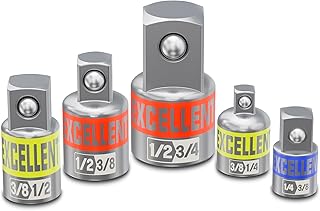
An adapter changes the connection between tools and sockets. It does not change the fundamental construction or intended application of the socket. Check the complete accessory chain before using powered impact equipment.
If the nut sits on a long threaded stud, a standard socket may bottom out before reaching the fastener. A deep socket can be the correct solution.
Mixed sets can be excellent for varied workshop use, but they can also increase cost and storage requirements without solving a real problem. Prioritise the fastener standards used in your own equipment.
Before purchasing, check your current ratchets, extensions and torque wrenches. Standardising around one drive size for a particular category of work can make a collection easier to manage.
This is one of the more important distinctions to make. Impact tools subject accessories to repeated shock loading, so use sockets specifically identified by the manufacturer as suitable for impact applications.
For vehicle maintenance, a useful socket collection should provide more than simply a large number of sizes. Access, depth, drive size and impact compatibility can all matter depending on the job.
A 1/2-inch impact socket set can be appropriate for heavier fasteners when used with a compatible impact wrench. A 3/8-inch collection is often more convenient for general mechanical work where access and moderate torque are more important. Smaller 1/4-inch sockets can complement these for lighter and more confined tasks.
For automotive buyers, consider building a system rather than searching for one box that supposedly does everything. A practical collection may eventually consist of a general-purpose ratchet set, a selection of deep sockets and a dedicated impact set.
DIY users rarely need every socket size available. The better strategy is to identify the work you are likely to perform and select the smallest set that covers those requirements with room for sensible expansion.
A compact set is easier to store, easier to carry and quicker to inspect. A larger mechanics set becomes more attractive if you regularly repair vehicles, maintain machinery or work on a broad range of fasteners.
Do not overlook ergonomics. A low-profile ratchet head, a small arc swing and easy-to-read socket markings can make a noticeable difference when working in confined areas, even if those specifications have little influence on the headline piece count.
When a fastener must be tightened to a specified torque, the socket is only one part of the system. The torque wrench, drive size, socket fit and manufacturer's tightening procedure all need to be appropriate for the application.
Use the correct socket size rather than selecting a near match. Avoid forcing a metric socket onto an imperial fastener or vice versa simply because the dimensions appear close. A seemingly small mismatch can increase the likelihood of damaging the fastener.
For safety-critical vehicle or machinery components, always follow the equipment manufacturer's specified torque and installation procedure rather than relying on a generic socket-set guide.
Quality sockets require relatively little maintenance, but sensible care can extend their useful life and make problems easier to spot.
Remove dirt, grease and metal debris after demanding jobs. Contamination inside a socket can interfere with proper seating on the fastener.
Look for cracks, deformation, excessive wear or damaged drive openings. Do not continue using a socket that has developed obvious structural damage.
Returning each socket to its designated position makes missing tools immediately apparent and reduces the temptation to substitute an incorrect size.
A ratchet is not automatically a substitute for a breaker bar. If a fastener requires excessive force, use an appropriate tool rather than extending a ratchet handle with an improvised lever.
Keep impact-rated accessories with the impact tools and conventional hand sockets with the hand-tool collection. Clear separation reduces the chance of selecting an inappropriate accessory in a hurry.
DEWALT socket products are sold under specific catalogue numbers such as DWMT72162, DWMT74739, DWMT74737 and DT7506-QZ. These identifiers are useful when comparing retailers because product names can be shortened, translated or displayed differently.
When two listings appear almost identical, compare the catalogue number, drive size, number of pieces and included socket sizes. This is a much safer approach than assuming similar packaging means identical contents.
Warranty terms should be checked for the exact product rather than assumed from the brand name. DEWALT's UK website publishes product-specific warranty information, and its current socket product pages can show different warranty statements. For example, several hand-tool socket sets state a one-year limited warranty, while some Extreme Impact products currently display no limited warranty.
This is an important reason to check the exact model number before purchase. Do not assume that every DEWALT accessory has the same warranty coverage as a DEWALT power tool.
Whether a DEWALT socket set represents good value depends on what you need from it. The brand offers a broad range covering compact hand-tool sets, full metric collections, combination metric and imperial sets, deep impact sockets and larger mechanics kits.
The strongest reason to choose a particular set is therefore not the DEWALT name alone. Look at the specification of the individual product: socket sizes, drive size, construction, ratchet mechanism, intended application and storage arrangement.
For occasional DIY use, a smaller set containing the most relevant sizes can be the sensible choice. For professional mechanical work, broader coverage and dedicated impact equipment may justify a larger investment. The best option is the one that matches the fasteners and tools you actually use.
If you are comparing several DEWALT options and need a quick shortlist of the specifications that matter most, prioritise the following.
There is no single best DEWALT socket set for every buyer. The right choice depends on drive size, socket range, metric or imperial requirements, intended use and whether you need impact compatibility. DEWALT currently offers multiple socket families rather than one universal set.
DEWALT offers socket products designed for mechanical and impact applications, including 1/2-inch sets and deep impact sockets. The appropriate model depends on the type of automotive work and the tools being used.
Products explicitly identified by DEWALT as impact sockets are designed for impact applications. Always verify the exact product specification rather than assuming every DEWALT socket can be used with an impact wrench. DEWALT's Extreme Impact range, for example, is specifically described for use with impact drivers and wrenches.
Choose the drive size according to the fasteners and tools you use. A 1/4-inch set suits smaller work, 3/8-inch is a versatile general-purpose choice and 1/2-inch is more appropriate for many larger and higher-torque applications. The actual socket-size range is just as important as the drive size.
Choose metric if the majority of your equipment uses metric fasteners. Choose a combination set if you genuinely work with both metric and imperial fasteners. Do not select a mixed set solely because its piece count is higher.
Neither is universally better. Deep sockets are useful when the nut is positioned further down a stud or inside a recessed area. Standard sockets are often more compact and can be preferable where additional depth is unnecessary.
Not necessarily. Compare the actual sizes, drive types and accessories included. A smaller set containing the sizes you use frequently can be more useful than a large collection containing many rarely used pieces.
DEWALT describes DirectTorque technology as providing greater contact with the flat surfaces of fasteners, helping reduce rounding and extend fastener life.
Check the exact catalogue number, drive size, number of pieces, individual socket sizes, metric or imperial coverage, standard or deep configuration, impact compatibility, included ratchet and current warranty statement. Product names can look similar even when the contents differ.
Keep them organised in their supplied case or another suitable storage system, with sizes clearly separated. Good organisation makes it easier to identify missing tools and prevents unnecessary searching during a job.
Before choosing a DEWALT socket set, work through this checklist rather than buying solely on brand recognition or piece count.
The most suitable DEWALT socket set is ultimately the one that gives you the right combination of sizes, drive compatibility, construction and access for the work you actually perform. A carefully selected smaller set can outperform a much larger collection in day-to-day usefulness, while demanding automotive and workshop applications may justify dedicated deep and impact socket ranges.