

♥ Wishlist
Compare 54 verified DeWalt Batteries & Chargers products in United Kingdom. Reviews, ratings, pros, cons and buying advice updated for October 2026.


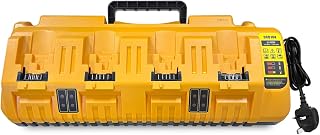


Choosing the right DeWalt battery or charger is about more than selecting the largest capacity or the most powerful-looking specification. The correct combination depends on the DeWalt cordless platform you own, the tool being powered, how intensively it is used, the balance between runtime and weight, and whether you need a single replacement battery or a complete charging setup.
For buyers comparing DeWalt batteries and chargers in the UK, compatibility should always be the first consideration. A battery that appears suitable because it has a similar voltage or capacity may not necessarily be appropriate for a particular tool. DeWalt has produced several cordless battery platforms and generations, so checking the exact tool and battery designation is more reliable than judging compatibility from appearance alone.
It is also worth separating battery capacity from power output. Capacity, normally expressed in amp-hours (Ah), is primarily an indication of how much electrical energy the battery can store. It should not be treated as a simple measurement of how powerful a cordless tool will be. The tool, battery technology, current delivery capability and electronic management system all contribute to real-world performance.
Before comparing prices, ratings or claimed runtime, identify the battery family required by your tool. This is particularly important if you are replacing an older battery or expanding an existing DeWalt cordless collection.
Look at the identification information printed on the tool, existing battery and charger. The model number is more useful than relying on colour, shape or connector appearance. If you are buying a replacement, compare the complete battery designation rather than searching only for a voltage figure.
Battery capacity is one of the most visible specifications when comparing cordless power-tool batteries. A higher Ah rating generally means a greater energy reserve, although actual runtime varies according to the tool, workload, material, temperature, battery condition and operating conditions.
A compact battery can therefore be the better choice for drilling, screwdriving or overhead work where low weight and manoeuvrability are more important than maximum runtime. A higher-capacity battery may make more sense for demanding cutting, grinding, sanding, outdoor equipment or other applications where frequent battery changes would interrupt the job.
There is an important trade-off: a larger battery normally adds weight and physical bulk. That can alter the balance of a tool considerably. A battery that provides excellent runtime on a bench or ground-based application may feel unnecessarily cumbersome on a drill used at shoulder height.
There is no universally best DeWalt battery size. The most appropriate capacity depends on the task.
For tradespeople, installers and regular DIY users, owning batteries of different capacities can be more useful than buying several batteries of exactly the same size. A compact battery can be reserved for lightweight tools, while a larger pack can be used where sustained runtime is more important.
DeWalt XR is a prominent cordless tool range, and the XR designation appears across a wide selection of tools and batteries. However, buyers should avoid treating the XR name as a complete specification in itself. The battery's exact model, voltage, capacity, physical design and compatibility remain important.
When comparing DeWalt XR batteries, consider the complete specification rather than assuming that a higher Ah figure automatically makes one battery better in every application. The best choice is the one that provides an appropriate combination of energy capacity, size, weight and current-delivery capability for the tool.
For users already invested in the DeWalt XR ecosystem, staying within the appropriate battery family can simplify ownership because multiple compatible tools may be operated from the same battery platform. Nevertheless, compatibility should be checked for each tool rather than assumed across the entire DeWalt range.
The XR designation alone does not tell you how long a battery will run a particular tool. Runtime depends on variables such as motor demand, trigger usage, material resistance, cutting or drilling conditions, temperature and the age and condition of the battery.
For this reason, a sensible buying guide should avoid promising a fixed number of minutes or hours unless that figure is specifically supplied for the exact tool and operating conditions. Manufacturer runtime claims and retailer descriptions should be treated as application-dependent rather than universal guarantees.
Voltage is a fundamental compatibility consideration. DeWalt cordless tools are designed around particular battery platforms, and the battery voltage must correspond to the requirements of the tool.
Buyers should not attempt to select a battery by choosing the highest available voltage. A higher-voltage battery is not automatically an upgrade for a lower-voltage tool. The correct battery is the one designed for the relevant platform and specified for the tool.
Voltage and Ah also describe different characteristics. Voltage relates to the electrical potential of the battery system, while Ah describes charge capacity. Comparing Ah figures across different voltage platforms without considering the complete electrical system can therefore be misleading.
Battery specifications can sometimes be presented in ways that make direct comparisons confusing. When comparing products, use the manufacturer's stated platform and model information rather than trying to infer compatibility from an isolated numerical specification.
This is particularly important when purchasing replacement batteries from third-party sellers. A product title may contain several familiar DeWalt terms, but the actual compatibility, construction and intended application still need to be verified.
Modern DeWalt cordless power-tool batteries predominantly use lithium-ion technology. Lithium-ion batteries are widely used in cordless tools because they can provide a useful combination of energy density, weight and power delivery.
However, lithium-ion batteries require appropriate electronic management. Temperature, charging conditions, discharge behaviour and battery health all matter. Built-in battery management systems help monitor operating conditions and protect the pack and tool system within their designed parameters.
Buyers should therefore avoid treating a cordless battery as a simple collection of cells. The electronic components, cell arrangement, casing, terminals, thermal management and protection circuitry all form part of the battery system.
Two batteries with identical printed specifications can behave differently if one has been heavily used and the other is relatively new. Battery ageing can affect available capacity and performance, while storage conditions and charging history can also influence long-term condition.
A battery that appears to charge normally may not necessarily provide the same usable runtime it delivered when new. For replacement purchases, consider the age and condition of your existing batteries rather than assuming that a charger or different tool will compensate for an ageing pack.
The charger deserves just as much attention as the battery. A high-quality battery paired with an unsuitable or inconvenient charging arrangement can be frustrating, particularly for users who depend on cordless tools throughout the working day.
When comparing DeWalt chargers, consider compatibility, charging speed, the number of batteries you need to charge, portability, workspace requirements and whether you need a basic single-battery solution or a more productive multi-battery setup.
A conventional single-battery charger can be entirely adequate for occasional DIY use. If a battery is normally charged overnight or between infrequent jobs, paying more for advanced charging arrangements may offer little practical benefit.
For professional users, however, charging speed and battery turnover can become much more important. When several cordless tools are used throughout the day, the ability to rotate batteries efficiently can reduce downtime.
Fast charging can be valuable where batteries are repeatedly discharged and returned to service during the same working period. However, charging speed should not be considered in isolation.
A fast charger may be unnecessary for a homeowner with several batteries who normally charges them overnight. Conversely, it can be an important productivity consideration for a professional relying on cordless equipment for extended periods.
Users with larger cordless tool collections may benefit from a charging setup that accommodates multiple batteries. The important distinction is whether the charger charges batteries simultaneously or manages them sequentially, depending on the particular model.
Do not assume that a charger with several battery positions will necessarily charge every battery at the same time. Check the manufacturer's description and operating instructions for the specific charger.
Drills are often used in situations where weight and balance matter. A compact battery can make a drill easier to hold, especially when working overhead, on ladders or in awkward positions.
If the drill is being used for prolonged heavy drilling, a larger capacity may be preferable. The decision should therefore reflect the typical task rather than the maximum specification available.
Impact drivers can benefit from a compact, well-balanced battery because the tool is frequently used for repetitive fastening. A larger battery may be worthwhile for intensive work, but excessive battery size can reduce the handling advantage of a compact impact driver.
Circular saws can place considerably greater demands on a battery than light-duty screwdriving. Users making repeated cuts may therefore prioritise energy capacity and sustained performance over minimum weight.
The material being cut also matters. Dense timber, sheet materials and repeated deep cuts can impose different demands from occasional light cutting. For demanding applications, consider the complete tool-and-battery combination rather than evaluating the battery independently.
Grinding and cutting applications can consume substantial battery energy. A higher-capacity battery may reduce interruptions, but the resulting weight can also become noticeable during handheld work.
If portability and frequent repositioning are important, several appropriately sized batteries can sometimes provide a better working arrangement than one exceptionally large battery.
Battery-powered garden equipment such as blowers, trimmers and chainsaws can have very different energy requirements. A blower may be used intermittently, whereas sustained cutting can place a greater demand on the battery.
For garden tools, consider not only Ah but also temperature, seasonal storage, the length of each working session and how many batteries are available for rotation.
Battery weight is often overlooked in online comparisons because specifications tend to focus on voltage and capacity. In actual use, however, the battery can materially affect how a cordless tool feels.
A heavier pack positioned at the base or rear of a tool changes its centre of gravity. That may be unimportant for short bench work but tiring during repetitive overhead tasks.
For professional users, this is an ergonomic consideration rather than simply a comfort preference. Reduced fatigue can be particularly valuable when a tool is used repeatedly throughout a working day.
Battery runtime is one of the most frequently searched buying factors, but it is also one of the easiest specifications to misunderstand. There is no single runtime figure that applies to every DeWalt tool.
The same battery can deliver very different results in a drill, saw, grinder or garden tool because each application places a different load on the motor. Even within the same tool category, workload and operator behaviour can significantly change energy consumption.
For meaningful comparisons, ask:
These questions are generally more useful than simply choosing the battery with the highest Ah rating.
Temperature can influence lithium-ion battery behaviour. Very cold or very hot conditions can affect charging and operation, which is one reason appropriate storage and charging practices matter.
Users working outdoors in the UK should be particularly aware of seasonal conditions. A battery stored in an unheated vehicle, shed or garage may be exposed to substantially different temperatures from a battery kept in a controlled indoor environment.
Follow the manufacturer's charging, storage and temperature guidance for the specific battery. Do not attempt to force a battery into operation or charging when its condition is outside the manufacturer's specified operating range.
Good storage habits can help protect cordless batteries between jobs. Batteries should be kept in accordance with the manufacturer's instructions and protected from excessive heat, moisture and physical damage.
Do not leave a battery in a location where tools, metal objects or loose equipment can accidentally contact its terminals. Proper storage is particularly important when several batteries are kept together.
Lithium-ion batteries contain significant stored energy and should be treated as electrical components rather than ordinary disposable batteries. Damage to a pack, its casing or terminals can create safety concerns.
Do not use a battery if it is visibly damaged, swollen, cracked, leaking, unusually hot or otherwise behaving abnormally. Do not attempt to dismantle a battery pack or replace internal cells unless you are appropriately qualified to do so and the procedure is specifically supported by the manufacturer.
Use the charger intended for the battery system and follow the manufacturer's instructions. Avoid improvised charging arrangements or attempting to modify battery connectors.
If a battery shows signs of damage or abnormal behaviour, stop using it and follow the manufacturer's safety and disposal guidance.
Price is an important consideration when shopping for replacement batteries, but unusually cheap battery listings deserve closer examination. A battery is not simply a casing containing rechargeable cells; construction quality, cell selection, electronic protection and manufacturing consistency all matter.
When comparing genuine DeWalt batteries with third-party alternatives, check exactly what is being offered and who is responsible for the product. Marketplace listings can use familiar brand terminology in titles, making it particularly important to read the manufacturer's identity and compatibility information.
Do not assume that a battery is genuine simply because the listing contains the DeWalt name or product photographs. Buyers should use reputable retailers and verify the exact product designation where authenticity matters.
A larger capacity is not automatically better. The additional weight and size may make a tool less comfortable, particularly during repetitive overhead work.
The cheapest battery may not represent the best value if its compatibility, authenticity, durability or support arrangements are uncertain. Compare the complete proposition rather than the headline price.
A battery collection is only as useful as the charging arrangement supporting it. Consider how quickly batteries need to be returned to service and how many packs need charging during a typical working period.
DeWalt has multiple cordless platforms and battery specifications. Always verify compatibility for the exact tool and battery rather than assuming that brand ownership guarantees interchangeability.
A high-capacity battery can add unnecessary bulk to a compact drill or impact driver. If the task is short and the tool is frequently handled at awkward angles, a smaller pack may be the more sensible option.
If buying used or older stock, battery age and condition deserve attention. Storage history and previous usage can affect the remaining useful life of a rechargeable battery.
Price comparisons should be made using equivalent products. A larger-capacity battery, multi-pack or fast charger should not be compared directly with a basic single-battery product simply because both appear in the same search results.
Compare the exact model number, capacity, voltage platform, pack quantity and charger type. Also check whether a product is being sold as a battery only, charger only, twin pack, starter kit or complete kit.
Retail prices can change, so buyers should check current prices at trusted UK retailers before purchasing. Promotions and bundle offers can also alter the relative value of individual batteries and chargers.
If you are new to a DeWalt cordless platform, a kit containing a tool, battery and charger may sometimes be more economical than purchasing every component separately. Existing DeWalt users, by contrast, may already have suitable chargers and therefore need only an additional battery.
Always calculate the actual components included before comparing two offers. A lower headline price may reflect a smaller battery, fewer batteries, the absence of a charger or a different tool specification.
For occasional DIY users, simplicity is often more important than maximum specification. A sensible battery setup should cover the tools you actually use without creating unnecessary cost or weight.
If the majority of your work involves drilling, screwdriving and small household repairs, a compact or mid-capacity battery may provide a practical balance. If you regularly undertake heavier renovation work, cutting, sanding or outdoor projects, additional capacity can become more valuable.
Professional users should think in terms of a battery system rather than an individual battery. The most useful setup may include several capacities so that the right pack can be matched to the right tool.
Consider how many tools are used simultaneously, how frequently batteries are depleted, whether mains electricity is readily available, and whether charging can take place during breaks or overnight.
For a professional, battery rotation can be more important than maximising the capacity of every individual pack. Several appropriately selected batteries can allow one pack to charge while another is working.
A useful specification comparison should include more than Ah. When assessing a battery, look for the complete set of information available for the exact model.
The best combination is one that matches the tool, workload and working routine. A good setup should provide adequate runtime without making the tool unnecessarily heavy, while the charger should fit the pace at which batteries are consumed.
For occasional use, a straightforward battery and charger combination may be preferable. For intensive professional work, investing in a broader battery rotation and a suitable charging strategy can be more useful than spending the entire budget on the largest individual battery.
Regular inspection is one of the simplest ways to maintain a cordless battery collection. Before use, look for obvious physical damage and check that the contacts and casing appear normal.
Keep batteries clean and dry, but avoid introducing liquids into the battery housing. If dirt accumulates around connection points, follow the manufacturer's cleaning instructions rather than using aggressive chemicals or improvised tools.
Chargers should also be kept free from excessive dust and moisture. Good ventilation around charging equipment is important, and chargers should be used according to their instructions rather than covered or placed in unsuitable enclosed spaces.
A charger does not necessarily need replacing simply because it is old. If it remains compatible, operates normally and is free from damage, it may continue to be useful. However, abnormal charging behaviour, visible damage or repeated charging errors should not be ignored.
If a battery consistently fails to charge correctly, do not immediately assume that the charger is defective. The battery itself may be the cause. Testing the system with known-compatible equipment, where appropriate, can help identify whether the issue is the battery, charger or tool.
Buying batteries strategically can reduce unnecessary expenditure. Before adding another battery, review the capacities you already own and identify where the gaps are.
For example, a collection consisting entirely of large batteries may be poorly suited to compact installation tools. Conversely, a collection of only small batteries may lead to frequent charging during demanding cutting or outdoor work.
A mixed-capacity collection can therefore provide greater flexibility. The goal is not to own the biggest battery available, but to have suitable energy capacity for the range of tools and tasks you actually perform.
DeWalt is part of a highly competitive cordless power-tool market that also includes brands such as Makita, Bosch Professional, Milwaukee and Ryobi. Cross-brand comparisons should focus on the complete cordless ecosystem rather than comparing a single battery in isolation.
Battery platforms are generally designed around their own tool ecosystems, so switching brands can mean purchasing additional batteries and chargers. This makes the long-term cost of ownership an important part of a commercial comparison.
If you already own several compatible DeWalt tools, expanding that system may be more convenient than starting a second battery platform. If you are buying your first cordless tools, compare the wider ecosystem, including tool selection, battery choices, chargers and the types of equipment you expect to purchase later.
When building a cordless collection, think ahead. Buying a single tool may appear inexpensive, but the battery and charger ecosystem can become a significant part of future expenditure.
If you expect to add several tools over time, consider which DeWalt platform best fits those future applications before buying additional batteries. Once you own compatible batteries and chargers, expanding within the same ecosystem can simplify charging and reduce duplication.
At the same time, avoid buying batteries for tools you do not expect to own. Battery technology develops over time, and unnecessary stock can tie up money while providing little practical benefit.
The best DeWalt battery depends on the tool and workload. A compact battery can be preferable when low weight and manoeuvrability are important, while a higher-capacity battery can be more appropriate for demanding work where longer runtime matters.
No. A higher Ah rating generally provides greater energy capacity, but it can also increase battery size and weight. The ideal capacity depends on the application, tool balance and desired runtime.
No. DeWalt has different cordless platforms and specifications. Always confirm compatibility between the exact battery and tool models before use.
Not necessarily. Battery capacity and tool output are related but are not the same specification. A larger-capacity battery primarily provides more stored energy, while actual tool performance depends on the complete tool, battery and electronic system.
It depends on your working pattern. A fast charger can be valuable when batteries need to be returned to service quickly, but occasional DIY users who charge batteries between jobs may have little practical need for the fastest charging option.
There is no universal number. Occasional users may need only one or two batteries, whereas professional users may benefit from several packs so that tools can remain in use while other batteries are charging.
Not necessarily. A mixture of compact and higher-capacity batteries can be more versatile because different tools benefit from different weight and runtime characteristics.
Follow the charging and storage instructions supplied by DeWalt for the specific battery and charger. Do not rely on generic assumptions about lithium-ion batteries when the manufacturer's instructions are available.
Store them in accordance with the manufacturer's instructions, away from excessive heat, moisture and physical damage. Protect battery terminals from accidental contact with conductive objects.
Do not continue using a battery that is visibly damaged, swollen, cracked or behaving abnormally. Follow the manufacturer's safety guidance and appropriate local battery recycling or disposal requirements.
Compatibility claims should be treated carefully. Buyers should assess authenticity, construction quality, safety features, exact specifications and seller credibility rather than choosing solely on price.
It depends on the job. For prolonged heavy-duty work, additional capacity may be valuable. For repetitive overhead or precision work, reducing battery weight can make the tool easier to handle.
The strongest buying decision is rarely based on one specification. Start with compatibility, then consider capacity, weight, workload, charging requirements and the number of batteries needed for your routine.
For light-duty work, prioritise a compact and well-balanced setup. For demanding applications, consider higher-capacity batteries and a charging arrangement that supports continuous use. If you are already invested in the DeWalt cordless ecosystem, compare the exact battery models available for your tools before introducing another platform.
When comparing products, verify specifications with current manufacturer information and check the exact model number rather than relying on generic descriptions. Read verified customer feedback for indications of common ownership issues, but distinguish individual experiences from manufacturer specifications and safety information.
Finally, remember that the most expensive DeWalt battery is not automatically the best choice. The right battery is the one that fits your tool, your working conditions and your priorities without adding unnecessary weight, cost or complexity.