

♥ Wishlist
Compare 39 verified Dewalt Reciprocating Blades products in United Kingdom. Reviews, ratings, pros, cons and buying advice updated for October 2026.

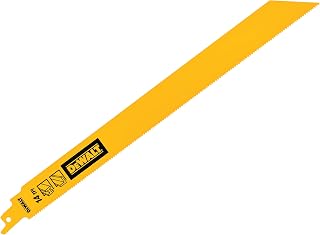





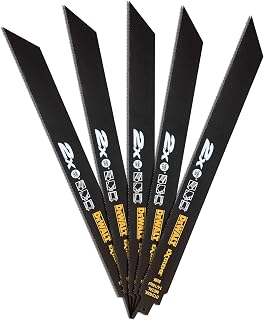


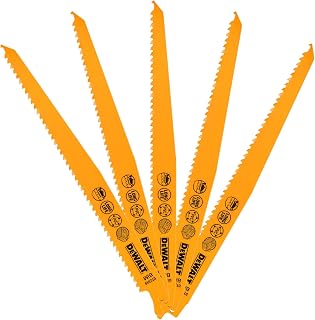


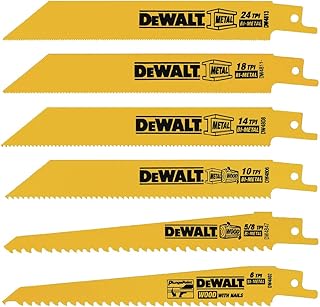

Choosing a DEWALT reciprocating saw blade is less about finding one universally “best” blade and more about matching the blade to the material, thickness, cutting conditions and finish you need. A blade designed for clean timber can behave very differently from one intended for nail-embedded demolition timber, structural steel, thin sheet metal or mixed materials.
DEWALT's UK range includes bi-metal reciprocating blades in different lengths and tooth configurations, along with specialist options for demolition, wood, metal and general-purpose applications. Current manufacturer specifications include examples such as 152mm 6 TPI wood blades, 152mm 14 TPI metal blades, 152mm 18 TPI metal blades, 203mm and 228mm options, and longer 305mm blades for applications where additional reach is useful.
The most useful way to compare reciprocating blades is by application rather than simply by blade length or pack size. Start by identifying what you are cutting, then select the tooth count, blade construction and length that suit the job.
Wood blades generally use a relatively low tooth count so the teeth can remove material quickly and clear chips from the cut. They are particularly useful for timber, branches, boards, studs and other wood-cutting applications where speed matters more than achieving a fine finish.
For example, DEWALT lists 152mm 6 TPI and 228mm 6 TPI bi-metal wood blades in its current range. The lower tooth count makes this type of blade better suited to aggressive material removal than a fine-tooth metal blade.
Demolition work is harder on a blade because the material can change from soft timber to nails, screws, brackets and other embedded material within seconds. A conventional wood blade may therefore be the wrong choice when you cannot guarantee that the timber is free from metal.
DEWALT's Extreme DT2300L-QZ, for example, is specified as a 152mm 6 TPI bi-metal blade for demolition work involving wood and nails. DEWALT describes its construction as a high-carbon-steel body combined with high-speed-steel teeth, with tooth geometry and a heat-resistant coating intended to support demanding cutting conditions.
For renovation and strip-out work, this category is often more useful than a dedicated timber blade because the blade needs to tolerate unpredictable materials rather than simply cut clean wood as quickly as possible.
Metal-cutting blades normally use a higher tooth count than aggressive timber blades. The closer tooth spacing provides more controlled engagement with metal and is particularly important when cutting thinner sections, tubing, conduit and sheet material.
DEWALT currently lists 152mm metal blades in 14 TPI, 18 TPI and 24 TPI configurations, illustrating why “metal blade” alone is not enough information when comparing products.
A 14 TPI blade can be a useful choice when you want a balance between cutting speed and control, whereas a finer 18 or 24 TPI pattern can be more appropriate where the material is thinner and tooth engagement needs to be more controlled.
General-purpose blades are designed for situations where changing blades repeatedly is inconvenient or where the exact material is not known in advance. They can be useful for maintenance, renovation and general site work, but they should not automatically be treated as the best option for every material.
DEWALT's Extreme range includes a 28mm 10 TPI general-purpose bi-metal reciprocating blade, while mixed blade sets can combine different blade types for wood, metal and other common applications.
TPI means teeth per inch. It is one of the most important specifications to understand when comparing reciprocating blades.
TPI should never be considered in isolation. Blade thickness, tooth geometry, material type, cutting speed and the thickness of the workpiece all affect performance.
Blade length is another specification that can easily be misunderstood. A longer blade does not automatically mean a better blade.
A short blade can be easier to control in confined spaces and may reduce unnecessary flex. A longer blade provides greater reach and can be useful when cutting through thicker sections or when access requires the blade to project further from the saw.
DEWALT's current reciprocating blade range includes lengths such as 152mm, 203mm, 228mm and 305mm, depending on the application.
Short blades are worth considering when access and control are more important than maximum reach. They can be particularly useful for pipework, metalwork, trimming and cuts in restricted spaces.
Medium-length blades are often the most versatile option for general building, maintenance and renovation work. They provide a useful compromise between reach, rigidity and manoeuvrability.
Long blades become useful when the workpiece is large, the cut is deep or additional reach is required. DEWALT offers 305mm options for both wood and metal applications, but a long blade should only be selected when its additional reach genuinely benefits the task.
Bi-metal construction combines two types of steel so that different parts of the blade can provide different properties. DEWALT describes its bi-metal reciprocating blades as combining a high-carbon-steel body with high-speed-steel cutting teeth.
The underlying idea is practical: the blade body needs flexibility and toughness, while the cutting edge needs to retain its hardness and cutting ability. This makes bi-metal blades particularly relevant when a blade needs to cope with vibration, repeated flexing and demanding cutting conditions.
For buyers, “bi-metal” should therefore be treated as an important construction characteristic rather than a guarantee that every bi-metal blade will perform identically. Tooth geometry, steel formulation, blade thickness, coating and intended application still matter.
Two blades with the same TPI can behave differently because their teeth are not necessarily shaped or arranged in the same way. Tooth geometry influences how aggressively the blade enters the workpiece, how material is removed and how easily chips clear from the cut.
DEWALT highlights optimised tooth geometry on its Extreme reciprocating blades and describes aggressive tooth geometry on selected 2X Long Life blades.
This is one reason it is risky to compare blades using TPI alone. When choosing between two apparently similar options, check the manufacturer's intended application and the complete specification rather than assuming that the blade with the highest or lowest TPI must be superior.
Blade thickness affects rigidity, durability and the way the blade behaves under load. A thicker blade can provide greater resistance to bending and can be advantageous for demanding cuts, but it may not be the ideal choice for every application.
A blade that is unnecessarily heavy or rigid can be less convenient where precision, access or a narrow kerf is more important. Conversely, a very flexible blade can be difficult to control when making a demanding straight cut.
When comparing professional reciprocating blades, consider thickness alongside length and application. DEWALT's 16-piece bi-metal set, for example, highlights a tall, thick blade profile for straight cuts in heavy metal applications and durability in demanding demolition work.
Heat is an important consideration during prolonged cutting, particularly in metal. Excessive friction can accelerate wear and make a blade less effective.
Selected DEWALT blades use coatings intended to reduce friction or manage heat. DEWALT describes an anti-stick coating on its 2X Long Life wood and metal blades, while its Extreme blades use a heat-resistant “Tough Coat” intended to help prevent heat build-up.
These features should be viewed as part of the overall blade design rather than a substitute for choosing the correct blade, cutting technique and material-specific TPI.
A useful starting point is to match tooth density to the thickness and hardness of the material rather than choosing a blade simply because it is labelled “heavy duty”.
These are starting principles, not universal rules. Always check the manufacturer's application guidance for the specific blade.
A multi-piece set can make sense if your work regularly involves several materials. Instead of buying several dedicated packs immediately, a mixed set can provide a practical selection for wood, metal and demolition applications.
DEWALT currently offers mixed reciprocating blade sets, including 12-piece Extreme and 16-piece bi-metal sets. Retail listings also show mixed DEWALT sets containing blades for ferrous and non-ferrous metal, sheet metal, pipework, wood, wood with nails, aluminium, fibreglass and tough plastics.
A dedicated pack can be better value for a trade that repeatedly performs the same operation. For example, someone regularly cutting metal pipe may get more practical value from a consistent metal-blade pack than from a mixed assortment containing several blade types they rarely use.
Occasional DIY users should resist the temptation to buy the most aggressive or expensive blade available simply because it appears more professional.
Instead, identify the jobs you are realistically going to perform. For occasional timber cutting, a suitable wood blade may be all that is required. For renovation projects involving old timber, nails and unknown materials, a demolition-oriented blade can be a more sensible choice.
If your projects cover several materials, a mixed set can reduce the need to predict every future job and gives you the flexibility to select an appropriate blade when the material changes.
Professional users should place greater emphasis on productivity, consistency and application-specific performance. A blade that costs less per pack is not necessarily the cheaper option if it requires more frequent replacement or slows down the work.
For frequent site use, it can be sensible to maintain separate blade groups for timber, demolition and metal rather than relying on one general-purpose blade for everything. This also makes it easier to choose the correct TPI and blade length before starting a job.
Plumbers, electricians, builders, maintenance engineers and demolition teams can all have different requirements despite using the same basic reciprocating saw format. The correct blade is therefore determined by the work rather than by the occupation alone.
DEWALT is not the only established manufacturer worth considering. Depending on the application, buyers may also encounter reciprocating blades from Bosch, Makita, Milwaukee, Bahco and IRWIN.
The sensible approach is not to assume that one brand wins every category. Compare the individual blade specification, application, tooth pattern, construction, length and pack contents.
DEWALT offers a broad selection covering wood, metal, demolition, general-purpose and mixed-blade applications. Its range includes conventional bi-metal products alongside Extreme and longer-life-oriented options.
Bosch is another major power-tool accessory manufacturer with a wide selection of reciprocating saw blades. When comparing Bosch against DEWALT, concentrate on the individual blade's intended material and specifications rather than comparing brand names alone.
Makita is also well established in power-tool accessories. Its reciprocating blade selection can be relevant when a user already has Makita tools or wants to compare application-specific blade options across manufacturers.
Milwaukee offers reciprocating saw blades aimed at professional and heavy-duty applications. When comparing Milwaukee and DEWALT, examine tooth geometry, blade thickness, material suitability and stated application rather than relying on “heavy duty” branding.
Bahco is particularly relevant when comparing cutting accessories from manufacturers with a strong heritage in saw and cutting products. Its blades can be worth considering when the application calls for a particular metal-cutting or professional cutting configuration.
IRWIN is another recognised accessory brand with reciprocating blade options. It can be useful as a comparison point when assessing tooth configurations, blade lengths and pack sizes.
Most reciprocating saw blades use a common shank format, but buyers should still verify compatibility with their particular saw and follow the tool manufacturer's instructions.
Compatibility is more than whether the blade can be inserted into the tool. Safe and effective operation also depends on using the blade for an appropriate material and application.
The cheapest pack is not necessarily the best value. A blade that wears quickly or is poorly suited to the material can increase replacement frequency and reduce productivity.
Longer does not automatically mean better. Excess blade projection can make control more difficult and may be unnecessary for shallow or confined cuts.
Buying a blade without considering tooth count is one of the easiest ways to end up with poor cutting performance. Material and thickness should influence TPI selection.
Old timber can contain hidden nails, screws and fixings. If the presence of metal is likely, select a blade designed for mixed or demolition conditions rather than treating the job as clean timber cutting.
General-purpose blades are convenient, but convenience comes with compromises. A dedicated metal blade can be preferable for repeated metal cutting, while a dedicated wood or demolition blade can be more appropriate for timber-heavy work.
A large set looks versatile, but unused blade types do not provide much value. Choose a mixed set when you genuinely expect to work across multiple materials.
The blade is only one part of the cutting system. Technique and setup can substantially affect how effectively the blade works.
There is no universal replacement interval because blade life depends heavily on material, cutting frequency, technique, tool settings and workload.
Replace a blade when its cutting performance has deteriorated significantly or when the blade has become damaged. Signs can include unusually slow cutting, excessive vibration, damaged teeth, visible distortion, excessive flex or a noticeable increase in the force required to make the cut.
Do not attempt to extend the life of a blade when its condition compromises safe operation. A consumable accessory is not worth continuing to use once it is visibly damaged or unsuitable for the task.
Reciprocating blades are consumables, but sensible storage can prevent unnecessary damage before they are used.
For a meaningful product comparison, use a consistent set of criteria rather than relying on star ratings or product names.
There is no single blade that is objectively best for every cutting task. The most appropriate choice changes according to the job.
For occasional DIY work, a premium blade is not automatically necessary. For frequent professional cutting, however, the economics can be different because durability, cutting speed and consistency can matter more than the initial cost of a pack.
DEWALT's higher-specification Extreme products incorporate features such as optimised tooth geometry, increased cobalt content in selected products, heat-resistant coatings and bi-metal construction.
The right question is therefore not “Is the most expensive blade worth it?” but “Will the additional specification solve a problem I regularly encounter?” If the answer is no, a simpler application-specific blade may be the more sensible purchase.
Metal cutting deserves particular attention because the wrong blade can quickly lose effectiveness.
First identify the material: mild steel, stainless steel, aluminium, conduit, pipe, sheet metal and other metals do not necessarily place identical demands on a blade. Then consider thickness and access before selecting TPI and blade length.
DEWALT's 152mm 14 TPI metal blade is specified for applications including rebar, angle iron, black pipe, conduit and cold-rolled steel, while its 18 TPI and 24 TPI products provide finer tooth configurations for other metal-cutting requirements.
For repeated metal work, it is worth keeping more than one TPI option available rather than trying to make one blade cover every thickness.
Demolition is one of the most demanding reciprocating-saw applications because the material is rarely uniform. A cut may move through timber, nails, screws, brackets and other debris without warning.
A demolition blade should therefore be selected for toughness and mixed-material capability rather than simply maximum cutting speed in clean wood. DEWALT's Extreme demolition blades are specifically positioned for wood-and-nail applications and use bi-metal construction.
For major strip-out work, having dedicated demolition blades available can be more practical than repeatedly damaging clean-wood blades against hidden fixings.
Pipe cutting often involves restricted access, so blade length and control can be as important as tooth count. A blade that is excessively long may be awkward where the saw has limited room to move.
For metal pipe, choose a blade designed for the appropriate metal and thickness. For plastic pipe, verify that the selected blade is specifically suitable for the material rather than assuming that a metal blade will provide the best result.
Maintenance jobs can involve an unpredictable mixture of materials. Conduit, brackets, timber, plastics and fixings may all appear on the same job.
This is where a small selection of application-specific blades can be more useful than a single “do everything” blade. A general-purpose blade can cover occasional mixed tasks, while dedicated metal and wood or demolition blades can be reserved for repeated specialist cuts.
Reciprocating saws can remove material rapidly and can generate substantial vibration and debris. Always follow the operating instructions supplied with the saw and blade, use appropriate personal protective equipment and make sure the workpiece is properly supported.
The best DEWALT reciprocating blade depends on what you are cutting. A low-TPI wood blade can be appropriate for fast timber cutting, a demolition blade is better suited to timber containing nails, and a higher-TPI metal blade is generally more appropriate for metal. There is no single blade that is best for every application.
6 TPI means the blade has six teeth per inch. It is a relatively open tooth pattern commonly associated with aggressive cutting applications such as timber and demolition work. DEWALT lists 6 TPI options for both wood and demolition wood-and-nails applications.
Not necessarily. Higher TPI is generally useful when you need closer tooth spacing and controlled cutting, particularly on thinner metal. Lower TPI can be preferable for fast material removal in timber and demolition. The correct TPI depends on the material and thickness.
Bi-metal construction is well suited to demanding reciprocating-saw work because it combines a tougher blade body with harder cutting teeth. DEWALT specifically offers bi-metal Extreme blades for demolition applications involving wood and nails.
You should not assume that a conventional wood blade is suitable for nail-embedded timber. Where nails or other metal fixings are expected, choose a blade specifically intended for demolition or mixed wood-and-metal cutting.
Select a blade long enough to make the required cut while maintaining sensible control. Shorter blades can be preferable in confined spaces, while longer blades are useful where greater reach or cutting depth is required.
No. A longer blade provides additional reach but can introduce more blade movement than necessary for a shallow cut. Choose length according to the work rather than assuming that the longest available blade offers the best performance.
The exact difference depends on the product. DEWALT's Extreme products can incorporate features such as optimised tooth geometry, bi-metal construction and heat-resistant coatings, with particular models designed for demolition or general-purpose applications.
A mixed set can be a practical choice if you regularly cut different materials. If almost all of your work involves one material, a dedicated pack may provide a more useful selection of blades for the jobs you actually perform.
Yes. Bosch, Makita, Milwaukee, Bahco and IRWIN all provide reciprocating saw accessories, but comparisons should be made at individual product level. Look at material suitability, TPI, length, construction, blade profile and intended application rather than choosing purely by brand reputation.
There is no fixed replacement schedule. Blade life varies according to material, workload, technique and cutting conditions. Replace a blade when it becomes damaged or its cutting performance has deteriorated enough to make continued use ineffective or unsafe.
DEWALT offers reciprocating blades specifically aimed at demanding applications, including demolition and heavy-duty cutting. Professional users should still select the individual blade according to material, thickness and workload rather than relying on the brand name alone.
The strongest way to choose a DEWALT reciprocating blade is to work backwards from the cut. Identify the material, determine its thickness, decide whether nails or mixed materials are present, then select the appropriate TPI, blade length and construction.
For clean timber, start with a suitable wood blade. For renovation and demolition where nails are likely, prioritise a dedicated demolition blade. For metal, pay particular attention to TPI and material thickness. For varied maintenance work, consider whether a general-purpose blade or mixed set will genuinely save time.
Before buying, compare the current manufacturer specification, pack contents and verified customer feedback, and check today's retailer pricing because availability and prices can change. A well-matched application-specific blade is usually a more useful purchase than simply choosing the longest, thickest or most expensive option.