

♥ Wishlist
Compare 53 verified Bosch Batteries & Chargers products in United Kingdom. Reviews, ratings, pros, cons and buying advice updated for October 2026.


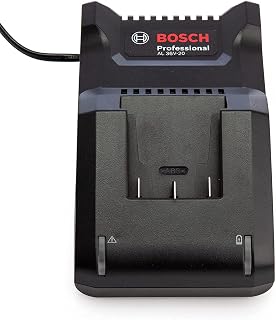


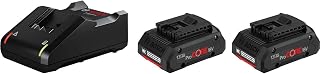


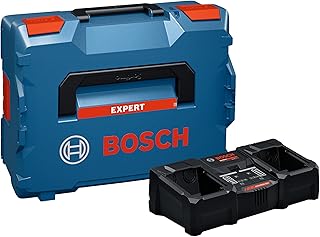


Choosing a Bosch battery is not simply a matter of selecting the highest Ah rating. The most important decision is identifying which Bosch battery platform your tool belongs to. Bosch has separate cordless ecosystems, including the Bosch Home & Garden 18V POWER FOR ALL system and the Bosch Professional 18V system. Their batteries may both be labelled 18V, but that does not make them interchangeable.
For buyers comparing Bosch batteries and chargers in the UK, this distinction should be checked before considering capacity, charging speed or price. Bosch states that its Professional 18V batteries and chargers are compatible across the Bosch Professional 18V System, while the POWER FOR ALL range is designed around Bosch Home & Garden 18V products and participating POWER FOR ALL partners.
The Bosch Home & Garden 18V POWER FOR ALL platform is aimed primarily at domestic DIY, home improvement and garden applications. Its 18V batteries are available in several capacities, allowing buyers to balance runtime against weight and cost. Bosch currently lists batteries including the PBA 18V 2.5Ah, PBA 18V 4.0Ah variants and PBA 18V 6.0Ah on its UK site, alongside compatible chargers such as the AL 1830 CV, AL 1880 CV and AL 18V-44.
The Bosch Professional 18V platform is designed for more demanding trade and professional applications. The range includes standard GBA batteries as well as higher-performance ProCORE18V batteries. Bosch currently lists ProCORE18V capacities including 4.0Ah, 5.5Ah, 8.0Ah and 12.0Ah, with its Professional 18V batteries using COOLPACK technology to help manage heat within the battery pack.
This distinction is one of the most important pieces of buying advice on any Bosch battery comparison. A buyer who owns a Bosch Professional drill should not assume that an 18V POWER FOR ALL battery is a suitable substitute simply because both products carry an 18V label.
Ah means ampere-hours and is a measure of battery capacity. In practical terms, a higher Ah rating generally provides more stored energy, although actual runtime depends heavily on the tool, workload, operating conditions and battery technology.
A larger battery is not automatically the best battery. On a compact drill, screwdriver or light garden tool, the additional weight of a high-capacity pack can make the tool less comfortable to use. Conversely, on a high-demand saw, grinder or other power-hungry Professional tool, a small battery may require more frequent charging.
Battery selection is fundamentally a compromise between energy capacity and portability. Bosch's current UK product listings illustrate the difference: the PBA 18V 2.5Ah W-B is listed at approximately 0.363kg, while the PBA 18V 6.0Ah W-C is approximately 0.667kg.
For overhead work, drilling at arm's length or using a tool continuously throughout a day, the lightest suitable battery can be more useful than the highest-capacity model. For bench work, flooring, construction or repeated cutting applications, the additional runtime of a larger pack may be worth the extra weight.
Heat is an important consideration when comparing rechargeable tool batteries. High electrical loads generate heat, and excessive heat can affect battery performance and longevity. Bosch Professional batteries use COOLPACK technology, which is intended to improve heat dissipation by directing heat away from the cells. Bosch also describes COOLPACK 2.0 technology on its newer ProCORE18V battery range.
This is particularly relevant when comparing batteries for demanding Professional tools. The useful question is not simply how many ampere-hours a battery contains, but how effectively the complete battery system manages heat and delivers power under load.
Two batteries with similar Ah ratings can behave differently depending on their cell configuration, thermal management, electronics and intended application. For commercial users, a battery's compatibility with high-output tools and the manufacturer's intended application can therefore matter as much as nominal capacity.
For domestic users, the calculation is usually simpler: choose the capacity that provides a sensible combination of runtime, weight and purchase cost for the tools already owned.
The charger should be considered alongside the battery rather than as a separate purchase. Charging current, supported battery platform, charging time, physical size and mounting options can all affect which charger makes sense.
The Bosch AL 1830 CV is an established charger for the Bosch Home & Garden 18V POWER FOR ALL ecosystem. Bosch lists a 3.0A charging current and support for 14.4–18V batteries. Its UK product listings also show it alongside several PBA 18V battery capacities.
It can make sense for buyers who want a straightforward charger without paying for a higher charging rate. Charging speed should nevertheless be assessed against the size of the battery being used: a charger that is perfectly adequate for a 2.5Ah battery may feel slow when regularly charging a much larger pack.
The AL 1880 CV is another Bosch Home & Garden charger designed for 14.4–18V batteries. Bosch's published charging information shows substantially shorter charging times than the AL 1830 CV for several compatible PBA 18V batteries, making it a more attractive choice where reducing time between jobs is important.
The Bosch AL 18V-44 is a useful option for owners of the Home & Garden 18V POWER FOR ALL platform who want faster charging. Bosch specifies a 4.4A charging current and states that a 4.0Ah battery takes approximately 59 minutes to reach full charge, while its listed charging time for a 2.0Ah battery is approximately 34 minutes. It also has an integrated wall-mounting facility and rubber feet.
For a typical household with several Bosch 18V tools, the AL 18V-44 can be particularly appealing when the charger is likely to remain in a workshop or utility area and needs to be used regularly.
The Bosch Professional GAL 18V-40 is intended for the Professional 18V System rather than the Home & Garden POWER FOR ALL platform. Bosch specifies a 4A charging current and states that it can charge a GBA 18V 4.0Ah battery to 80% in approximately 48 minutes and a GBA 18V 2.0Ah battery to 80% in approximately 24 minutes. Bosch also states that it is compatible with the AMPShare battery alliance.
The GAL 18V-40 is a sensible charger to consider where compactness matters. Bosch also provides a wall-mounting option, which can be useful in a workshop where bench space is limited.
The GAL 18V-160 C occupies a different category from basic compact chargers. Bosch specifies a maximum 16A charging current and describes it as its fastest 18V charger. With a compatible ProCORE18V 8.0Ah battery and Power Boost mode, Bosch states that the battery can reach 80% charge in approximately 32 minutes.
The charger also incorporates connectivity features and charging modes, while Bosch describes active air cooling and charging-status indicators.
This level of charging performance is primarily relevant to users who regularly operate several Professional cordless tools and cannot afford long interruptions between battery cycles. For occasional DIY use, a high-output Professional charger may offer little practical advantage if the battery is only charged once every few days.
Fast charging should not be judged solely by the charger's advertised current. The battery capacity, charger electronics, charging stage and manufacturer's specified charging conditions all influence the time required to reach a particular state of charge.
It is also important to distinguish between reaching 80% and achieving a full charge. Bosch's published figures for its Professional GAL 18V-40, for example, specify 80% charging times for particular battery capacities.
Compact 2.0Ah or 2.5Ah batteries can be attractive for general drilling and screwdriving because they keep the tool relatively light. A 4.0Ah battery becomes more appealing when the tool is used for extended periods or when frequent battery changes are inconvenient.
For applications involving repeated fastening or higher loads, a larger-capacity battery can provide a useful increase in working time. Professional users should also consider whether the tool manufacturer specifies or recommends a high-performance battery for maximum output.
Saws can place considerably greater demand on a battery than intermittent drilling. Buyers should therefore pay more attention to capacity, thermal behaviour and the intended battery class rather than choosing purely on the lowest purchase price.
Grinding applications can be particularly demanding because the motor may draw substantial current for sustained periods. For Bosch Professional equipment, this is an area where ProCORE18V batteries can be worth investigating, provided the battery size is appropriate for the balance and handling of the particular grinder.
For Bosch Home & Garden equipment such as cordless garden tools, the right capacity depends heavily on the task. A light trimmer may benefit from a smaller pack, while prolonged mowing or other demanding garden work may justify a larger battery or a second battery.
The most expensive buying mistake is purchasing a battery that does not belong to the same compatible ecosystem as the tool.
Bosch Professional states that its Professional 18V batteries and chargers have been compatible with Bosch Professional 18V tools since 2008, while the POWER FOR ALL system uses its own 18V ecosystem and participating partners.
Before ordering, identify the exact tool model and look for its battery-system designation. Do not rely on the voltage printed on the battery alone.
More capacity can mean more runtime, but it also means additional weight, size and expense. A 6.0Ah or 8.0Ah battery can be unnecessary for a tool that is only used for short periods.
A basic charger may be excellent value for occasional users, but frequent cordless-tool users can benefit from shorter charging cycles. Compare the charging time for your actual battery rather than comparing charger prices in isolation.
This is one of the most important compatibility checks. Both ranges contain 18V products, but they are separate ecosystems. Confirm the system before buying.
Battery weight becomes noticeable during overhead drilling, installation work, prolonged sanding or repetitive garden tasks. A lighter battery can make a cordless tool easier to control and less tiring to use.
Ah describes capacity, not the complete performance of a battery. Thermal management, battery design, tool compatibility and the application's power demand all matter.
Low-cost alternatives may appear attractive, but buyers should compare the manufacturer's stated compatibility, protection electronics, construction, warranty arrangements and safety information rather than assuming that an 18V label makes two battery packs equivalent.
When buying replacement batteries, authenticity and compatibility deserve particular attention. Bosch's own safety documentation states that batteries should be used with products from the relevant POWER FOR ALL system or according to the specified battery recommendations, and that charging should be carried out using chargers recommended by the manufacturer or system partners.
For an expensive cordless-tool collection, a battery should be viewed as a critical part of the system rather than a generic accessory. The cheapest compatible-looking listing is not necessarily the lowest-risk choice.
For occasional DIY work, one battery and one charger may be sufficient. The case for buying a second battery becomes stronger when a cordless tool is used frequently or when several tools share the same battery platform.
Suitable when jobs are short and charging can take place between uses. This is generally the simplest and lowest-cost arrangement.
A two-battery setup can be significantly more convenient. One battery can be used while the other is charging, reducing downtime during longer projects.
For professional or intensive users, multiple batteries allow tools to remain productive throughout the working day. Capacity can also be mixed: smaller packs for lightweight tools and larger high-performance packs for demanding equipment.
Good storage habits matter when batteries are not being used regularly. Keep lithium-ion tool batteries in a clean, dry location and follow Bosch's instructions for charging, storage and operating conditions.
For long-term ownership, storing batteries correctly is at least as important as choosing the right Ah rating. A well-matched battery and charger combination should be treated as part of the cordless-tool system rather than as disposable accessories.
Rechargeable lithium-ion batteries should be handled according to the manufacturer's instructions. Bosch's safety documentation specifically advises using recommended chargers and observing the battery recommendations in the tool's operating manual.
If a battery shows signs of physical damage, swelling, unusual odour, leakage, overheating or other abnormal behaviour, stop using it and follow the manufacturer's safety and disposal guidance. Do not dismantle a battery pack or attempt an improvised repair.
A useful comparison should assess the complete system rather than ranking products by one specification.
A compact Bosch Home & Garden 18V battery can be the sensible starting point for occasional drilling, fastening and small household jobs. Prioritise low weight and reasonable capacity rather than buying the largest pack available.
A 4.0Ah-class battery is a useful capacity to investigate when the same battery is likely to power several household tools. It offers a compromise between portability and runtime, while a faster charger can reduce downtime when the battery is used frequently.
Garden-tool users should match battery capacity to the size of the garden and duration of each task. Buyers who already own several compatible POWER FOR ALL tools can benefit from sharing batteries across the system rather than purchasing a dedicated pack for every machine.
Professional users should look beyond basic capacity and consider battery performance, thermal management, tool compatibility, charging speed and the practicality of carrying several packs. ProCORE18V batteries are specifically positioned by Bosch as high-performance options within its Professional 18V system.
A straightforward POWER FOR ALL charger can be sufficient when batteries are charged infrequently and there is little pressure to return a tool to service quickly.
A faster charger such as the Bosch AL 18V-44 is worth considering when several tools share the same 18V POWER FOR ALL batteries. Its specified 4.4A charging current and published charging times make it a practical step up from a basic charger for regular users.
The GAL 18V-40 is a compact Professional option, while the GAL 18V-160 C is aimed at users who place a much greater emphasis on charging speed and high-performance battery management.
No. The best capacity depends on the tool and the job.
A high-capacity battery can reduce interruptions, but it also adds weight. For a lightweight drill used intermittently, a smaller pack may provide a better overall experience. For a demanding saw or grinder, a larger battery may be much more appropriate.
The right question is therefore not “Which Bosch battery has the most Ah?” but “Which battery gives this tool enough runtime and power without adding unnecessary weight?”
It depends on usage frequency. If a battery is charged overnight after every project, extreme charging speed may have little practical value. If several cordless tools are being used throughout a working day, reducing charging time can make a substantial difference to workflow.
Fast charging is particularly relevant when paired with multiple batteries. One pack can remain on the tool while another is being replenished, allowing the user to take advantage of faster charging without repeatedly stopping work.
No. The 18V designation alone does not establish universal compatibility. Bosch has separate 18V ecosystems, including Home & Garden POWER FOR ALL and Professional 18V. Always match the battery to the system specified for the tool.
PBA batteries are associated with the Bosch Home & Garden POWER FOR ALL system, while GBA batteries are used within Bosch Professional battery systems. The product family designation is therefore an important compatibility check rather than simply a naming variation.
For many general-purpose drilling and screwdriving tasks, 4.0Ah provides a useful balance between capacity and weight. However, the ideal choice depends on the particular tool, workload and user's preference for portability versus runtime.
It provides greater nominal capacity, but that does not automatically make it better for every tool. A 6.0Ah pack can offer longer runtime while adding weight, so the better choice depends on the application.
Ah primarily describes capacity rather than simply defining power. Some high-performance batteries can support demanding applications particularly well, but buyers should follow the tool manufacturer's battery recommendations rather than assuming that any higher-Ah pack automatically increases tool performance.
There is no single charging time. It depends on the battery capacity and charger. For example, Bosch lists approximately 59 minutes to fully charge a 4.0Ah battery with the AL 18V-44, while its Professional GAL 18V-40 is specified to charge a GBA 18V 4.0Ah battery to 80% in approximately 48 minutes.
Follow the instructions supplied with the particular battery and charger. Do not treat every lithium-ion charging system as interchangeable, and use the manufacturer's recommended charging equipment.
Bosch currently describes the Professional GAL 18V-160 C as its fastest 18V charger, with a maximum 16A charging current. It is designed for the Bosch Professional 18V system rather than being a general charger for every Bosch 18V battery family.
There is no single best battery for every professional application. Bosch Professional's ProCORE18V range is designed for high-performance applications, with capacities including 4.0Ah, 5.5Ah, 8.0Ah and 12.0Ah. The correct choice depends on the tool, required runtime, weight and workload.
Compare the complete package rather than assuming one purchasing format is automatically better. Starter sets can be useful when building a battery system from scratch, while buying an individual battery can make more sense when you already have a compatible charger.
Start with the exact model of your tool and identify its battery platform. Then confirm voltage, battery family and charger compatibility. Checking the manufacturer's current specifications before purchase is more reliable than choosing by appearance or by the fact that two products are both labelled 18V.
The strongest buying decision starts with compatibility, not capacity. Once the correct Bosch battery ecosystem has been identified, compare Ah rating, weight, expected runtime, charging speed, thermal management and total ownership requirements.
For Bosch Home & Garden users, the 18V POWER FOR ALL ecosystem provides a practical way to share batteries between compatible products, with chargers such as the AL 1830 CV, AL 1880 CV and AL 18V-44 offering different approaches to charging speed.
For Bosch Professional users, the Professional 18V system offers standard GBA batteries alongside higher-performance ProCORE18V options, while chargers such as the GAL 18V-40 and GAL 18V-160 C address different requirements for compactness and charging speed.
The best Bosch battery and charger combination is therefore the one that fits the correct platform, supplies appropriate runtime and performance, remains manageable in weight, and matches the way the tool is actually used. Buyers should verify the latest product specifications and today's retailer pricing before making a final purchasing decision.