
♥ Wishlist
Compare 44 verified Bosch Abrasive Cutting Discs products in United Kingdom. Reviews, ratings, pros, cons and buying advice updated for October 2026.










Choosing a Bosch abrasive cutting disc is less about finding a single universally “best” disc and more about matching the disc to the grinder, material, cutting method and frequency of use. Bosch Professional’s current range includes bonded abrasive discs for metal and stainless steel as well as specialist diamond and carbide-based cutting accessories, so two discs that look broadly similar can have very different intended applications.
Before comparing individual products, establish four things: the diameter your grinder accepts, the mounting system and bore required, the material being cut, and the disc specification shown on the packaging. Once those basics are correct, thickness, abrasive type, construction and expected workload become much more useful comparison criteria.
The grinder should determine the starting point for your disc selection, not the other way around. Small angle grinders commonly use discs around 115 mm or 125 mm in diameter, while larger grinders can accept substantially larger accessories. Bosch’s current UK catalogue includes small-grinder cutting discs in 115 mm and 125 mm sizes, with many conventional variants using a 22.23 mm bore.
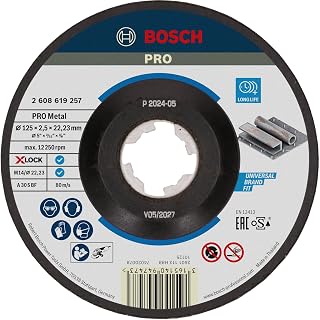
X-Lock deserves particular attention when comparing Bosch accessories. X-Lock is a dedicated interface designed for compatible grinders and accessories; Bosch states that conventional accessories cannot simply be fitted to an X-Lock grinder because the mounting interfaces differ.
For buyers choosing between 115 mm and 125 mm discs, the difference is not simply a matter of disc size. The correct choice depends on what the grinder is designed to accept and the access required for the job.
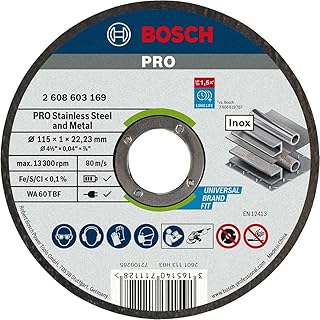
A 115 mm disc is commonly associated with compact angle grinders. Its smaller diameter can be useful where access and manoeuvrability matter, particularly for lighter cutting tasks. Bosch offers several 115 mm bonded cutting discs, including stainless-steel and metal products in both conventional and X-Lock formats.
A 125 mm disc provides a slightly greater maximum cutting depth than a 115 mm disc when used with a suitable grinder, although the actual depth depends on the machine, guard arrangement, disc wear and workpiece geometry. Bosch’s current UK range includes 125 mm discs for metal, stainless steel, multi-material and specialist applications.
Do not fit a larger disc to a grinder merely to gain cutting depth. The machine, guard and accessory must be designed for the combination. Compatibility and manufacturer instructions take priority over convenience.
Disc thickness is one of the most important specifications when comparing cutting discs because it affects the way the accessory interacts with the workpiece. Thin cutting discs are intended for cutting rather than material removal by grinding. Thicker discs may provide a different balance of rigidity, material removal and cutting characteristics, depending on their construction and intended application.
Thin discs are attractive when a clean, narrow cut is important and when the application calls for a dedicated cutting accessory. Bosch currently lists 1.0 mm and 1.6 mm bonded cutting-disc variants for small angle grinders, illustrating why buyers should compare the exact specification rather than relying on a product family name alone.
A thin disc should not automatically be regarded as better. The right thickness depends on the material, machine, cutting conditions and the manufacturer's intended use. A buyer carrying out occasional cuts in light-gauge metal has different requirements from someone repeatedly cutting heavier sections in a workshop.
Product descriptions can contain a mixture of marketing terminology and technical information. For a meaningful comparison, concentrate on the actual specifications printed on the disc and packaging.
The diameter is normally expressed in millimetres and must correspond with the grinder's approved accessory size. Common Bosch small-grinder options include 115 mm and 125 mm.
The bore is the central opening through which the disc mounts to the grinder. A 22.23 mm bore is widely used on conventional Bosch angle-grinder cutting accessories. It should not, however, be treated as a universal specification for every grinder or every Bosch accessory.
Thickness is particularly relevant to cutting performance and should be compared alongside the intended material and application. Bosch lists examples of 1.0 mm, 1.4 mm, 1.6 mm and other thicknesses across different accessory families, demonstrating that there is no single optimum thickness for every job.
Technical markings such as abrasive type, grit designation, hardness or bond information can appear on bonded abrasive discs. Rather than attempting to select a disc from one code in isolation, buyers should compare the complete specification and intended material.
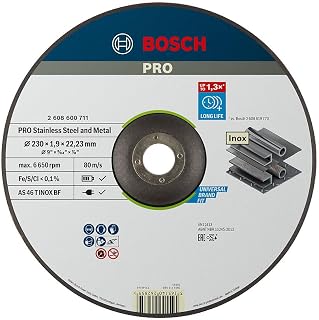
Bonded cutting discs can incorporate reinforcement within the disc structure. Bosch describes its PRO Stainless Steel and Metal bonded discs as using aluminium oxide abrasive grains, a phenol resin matrix and fibreglass reinforcement.
Stainless steel deserves its own consideration because a general-purpose metal disc is not necessarily the most appropriate choice. Look specifically for a disc whose manufacturer identifies stainless steel as an intended material.
Bosch's PRO Stainless Steel and Metal range is specifically described for stainless steel and metal. Bosch also identifies iron-free construction for certain stainless-steel products, which can be relevant where contamination of stainless workpieces needs to be avoided.
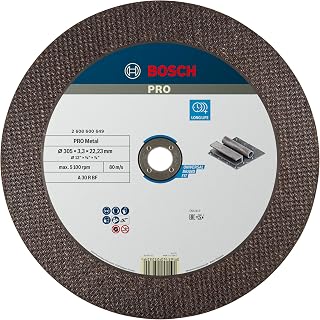
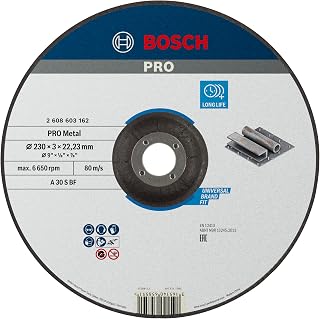
For ordinary steel and general metalwork, a conventional bonded abrasive cutting disc can be a sensible choice when its specifications match the material and grinder. Bosch describes its metal cutting range as covering applications involving steel, pipes and other metal profiles.
The best option for occasional DIY use may therefore be different from the best option for repetitive fabrication work. A professional user should consider not only the purchase cost of an individual disc but also how consistently the disc performs, how quickly it cuts the required material and how frequently it needs replacing.
One of the most useful comparisons for buyers is between Bosch's different performance tiers. The name of the range should not be the sole deciding factor; the material designation, dimensions and mounting system still need to match the job.
Standard products can make sense for buyers who have straightforward requirements and do not use cutting discs continuously. The attraction is often straightforward specification and suitability for routine applications.
Bosch's PRO Stainless Steel and Metal range is positioned around durability and long-life cutting, with the manufacturer describing robust aluminium oxide grains, a resin matrix and fibreglass reinforcement.
That does not mean every PRO disc is automatically the best choice. A premium disc designed for one material can still be the wrong accessory for another. The correct product specification matters more than the tier name.
Bosch EXPERT accessories sit further towards specialist applications. The range includes carbide and diamond technologies intended for particular cutting requirements rather than simply being interchangeable alternatives to ordinary bonded abrasive discs.
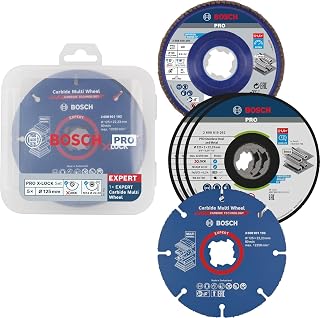
For example, Bosch currently lists an EXPERT Multi Material Carbide Cutting Disc in 115 mm and 125 mm X-Lock variants. This illustrates an important buying principle: a specialist accessory should be selected because its technology solves a particular cutting problem, not merely because it belongs to a higher product tier.
Traditional bonded abrasive cutting discs use abrasive grains held within a bonded structure. Bosch's metal and stainless-steel discs provide examples of aluminium oxide abrasive technology combined with resin and reinforcement.
These discs are commonly considered when cutting metal and similar applications specified by the manufacturer. They gradually wear as they cut, which means disc diameter changes during use.
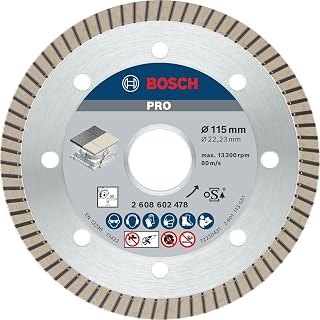
Diamond cutting discs are a different category and should not be treated as simply longer-lasting versions of every abrasive disc. Bosch offers diamond accessories for applications including stone and abrasive construction materials, as well as specialist products for other materials.
For example, Bosch's Standard for Stone Diamond Cutting Disc is listed for materials including hard stone, soft stone and roof tiles, with 115 mm and 125 mm variants shown in the UK range.
Carbide-based cutting accessories occupy another specialist category. Bosch's EXPERT Multi Material Carbide Cutting Disc is designed as a multi-material accessory, demonstrating why the intended application should be checked before purchase rather than assuming all discs with similar dimensions are interchangeable in purpose.
A multi-material disc can look appealing because one accessory may cover several materials. However, versatility should be weighed against the exact jobs you perform most often.
Mounting compatibility is an easy detail to overlook when shopping online. Bosch offers cutting discs with conventional 22.23 mm mounting as well as X-Lock variants.
Conventional accessories are retained using the grinder's normal flange and locking arrangement. The exact procedure and compatible accessories depend on the machine.
X-Lock uses a dedicated interface intended to make accessory changes quicker. Bosch explains that the corresponding interface is required and that conventional accessories cannot simply be used on an X-Lock grinder.
If you are comparing two otherwise similar Bosch discs, confirm the mounting system before placing an order. A disc that has the correct diameter but the wrong interface is not the right purchase.
Cutting discs can carry several letters, numbers and symbols. These markings are useful because they communicate information about dimensions and abrasive construction, but they should be interpreted as a complete specification rather than as isolated performance scores.
Always use the complete manufacturer specification and the instructions supplied with the grinder and accessory. If a marking appears unclear or conflicts with a retailer's description, the manufacturer's current product information should take precedence.
DIY buyers often need only a small number of cuts, which changes the value equation. A disc that is optimised for intensive professional use may not provide enough practical benefit for a homeowner making occasional repairs.
For professional users, the lowest purchase price per disc is rarely enough information to determine value. Productivity, consistency, material suitability and replacement frequency can matter more over the course of repeated work.
Calculate value at the job level rather than simply comparing pack prices. If one suitable disc allows more productive cutting than another, the difference may matter to a tradesperson even where the initial unit price is higher. Conversely, paying more for specialist technology that is unnecessary for the task may provide little practical benefit.
The cheapest disc is not necessarily the lowest-cost option once cutting speed, wear and replacement frequency are considered. Equally, an expensive specialist disc is not automatically better for every task.
A disc intended for stone should not be selected merely because its diameter matches a metal-cutting disc. Bosch separates its stone, metal, stainless-steel, diamond and multi-material accessories for precisely this reason.
Check whether the grinder uses a conventional locking system or X-Lock. The mounting interface is a fundamental compatibility requirement.
Bosch is a broad accessory family rather than one single disc specification. Diameter, bore, thickness, abrasive construction, intended material and mounting system can all vary.
A cutting disc and a grinding disc have different intended functions. Do not improvise with an accessory outside its stated application. Use the correct accessory for the operation and follow the grinder and disc manufacturer's instructions.
Do not use an accessory that is damaged, visibly compromised or otherwise outside the manufacturer's acceptable condition. Inspect accessories before fitting and follow the storage, handling and usage instructions supplied by the manufacturer.
Cutting discs are consumable power-tool accessories that can present serious hazards if incorrectly selected, fitted or used. Product selection should therefore include safety compatibility, not just cutting performance.
Safety information supplied with the grinder and disc should always take precedence over generic buying advice. If you are unfamiliar with abrasive-wheel safety or professional grinding equipment, obtain appropriate instruction before use.
Even an excellent disc can perform poorly when the setup is wrong. Secure the workpiece properly, mark the cut clearly and allow the tool to work at an appropriate rate rather than applying excessive pressure.
For thin material, controlled movement and a suitable cutting disc can help reduce unnecessary material removal. For heavier sections, workpiece support becomes increasingly important because movement during cutting can affect control and place additional load on the accessory.
The workpiece should be positioned so that it remains stable throughout the cut. Consider where the cut will open as the material separates. Poor support can allow the workpiece to move or close onto the disc.
Excessive force is not a substitute for choosing the correct accessory. If a disc struggles, stop and reassess the disc specification, material, grinder and cutting technique rather than simply pushing harder.
Accurate marking, stable workholding and a controlled approach are often more important to final results than buying the most expensive disc available.
Abrasive discs should be handled and stored in accordance with the manufacturer's instructions. Avoid treating loose discs as indestructible consumables that can be thrown into a toolbox.
Customer reviews can be useful when comparing Bosch abrasive cutting discs, but they need to be read in context. A review from someone cutting thin sheet steel is not directly comparable with feedback from a fabricator repeatedly cutting heavier sections.
Look for patterns rather than isolated comments. Reviews become more informative when several customers independently mention similar characteristics such as fit, cutting behaviour, durability or suitability for a particular application.
Bosch is the central brand covered by this buying guide, but buyers conducting commercial research may also encounter established abrasive and power-tool accessory brands such as 3M, DeWalt, Makita, Norton and Pferd. The presence of another established brand does not automatically make it a better choice; comparisons should be based on the exact disc specification, material compatibility, dimensions, mounting system and intended workload.
For a like-for-like comparison, avoid comparing a specialist diamond disc from one manufacturer with a conventional bonded abrasive disc from another and then treating the result as a simple brand comparison. The technologies may be intended for different applications.
Value is best judged against the job rather than the shelf price. A suitable disc should provide the required compatibility and material performance without paying for capabilities that are irrelevant to the application.
For occasional DIY work, a straightforward Bosch disc that correctly matches the grinder and material may offer the most sensible balance. For repetitive professional cutting, a longer-life or specialist disc may deserve consideration if its additional capability is relevant to the workload.
A useful comparison should record the important specifications side by side. This avoids a common shopping mistake where a buyer compares product names but overlooks differences between variants.
Look for a conventional Bosch metal cutting disc that matches your grinder's dimensions and mounting requirements. There is little reason to choose specialist technology unless the material or application calls for it.
Prioritise Bosch discs specifically identified for stainless steel and check whether an iron-free specification is relevant to your work. Bosch's PRO Stainless Steel and Metal family is specifically positioned for stainless steel and metal applications.
Compare the complete specification and consider whether a PRO or other long-life option offers a useful advantage for your workload. Bosch's PRO range includes reinforced bonded constructions designed around long-life metal and stainless-steel cutting.
Look beyond ordinary metal-cutting abrasives and select a diamond accessory specifically intended for the material. Bosch's Standard for Stone Diamond Cutting Disc is listed for stone applications including hard stone, soft stone and roof tiles.
A specialist multi-material accessory can be worth considering where the manufacturer's material list corresponds closely with the jobs you actually perform. Bosch's EXPERT Multi Material Carbide Cutting Disc is one example of a dedicated multi-material technology rather than a conventional abrasive disc.
If you want a simple way to narrow down the choices, work through the following sequence.
There is no single best Bosch cutting disc for every application. The right choice depends primarily on the material, grinder, disc diameter, mounting system, thickness and frequency of use. A Bosch disc designed for stainless steel, for example, should be assessed differently from a diamond disc intended for stone.
Not automatically. The grinder must be designed for the disc diameter being used, and the mounting specification must also be correct. Bosch's range contains both 115 mm and 125 mm variants, but that does not mean either size can be fitted to every angle grinder.
Many Bosch conventional small-angle-grinder discs use a 22.23 mm bore, but buyers should always verify the exact specification for the grinder and accessory. Bosch also offers X-Lock accessories, which use a different mounting interface.
Not universally. Thin discs can be advantageous where the application calls for a narrow cutting action, but the appropriate thickness depends on the material, grinder and manufacturer's intended use. Bosch offers several thicknesses across its cutting-disc range.
Only where the specific disc is identified by the manufacturer as suitable for stainless steel. Bosch has dedicated stainless-steel and metal cutting products, so the exact product specification should be checked rather than assuming every metal disc is suitable.
They represent different product families and technologies, but the important distinction for a buyer is the individual accessory's intended application and construction. Bosch's EXPERT range includes specialist carbide and diamond technologies, while PRO includes purpose-specific bonded cutting products such as stainless-steel and metal discs.
Compatibility depends on the specific grinder and accessory. Bosch describes X-Lock as a dedicated interface and states that conventional accessories cannot simply be fitted to an X-Lock grinder. Check the manufacturer's compatibility information for the exact combination before buying.
Do not assume that a diamond disc intended for stone or construction materials is suitable for metal. Diamond accessories are application-specific, and Bosch lists separate product families for stone, ceramic and other specialist uses. Check the manufacturer's stated material compatibility before use.
There is no meaningful universal replacement interval. Disc life depends on material, section size, cutting technique, pressure, frequency of use, disc specification and operating conditions. Instead of relying on an arbitrary number of cuts, inspect the disc and follow the manufacturer's instructions for condition and replacement.
Bulk purchasing can make sense for frequent users who regularly consume the same specification. Occasional users should consider storage requirements and whether the discs will remain suitable for their intended use before buying a large quantity.
Prioritise reviews that identify the material being cut, grinder size and exact product variant. Repeated feedback about the same accessory is more informative than a single short review, particularly when the reviewer explains the working conditions.
The strongest Bosch abrasive cutting disc purchase is not necessarily the newest, thinnest or most expensive option. It is the accessory whose specification matches the grinder and the material while providing the performance level appropriate to the workload.
For a straightforward purchase, begin with compatibility, then material, then disc construction and thickness. After that, compare Standard, PRO, EXPERT and specialist alternatives according to how frequently you work and whether their additional features solve a genuine requirement. Bosch's current UK catalogue demonstrates how broad the choice can be, ranging from conventional metal and stainless-steel bonded discs to diamond, carbide and X-Lock accessories.
Before purchasing, verify the exact product code, current dimensions, mounting system, material compatibility and manufacturer's operating instructions. Product ranges and specifications can change, so current manufacturer information should be checked alongside retailer listings and verified customer feedback rather than relying solely on an older product description.