

♥ Wishlist
Compare 48 verified Milwaukee Drilling Fixing Bit Sets products in United Kingdom. Reviews, ratings, pros, cons and buying advice updated for October 2026.


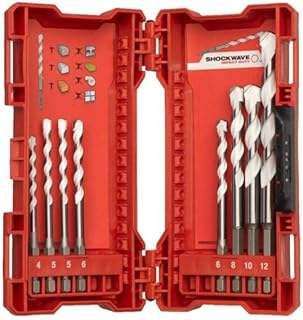


Choosing a Milwaukee drilling and fixing bit set is less about buying the largest box and more about matching the contents to the work you actually carry out. A compact set with the right screwdriver profiles can be more useful for general installation work than a much larger assortment containing sizes you rarely use. Equally, a masonry-focused SDS-Plus set is a very different proposition from an impact-rated fastening set, even though both may be described as drilling and fixing accessories.
Before comparing individual sets, identify the main jobs the bits will perform. Think about whether you regularly work with timber, sheet metal, masonry, concrete, fixings, cabinet hardware, electrical installations or general construction. Then consider the tool that will drive the accessories. A standard drill, combi drill, impact driver and SDS-Plus rotary hammer have different requirements, and using an otherwise high-quality bit in the wrong tool can lead to poor results or premature wear.
The first specification to check is the shank or holder type. Many Milwaukee fastening sets use hex-shank driver bits intended for quick-change holders and impact drivers, while SDS-Plus accessories are designed for compatible rotary hammers. These systems should not be treated as interchangeable simply because they may appear together in a broad accessories range.
This distinction is particularly important when buying a mixed set. A box may contain screwdriver bits, nut drivers, holders and drill bits, but the presence of a large number of accessories does not automatically make it the best choice for a particular job.
Milwaukee's SHOCKWAVE IMPACT DUTY accessories are primarily aimed at fastening work and use with impact drivers. The range includes different combinations of Phillips, Pozidriv, Torx and other common profiles, together with longer bits, bit holders and magnetic nut drivers depending on the set.
Milwaukee describes the SHOCK ZONE geometry as being designed to flex under impact, while its WEAR GUARD TIP is intended to improve wear resistance. The range also uses specially engineered steel and heat treatment for demanding impact applications.
For occasional household screwdriving, however, a large impact-duty assortment may provide more capacity than necessary. The better purchase is often the set whose contents most closely reflect the fixings you use.
SDS-Plus accessories are a separate category from screwdriver bit sets. They are designed for rotary hammer drilling in concrete, masonry and similar demanding materials. Milwaukee's UK accessory range currently includes SDS-Plus M2 two-cutter bits and MX4 four-cutter bits, alongside specialist accessories such as core cutters and dustless drilling solutions.
The choice between an M2 and MX4 configuration should be based on the application rather than simply assuming that a higher number of cutting edges is always preferable. Milwaukee positions its MX4 design for demanding concrete and reinforcement applications, with a four-cutter solid carbide tip and features intended to improve drilling behaviour when encountering rebar.
Milwaukee's M2 SDS-Plus range uses a two-cutter design and is available across a broad selection of diameters and lengths. The current range also includes multi-piece sets, making it possible to build a practical selection around frequently used masonry-hole sizes.
A two-cutter set can be particularly sensible when the majority of your work involves routine drilling in masonry and concrete rather than repeated drilling through reinforced concrete. As with every accessory, the correct choice depends on the tool, substrate, hole diameter and frequency of use.
Milwaukee's MX4 SDS-Plus bits use a four-cutter solid carbide tip on applicable sizes and are engineered for demanding concrete drilling. The manufacturer highlights a centring tip, rebar guards and dust grooves, together with a reinforced flute design intended to improve debris removal and stability.
For professional users who regularly drill concrete or encounter reinforcement, the MX4 family deserves particular attention. The important buying question is not simply whether a four-cutter bit sounds more advanced, but whether the additional capability corresponds to the work being performed often enough to justify the choice.
A useful general-purpose fixing set should contain the profiles and sizes you are most likely to reach for rather than simply maximising the number of pieces. In UK applications, Pozidriv and Torx are particularly relevant to many modern construction, furniture and installation fixings, while Phillips remains common in numerous applications.
A sensible general-purpose assortment may include:
Duplicates are not necessarily wasted space. A professional user may prefer several replacement PZ2 or Torx bits over a box containing numerous unusual profiles that spend most of their life unused.
One of the most common mistakes when comparing bit sets is treating piece count as a direct measure of value. A 70-piece set may sound considerably better than a 35-piece set, but the larger number can come from duplicates, multiple holders, sockets, short and long versions, or profiles that are unlikely to be useful for your particular work.
Instead, compare the usable contents of each set. Count how many pieces directly correspond to your applications, then examine whether the case provides sensible organisation and whether replacement items are available individually.
The material and geometry of a drill bit have a direct effect on how it behaves. There is no single drill-bit construction that is best for every material.
Metal-drilling accessories need to cope with heat, friction and the specific characteristics of the material being drilled. The correct bit geometry, cutting speed and lubrication can all matter. Stainless steel, mild steel, aluminium and thin sheet materials should not automatically be treated as identical applications.
When comparing a set for metalwork, check the stated application rather than relying on the brand name alone. A masonry bit and a metal drill bit may have similar-looking dimensions but completely different cutting geometry.
Wood presents another set of requirements. Depending on the job, users may need standard twist drills, brad-point bits, spade bits, auger bits or hole saws. A general-purpose fixing set should therefore not be mistaken for a complete woodworking drilling system.
Masonry and concrete require dedicated accessories. Milwaukee separates its concrete and masonry range into SDS-Plus, SDS-Max and straight-shank categories, reflecting the different tool interfaces and applications.
For regular concrete drilling, an SDS-Plus rotary hammer and correctly matched SDS-Plus bit will normally be a more appropriate combination than trying to perform demanding hammer drilling with a conventional drill and unsuitable accessory.
Brand comparison is useful, but it should be based on specifications and application rather than reputation alone. Milwaukee, DeWalt, Bosch and Makita all produce extensive accessory ranges, and each brand offers different set configurations.
When comparing equivalent sets, look at the following factors:
The strongest alternative is therefore not necessarily the cheapest or the largest. A Bosch set with the exact drill sizes you need can be a better purchase than a larger Milwaukee set with the wrong assortment, just as a Milwaukee SHOCKWAVE set can be more appropriate than a conventional driver-bit set when impact-driver use is the priority.
A bit set is used in working environments, not just stored on a retail shelf. The case should make it easy to identify and retrieve the correct accessory without tipping the entire contents onto a workbench.
Look for clearly marked positions, secure retention, sensible grouping and enough room to remove bits without excessive force. A compact case can be preferable for mobile work, while a larger organiser may be more practical for a workshop or van where a broader accessory inventory is required.
Also consider whether the case can be stored alongside the rest of your equipment. If you already use a modular storage system, compatibility with your existing organisation may be more valuable than a few additional bits.
Bit length is another specification that is easy to overlook. Short bits are generally convenient for compact tools and everyday fastening. Longer bits can be useful where the fastener sits inside a recess, behind an obstruction or at the end of a deep access point.
However, buying long versions of every size can unnecessarily increase the size of a set. For most users, a combination of standard and selected extended-length bits is more practical.
Longer does not automatically mean stronger or better. The bit still needs to match the fastener profile accurately, and excessive leverage can increase the load on the bit and fixing.
More pieces can mean greater versatility, but only when the additional accessories are relevant. Examine the contents before judging the value of a set.
Do not buy a masonry SDS-Plus set for a conventional chuck and assume an adapter makes every application equivalent. Similarly, if an impact driver is your main fastening tool, prioritise accessories designed for impact use.
Drill bits remove material to create holes. Driver bits engage the head of a fastener. Some comprehensive accessory sets combine both, but they perform entirely different jobs.
A PZ2 bit is not the same as a PH2 bit. Although they can appear similar at a glance, using the wrong profile can result in poor engagement and damage to the fastener or bit.
Frequently used bits eventually wear. Before committing to a set, check whether the high-use sizes can be replaced individually. This can make a modest initial set more practical over the long term than repeatedly replacing an entire assortment.
A workshop user may prioritise a large, organised case, while a mobile installer may value a compact selection that can be carried easily. Storage, transport and access should form part of the buying decision.
For occasional household work, prioritise common screw profiles, a reliable holder and a manageable selection of sizes. There is usually little benefit in purchasing a specialist concrete assortment unless you regularly drill masonry.
Prioritise accurate driver-bit engagement, common Torx and Pozidriv sizes, and access to both standard and longer bits. A well-organised compact set can be especially useful when moving between installation locations.
Consider a versatile fastening assortment containing common profiles and lengths. Magnetic nut drivers can also be useful where hex-head fasteners are part of the installation.
Durability, quick access and compatibility with impact drivers are likely to be more important. A SHOCKWAVE IMPACT DUTY assortment can be worth considering when high-torque impact fastening forms a significant part of the workload. Milwaukee offers SHOCKWAVE sets in several configurations, including sets combining driver bits, longer bits, magnetic nut drivers and holders.
Prioritise SDS-Plus or SDS-Max compatibility according to the rotary hammer being used. For SDS-Plus applications, compare M2 and MX4 options according to drilling conditions, hole sizes and expected exposure to reinforcement.
A thorough comparison should record more than the number of pieces. The following specifications can reveal whether a set is genuinely suitable:
Milwaukee's current UK SDS-Plus listings provide diameter, total length, working length and pack-quantity information across its M2 and MX4 ranges, illustrating why these details are more informative than piece count alone.
Even high-quality accessories can be damaged by incorrect use. Good maintenance starts with keeping bits clean, dry and organised after use.
For concrete drilling, excessive pressure is not a substitute for a suitable bit and rotary hammer. If progress becomes unusually slow, reassess the accessory, drilling mode, material and tool rather than simply applying more force.
A complete set generally makes the most sense when you need several sizes or profiles at the same time. It can also be useful when starting a new tool system or replacing an old collection that has become incomplete.
Individual bits can be the better option when you already own a comprehensive selection and only need to replace heavily used sizes. This approach avoids accumulating duplicate accessories that remain unused.
Before buying a complete set, compare its contents with the accessories already in your toolbox. If half of the pieces duplicate what you already own, an individual replacement or smaller set may provide better practical value.
Prices for accessory sets can change, so a useful buying comparison should be made at the time of purchase rather than relying on an old price figure. Compare the current price of the complete set with the cost of buying the most important accessories separately.
Also check whether different versions of the same family contain different sizes. A set with fewer pieces can sometimes contain a more useful selection than a larger configuration.
Milwaukee bit sets are particularly relevant to users already working within the Milwaukee tool ecosystem, but the accessories should still be assessed on their own specifications. Compatibility with a particular tool does not mean every Milwaukee accessory is the correct choice for every job.
For users who already own Milwaukee impact drivers, the SHOCKWAVE IMPACT DUTY range provides a broad fastening ecosystem. For users with SDS-Plus rotary hammers, the M2 and MX4 families provide dedicated masonry and concrete drilling options. Milwaukee also maintains separate ranges for SDS-Max and other specialist drilling applications.
Yes. Milwaukee positions its SHOCKWAVE IMPACT DUTY accessories specifically for impact-driver applications and incorporates features intended to handle repeated impact loading.
No. SDS-Plus bits use a specific shank interface for compatible rotary hammers and are commonly used for concrete and masonry drilling. They should not be confused with conventional straight-shank drill bits.
They use different cutting configurations. Milwaukee's M2 range uses a two-cutter design, while the MX4 range uses a four-cutter solid carbide tip on applicable sizes and is positioned for demanding concrete applications, including situations where reinforcement may be encountered.
No. The best set is the one containing the sizes and profiles you actually use. A smaller, well-selected assortment can be more useful than a larger set filled with rarely required accessories.
Potentially, provided the accessory interface and application are compatible. Accessory choice should be based on the specific tool, bit type, material and job rather than assuming that accessories must come from the same brand as the power tool.
Many impact-rated hex-shank driver bits can be used with compatible holders in conventional drills, but their principal advantage is their suitability for impact applications. Always follow the accessory manufacturer's stated compatibility and intended use.
There is no universal number. Occasional DIY users may need only a compact selection of common profiles, while professional installers and construction workers may benefit from duplicates and a broader range of sizes. Frequency of use is more important than the headline piece count.
Check the SDS interface, cutting design, diameter range, total length, working length and intended application. For demanding reinforced-concrete work, examine whether the particular bit is designed for contact with reinforcement rather than selecting solely on price or quantity.
Milwaukee offers accessory ranges specifically designed for demanding professional applications, including SHOCKWAVE IMPACT DUTY fastening accessories and SDS-Plus MX4 drilling accessories. However, suitability should always be judged against the exact application, tool and working conditions.
The strongest Milwaukee drilling and fixing bit set is not necessarily the one with the highest piece count, the most elaborate case or the highest advertised specification. Start with the jobs you perform, identify the tool interface, then compare the exact accessories included.
For general fastening, pay particular attention to screw profiles, duplicate high-use sizes, impact compatibility, bit length and holder quality. For masonry and concrete, concentrate on SDS compatibility, diameter range, cutting configuration and working length. If reinforced concrete is a regular part of the workload, investigate the additional capabilities of Milwaukee's MX4 SDS-Plus range rather than treating all masonry bits as equivalent.
Finally, compare current specifications and prices from trusted UK retailers before making a purchase. Check the precise model number, confirm the contents of the set and read recent verified customer reviews where available. A carefully matched assortment will usually deliver more practical value than simply choosing the biggest box on the shelf.