

♥ Wishlist
Compare 37 verified Milwaukee Sockets products in United Kingdom. Reviews, ratings, pros, cons and buying advice updated for October 2026.


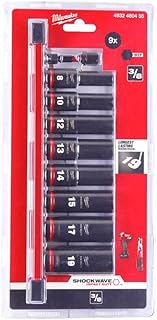
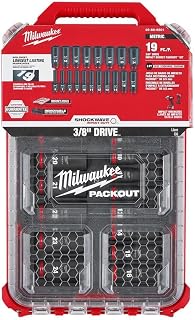


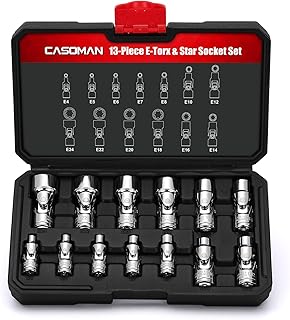
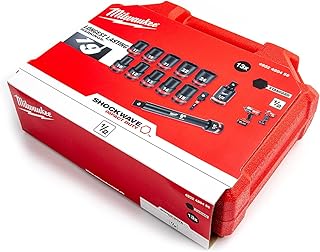

Choosing a Milwaukee socket set is less about buying the largest collection of sockets and more about matching the drive size, socket profile, size range and construction to the work you actually do. A compact set can be the better choice for routine maintenance, while a broader collection makes more sense for workshops, vehicle work and professional trades where unusual fastener sizes are encountered regularly.
Before comparing individual Milwaukee sockets, establish four things: the drive size of your tool, the fastener sizes you commonly work with, whether you need standard or deep sockets, and whether the sockets will be exposed to impact-tool use. These decisions have a much greater effect on suitability than simply choosing the set with the highest socket count.
The drive size is the square connection between the socket and the ratchet, breaker bar, torque wrench, impact wrench or other compatible tool. Milwaukee's SHOCKWAVE IMPACT DUTY socket range covers several drive formats, including 1/4-inch, 3/8-inch, 1/2-inch, 3/4-inch and 1-inch options.
Do not choose a socket drive solely because it matches the physical size of the fastener. Drive size relates to the tool connection, while the socket size describes the fastener the socket is designed to fit. A 1/2-inch-drive socket can therefore be a 10 mm, 19 mm or substantially larger socket depending on the particular range.
One of the most important decisions when comparing socket sets is whether you need standard-depth sockets, deep sockets, or a combination of both. The distinction becomes particularly important when a threaded stud or protruding bolt extends beyond the nut.
Standard sockets are generally the sensible starting point for everyday fastening because their shorter profile can make them easier to use where access is restricted. They are particularly useful when the nut or bolt head is relatively exposed and additional depth is unnecessary.
A standard socket can also be preferable when working in a confined area where a deep socket would add unnecessary length. For a general-purpose toolkit, consider how frequently you encounter extended studs before paying for a large collection of deep sockets.
Deep sockets provide additional internal clearance for fasteners with longer threaded sections. Milwaukee's current SHOCKWAVE IMPACT DUTY range includes deep socket sets, including 3/8-inch and 1/2-inch configurations.
Deep sockets are especially useful for automotive work, machinery, structural assemblies and other applications where the threaded portion of the fastener extends significantly beyond the nut. They can eliminate the frustrating situation where a correctly sized standard socket simply cannot seat fully because the protruding stud reaches the inside of the socket.
If you intend to use sockets with an impact wrench or another impact-rated fastening tool, socket construction is a critical consideration. Impact applications subject accessories to repeated shock loading rather than the comparatively smooth loading associated with a conventional hand ratchet.
Milwaukee's SHOCKWAVE IMPACT DUTY sockets are made from chrome-molybdenum alloy steel and are specifically positioned by the manufacturer for impact applications. The range incorporates features including a six-point gripping geometry, non-slip hex geometry, deep-wall construction on relevant designs, wear-resistant markings and provisions for security accessories.
This does not mean every socket should automatically be used with every power tool. Always check that the socket is rated and specified for the tool and application. A conventional chrome hand-tool socket should not be treated as interchangeable with an impact-rated socket simply because the square drive fits.
Material choice affects strength, durability, resistance to repeated loading and suitability for demanding applications. Milwaukee states that its SHOCKWAVE IMPACT DUTY sockets use chrome-molybdenum alloy steel.
For buyers, the important point is not simply the name of the alloy but how the complete socket has been designed for its intended use. Look at the material specification alongside the drive size, wall construction, socket geometry, markings and intended application.
Chrome-molybdenum, commonly shortened to chrome-moly or Cr-Mo, is widely used in demanding tooling and impact applications because appropriately engineered alloy steel can combine strength with the toughness required for repeated loading. Milwaukee identifies chrome-molybdenum as the material used for its SHOCKWAVE IMPACT DUTY sockets.
For a buyer, this is more useful as an indication of intended duty than as a reason to assume that every socket will survive every misuse. Correct drive selection, correct tool use, proper engagement with the fastener and regular inspection remain important.
Socket geometry is another important comparison point. Milwaukee describes its SHOCKWAVE IMPACT DUTY sockets as using six gripping points and non-slip hex geometry intended to improve engagement and reduce the risk of rounding.
A six-point socket contacts the six flats of a conventional hexagonal fastener rather than concentrating contact on the corners. This makes a properly sized six-point socket particularly attractive for high-torque fastening and for fasteners where preserving the hex shape is important.
The socket must still be the correct size. Even a high-quality six-point socket cannot compensate for a mismatched size, partially engaged fastener, damaged fastener or poor access angle.
A 19-piece set is not necessarily better for you than a 9-piece set. If the smaller set contains every size you routinely use and the larger set contains several rarely needed sizes, the smaller collection may provide better practical value.
When comparing Milwaukee socket sets, consider the actual size sequence rather than the headline number of pieces. A useful set should minimise the number of occasions when you have to stop work because the next required size is missing.
Metric sockets are generally the natural starting point for many modern UK automotive, mechanical and trade applications, but the appropriate range depends entirely on the equipment and fasteners involved. Milwaukee's current impact socket catalogue includes extensive metric size selections across different drive formats.
For general-purpose purchasing, make a list of the sizes you use most often before selecting a set. If you already own a partial collection, buy around the gaps rather than automatically duplicating sockets you already have.
Automotive fastening can demand features that are less important in general-purpose socket collections. Wheel fasteners, for example, can require additional access around the wheel assembly and careful consideration of socket wall thickness.
Milwaukee offers dedicated 1/2-inch SHOCKWAVE IMPACT DUTY automotive impact sockets, including colour-coded options and thin-wall designs intended for access around tight wheel assemblies.
If your main reason for buying Milwaukee sockets is changing wheels or working on vehicles, compare dedicated automotive sockets with standard impact sockets rather than assuming that any 1/2-inch socket set will provide the same access.
Storage becomes increasingly important as a socket collection grows. Loose sockets are easy to misplace, while an organised set makes it much quicker to identify missing sizes and select the correct accessory.
Milwaukee offers socket configurations packaged with PACKOUT storage solutions. Its current 1/2-inch impact socket offering includes a 16-piece deep socket set supplied with a PACKOUT compact organiser, while other configurations include PACKOUT options for different drive sizes and socket ranges.
For mobile tradespeople, the storage system can therefore be part of the buying decision rather than an afterthought. Compare not only the number of sockets but also how securely and conveniently those sockets can be transported between a workshop, van and job site.
Clear markings are easy to overlook when buying a set, but they become increasingly valuable during real-world use. Milwaukee states that its SHOCKWAVE IMPACT DUTY sockets use stamped and ink-filled diameter markings together with laser-etched part numbers designed to improve identification and wear resistance.
For professionals, clear identification can reduce wasted time when moving between fasteners. For occasional users, it also reduces the temptation to test several sockets until one appears to fit.
Socket retention matters when accessories are used with powered tools, particularly when working overhead, in awkward positions or on a mobile job site. Milwaukee's impact socket adaptor range includes a ball-detent design for socket retention as well as a dual-hole and groove arrangement for security accessories.
Buyers should distinguish between the retention system of the tool-to-socket connection and the design features of the socket itself. These are related but not identical considerations, and the appropriate retaining method depends on the tool, accessory and application.
Buying a complete set is convenient, but individual sockets can sometimes represent the more sensible purchase. The best option depends on how complete your current toolkit is.
Milwaukee's current UK range includes individual impact sockets as well as complete socket sets, making a build-your-own approach practical when your requirements are specific.
More pieces can look like better value, but unused sizes do not necessarily improve the usefulness of a toolkit. Prioritise the sizes, drive formats and socket depths that match your work.
A 1/2-inch drive does not mean the socket fits a 1/2-inch fastener. Always check the socket's across-flats measurement and the drive connection separately.
The fact that a socket physically fits an impact wrench does not automatically make it appropriate for impact use. Select sockets specifically specified for the application.
Standard sockets can be frustrating when a stud extends through the nut. If this is common in your work, include deep sockets in the comparison.
A larger drive is not automatically better. A bulky tool and socket combination can be inconvenient in confined spaces and may be unnecessary for smaller fasteners.
Conversely, a small drive may not be the appropriate choice for high-torque work or large fasteners. Match the accessory to the application rather than choosing based on convenience alone.
A socket collection that is difficult to organise can become inefficient even when the individual sockets are excellent. Consider how the set will be stored and transported before buying.
A black or dark-coloured finish may suggest an impact socket, but appearance is not enough to establish suitability. Check the manufacturer's stated specification and intended application.
When two Milwaukee sets appear similar, compare them in a fixed order rather than focusing on the headline piece count.
There is no single best drive size for every automotive job. For many vehicle applications, 1/2-inch drive provides a useful combination of socket size and torque capability, while 3/8-inch drive can be more convenient for smaller fasteners and tighter access.
Milwaukee's UK range includes dedicated 1/2-inch SHOCKWAVE IMPACT DUTY automotive sockets, as well as standard 1/2-inch impact sockets and deep configurations.
If your work is primarily wheel-related, compare automotive-specific socket designs rather than buying a general-purpose set solely on the basis of the 1/2-inch drive. If you work across an entire vehicle, a combination of drive sizes may be more useful.
For occasional DIY, the ideal socket collection is usually smaller and more focused than the collection required by a professional workshop. Start with the drive size that matches your existing ratchet or impact tool, then choose a practical metric range based on the fasteners you are likely to encounter.
There is little benefit in buying a very large heavy-duty socket system if most of your work involves light maintenance and assembly. Conversely, if you already use a compatible impact wrench regularly, selecting impact-rated sockets from the outset can avoid creating an incompatible accessory collection.
Professional users should place greater emphasis on repeatability, organisation, availability of replacement sizes, identification and compatibility with existing tools. The right set should support the tasks performed most frequently rather than simply maximising the number of sockets carried to every job.
For mobile work, storage can be especially important. A clearly organised socket set can make it easier to identify the required size, check that the collection is complete and transport the accessories alongside other Milwaukee tools and equipment.
You do not necessarily need to purchase every socket size at once. A staged approach can produce a more efficient toolkit.
Socket accessories generally require less maintenance than powered tools, but regular inspection is still worthwhile, particularly when they are exposed to high torque or repeated impact use.
Impact accessories deserve particular attention because repeated high-torque loading can place greater demands on the socket than occasional hand-tool use. Inspection should form part of routine workshop practice rather than being left until a socket visibly fails.
There is no universal replacement interval for sockets because service life depends on frequency of use, torque levels, working conditions, tool selection and the condition of the fasteners. Instead of replacing sockets according to an arbitrary calendar schedule, inspect them regularly and follow the manufacturer's guidance.
Replacement should be considered when there are visible cracks, substantial deformation, damaged drive areas, severe rounding, abnormal wear or other evidence that the socket may no longer perform safely and correctly.
Correct technique is just as important as socket quality. A high-quality socket can still damage a fastener if it is the wrong size, poorly seated or used at an unsuitable angle.
When comparing product listings, the following specifications are usually more useful than generic claims about quality or performance.
The answer depends on usage rather than price alone. A larger or more specialised set can be worthwhile when you regularly use the additional sizes, require deep sockets, need impact-rated accessories or benefit from integrated storage.
For occasional users, a smaller set containing the necessary sizes may provide better practical value. Professional users should consider the cost of missing sizes, replacement purchases, downtime and organisation alongside the initial purchase price.
When comparing today's prices, avoid judging value solely by the number of pieces. A smaller set with the correct sizes and drive configuration can be more useful than a larger set containing accessories that rarely leave the case.
Product listings can change, so check the specification of the exact model or set before placing an order. This is particularly important when several versions have similar names but different drive sizes, socket depths or piece counts.
Milwaukee's SHOCKWAVE IMPACT DUTY sockets are designed for impact applications, with the manufacturer describing them as impact sockets made from chrome-molybdenum alloy steel. Always select the appropriate socket and drive size for the specific tool and application.
The main difference is the square drive connection, not necessarily the size of the fastener. The correct choice depends on the tool being used, the fastener sizes involved, the available access and the torque requirements of the job.
Neither is universally better. Deep sockets provide additional clearance around protruding threaded sections, while standard sockets can be more compact and convenient where that extra depth is unnecessary.
Not necessarily. If a socket is used exclusively with compatible hand tools, a conventional socket may be appropriate. If you intend to use an impact wrench or other impact tool, select accessories specifically specified for impact applications.
Milwaukee states that its SHOCKWAVE IMPACT DUTY sockets use chrome-molybdenum alloy steel.
There is no single answer for every vehicle or repair. A 1/2-inch drive is widely relevant to automotive applications, while 3/8-inch drive can be useful for smaller fasteners and restricted access. Dedicated automotive sockets may also offer features suited to wheel assemblies.
A six-point socket is designed to engage the flats of a conventional hexagonal fastener. Milwaukee incorporates six gripping points and non-slip hex geometry in its SHOCKWAVE IMPACT DUTY sockets.
Yes. Milwaukee's UK impact socket range includes 1/4-inch, 3/8-inch, 1/2-inch, 3/4-inch and 1-inch drive categories, with different socket sizes and configurations available across the range.
Buy a set when you need several sizes and want matching organisation. Individual sockets make more sense when you already have a comprehensive collection and only need to add or replace particular sizes.
Identify the fastener size first, then select a socket with the matching across-flats measurement and the correct drive connection for your tool. Do not confuse the drive size with the socket size.
PACKOUT-equipped sets can be particularly useful for buyers who already use the PACKOUT storage ecosystem or who prioritise portable organisation. Milwaukee currently lists impact socket sets supplied with PACKOUT organisers in several configurations.
Milwaukee offers SHOCKWAVE IMPACT DUTY socket adaptors and reducers in several configurations. However, an adaptor should not be treated as a way to ignore the limitations of the smaller drive, the tool or the accessory. Confirm that the complete tool, adaptor and socket combination is appropriate for the intended application.
Keep them clean, inspect them for cracks or deformation, check the drive area for damage and remove accessories from service if their condition becomes questionable. Storage in an organised case or organiser also makes missing or damaged sockets easier to identify.
The best Milwaukee socket set is the one that matches your tools, fasteners and working environment rather than the one with the most impressive specification sheet. Start with drive size, then consider socket sizes, depth, impact suitability, material, geometry and storage.
For demanding impact work, the SHOCKWAVE IMPACT DUTY range is the key Milwaukee family to investigate. For automotive buyers, compare dedicated automotive sockets with general-purpose impact sets. For general DIY and workshop use, concentrate on the sizes you actually encounter and avoid paying for unnecessary duplicates.
Before purchasing, compare the exact model number, included socket sizes, drive format and current retailer information. Specifications can vary between apparently similar sets, so checking the individual product details is more reliable than relying on the product name or total piece count alone.