

♥ Wishlist
Compare 61 verified Milwaukee Diamond Core Drill Bits products in United Kingdom. Reviews, ratings, pros, cons and buying advice updated for October 2026.






Choosing a Milwaukee diamond core drill bit is less about finding the biggest or most expensive option and more about matching the bit to the material, hole diameter, drilling method and machine. The Milwaukee range covers several distinct types of diamond drilling accessories, so products that look similar in a comparison list can serve very different purposes.
For example, a small diamond drill intended for porcelain or quarry tile should not be treated as a substitute for a large wet core used for masonry or concrete. Likewise, a core with an M14 connection is fundamentally different from a wet drilling core using a 1/2-inch G or 1 1/4-inch UNC reception. Checking the connection before ordering is therefore just as important as checking the diameter.
Milwaukee's UK range currently includes dry diamond tile drills, dry cores for larger holes, dust-extraction cores, wet diamond drill bits, wet holesaws and professional wet drilling cores. The manufacturer's current UK catalogue also distinguishes between these systems according to application, diameter and machine interface.
One of the easiest mistakes is to assume that every diamond cutting accessory is designed for the same type of work. In practice, the terminology gives useful clues about the intended application.
This distinction matters because the correct bit is determined by more than whether the cutting edge contains diamond. The machine, connection, cooling method, material and required hole size all have to work together.
The dry-versus-wet decision is one of the most important buying considerations. Neither method is automatically better for every job. The appropriate choice depends on the substrate, diameter, equipment, working environment and the drilling system specified for the particular bit.
Dry drilling can be attractive where introducing water would be inconvenient or undesirable. It can simplify work in locations where water management is difficult, provided the selected Milwaukee bit and drilling machine are specifically intended for dry operation.
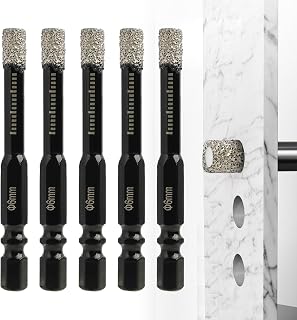
Milwaukee's dry range includes the M14 Diamond Tile Drill Bit, DCH 150 and DCH/DCU cores, as well as DCHXL cores designed for dust extraction. The M14 Diamond Tile Drill Bit is available in diameters from 5mm through 102mm and is designed for hard materials including porcelain, gres, quarry tiles, cast iron and fibreglass.
For larger dry holes, the DCH 150 range is offered in diameters including 52mm, 62mm, 68mm, 82mm, 102mm and 127mm, with an M16 core reception. Milwaukee specifies rotary-only operation for this range rather than hammer action.
Wet drilling introduces water into the cutting process to control heat and support the drilling operation. It is particularly important to look at the manufacturer's instructions rather than assuming that adding water to a dry-rated accessory will improve its performance.
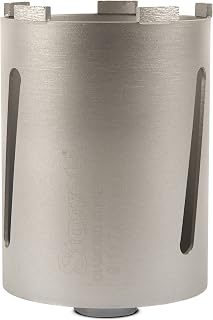
Milwaukee's professional wet core range includes WCHP-SB cores up to 50mm with a standard 1/2-inch G reception and WCHP and WCHP-SB cores above 52mm using a standard 1 1/4-inch UNC reception. The larger WCHP range extends through diameters up to 350mm.
Milwaukee also offers DIAMOND MAX wet drill bits and wet holesaws for hard materials such as porcelain, gres, quarry tiles, cast iron and fibreglass. These smaller accessories use limited water rather than requiring the same type of continuous water supply associated with larger professional wet-core systems.
Diameter should be selected from the actual hole requirement rather than from the outside dimensions of a fitting or accessory that will pass through it. Measure the required opening carefully and allow for the manufacturer's stated cutting diameter.
For sanitary fittings, pipework penetrations, tile fixtures and similar work, a smaller diamond drill or holesaw may be more appropriate than a conventional masonry core. Milwaukee's M14 Diamond Tile Drill Bit range covers a particularly broad selection of sizes, including 5mm, 6mm, 8mm, 10mm, 12mm, 14mm, 16mm, 18mm, 20mm, 22mm, 25mm, 30mm, 32mm, 35mm, 38mm, 40mm, 44mm, 51mm, 54mm, 55mm, 57mm, 60mm, 64mm, 65mm, 68mm, 73mm, 75mm, 76mm, 83mm and 102mm.
Once the required hole becomes substantially larger, connection type and machine capability become increasingly important. A 68mm core and a 150mm core cannot simply be treated as scaled-up versions of the same accessory. The drilling machine, spindle or adaptor, cooling method, working clearance and method of supporting the equipment all become more significant.
Milwaukee's wet-core catalogue illustrates this range particularly clearly, with professional wet cores listed from relatively small diameters through 350mm.
Connection compatibility is a specification that should be checked before considering cutting performance. A diamond core with the wrong reception may require a suitable adaptor, and an adaptor does not automatically make every drill and core combination appropriate for the job.
Milwaukee's current UK wet-core information specifically identifies the 1/2-inch G and 1 1/4-inch UNC interfaces, while its dry-core products use different receptions depending on the product family.
If you are comparing Milwaukee with alternatives from Bosch Professional, Makita, DeWalt or Hilti, do not assume that a similarly sized bit has the same connection, operating method or machine requirements. The diameter may be comparable while the complete drilling system is not.
A common buying mistake is selecting a diamond bit simply because the brand is reputable. Diamond cutting accessories are still application-specific tools. The substrate should be one of the first specifications checked.
Porcelain is substantially harder to drill than many ordinary wall tiles. A diamond cutting edge is generally the appropriate type of technology for creating clean openings, but the particular accessory still needs to be suitable for the tile and the intended drilling method.
Milwaukee's M14 Diamond Tile Drill Bit and DIAMOND MAX wet products are specifically positioned for hard materials including porcelain and gres. The dry M14 range is designed for dry use, while DIAMOND MAX wet products use limited water cooling.
Brickwork varies considerably in hardness and abrasiveness. A bit that performs well in one masonry product may not have the same service life in another. When selecting a core for brick, look for manufacturer guidance covering the relevant substrate rather than relying solely on diameter or customer-review scores.
Concrete introduces a different level of demand. Reinforcement can place considerably more stress on the cutting system than ordinary tile drilling, so a professional wet-core system may be more appropriate for repeated or larger-diameter work.
Milwaukee's WCHP-SB wet drilling cores up to 50mm use a 10mm segment height and an extra-thin 2mm segment for fast drilling in reinforced concrete, while the larger WCHP range uses 10mm-high laser-welded segments and a turbo-shaped segment design.
Some Milwaukee diamond accessories are also specified for cast iron and fibreglass. This is particularly relevant when comparing a diamond accessory against a conventional toothed holesaw. Always check the manufacturer's material recommendations for the exact product rather than assuming that any diamond bit is suitable for every hard material.
For larger professional core bits, the cutting segment is one of the most important technical components. It contains the diamond abrasive and determines how the accessory interacts with the substrate.
A taller segment can provide more diamond cutting material before the core reaches the point where replacement is required, although actual service life depends on the substrate, drilling technique, cooling, machine setup and other operating conditions.
Milwaukee specifies 10mm segment height on several of its professional wet-core products and 7mm segments on its DCU/DCH dry cores for electrical socket and junction-box applications.
Laser welding is another specification worth noticing on professional core products. Milwaukee states that the WCHP wet cores use laser-welded segments and describes this construction as protecting against segment break-off. Its DCH 150 and DCU/DCH dry-core ranges also specify laser-welded segments.
Segment geometry is not merely a marketing detail. It affects how the cutting edge enters the material and how material is removed. Milwaukee's larger WCHP cores use turbo-shaped segments, while the WCHP-SB range up to 50mm uses an extra-thin 2mm segment intended for fast and aggressive drilling in reinforced concrete.
Dry drilling can generate substantial dust, so dust management should be considered alongside the bit itself. For work where airborne dust is a significant concern, a dry diamond core designed for dust extraction can be more appropriate than a conventional dry core.
Milwaukee's DCHXL dry diamond core range is specifically designed for use with dust extraction and covers larger core applications. Milwaukee states that the DCHXL range is available in diameters from 38mm to 162mm and uses laser-welded segments.
The drilling machine, extraction system, adaptor and core should be considered as one system. Buying an extraction-ready core without checking the compatible connection and extraction accessories can leave you with an incomplete setup.
The terminology used by retailers can make this category unnecessarily confusing. A diamond core bit is the cutting accessory. A diamond core drill is the machine that rotates the core. Some machines are designed specifically for diamond drilling, while others can accept suitable diamond accessories within defined operating limits.
Milwaukee's current UK diamond-drilling range includes dedicated machines such as the MX FUEL 150mm and 350mm diamond core drills, as well as the DD 2-160 XE two-speed dry diamond drill. The DD 2-160 XE is offered in UK 110V and 240V versions and includes a two-speed gearbox, mechanical and electronic clutch protection and a keyed chuck on the UK version.
This distinction is particularly important when comparing a diamond core bit intended for a dedicated core drill against an accessory intended for an angle grinder or drill driver. The tool's spindle speed, torque, connection and operating mode all need to be compatible.
Do not assume that because a machine has a hammer function, a diamond core can be used with hammer action. Several Milwaukee dry diamond core products explicitly specify rotary-only operation.
The DCH 150 and DCU/DCH dry cores are specified for rotary-only use and are not suitable for hammer action. Milwaukee gives the same rotary-only instruction for its DCHXL dry diamond cores.
This is a specification to check before drilling, particularly if you are using an SDS or combination hammer that offers multiple operating modes. Select the mode stated for the particular core and follow the manufacturer's instructions for the machine, accessory and material.
Prioritise a diamond accessory designed specifically for hard tile. Check the required hole diameter first, then decide whether dry or limited-water wet drilling is more suitable for your workspace.
The M14 Diamond Tile Drill Bit is a logical product family to investigate for dry tile drilling, while DIAMOND MAX wet drill bits and holesaws provide alternatives where limited water cooling is appropriate.
A purpose-designed dry core can make more sense than adapting a smaller tile accessory. Milwaukee's DCU/DCH range includes 68mm and 82mm options and is specifically intended for electrical sockets and junction boxes.
Consider the DCH 150 or DCHXL families according to the required diameter and whether dust extraction is part of the intended setup. The DCH 150 range includes diameters up to 127mm, while DCHXL extends into larger dry-core applications and is designed around dust extraction.
Look beyond the diameter and focus on the complete wet drilling system. Milwaukee's WCHP-SB range up to 50mm is specifically configured with an extra-thin segment for reinforced concrete, while larger WCHP and WCHP-SB cores are available from 52mm upwards.
If you only need a small number of holes in tile, buying a large professional coring system may be unnecessary. A correctly sized diamond drill or holesaw can be the more sensible option where it matches the material and machine.
Frequent users should consider the entire system rather than the individual bit price. Connection standard, segment construction, cooling, dust extraction, machine compatibility, replacement cost and the expected number of holes can all affect the practical value of a core bit.
A 68mm core is not automatically compatible with every machine capable of drilling a 68mm hole. Check the reception and required adaptor before buying.
Some Milwaukee diamond products are primarily intended for hard tile and similar materials, while professional core systems are designed for larger masonry and concrete applications. The manufacturer's material guidance should take priority.
Where the bit specifies rotary-only operation, hammer action should not be used. Milwaukee explicitly identifies rotary-only operation on several dry diamond core families.
Dry-rated products and wet-rated products are designed around different operating methods. Do not improvise the cooling method. Check whether the product requires dry operation, limited water or a dedicated wet drilling setup.
The cheapest core may not represent the lowest cost per hole. Conversely, a premium professional core can be unnecessary for an occasional small tile installation. Compare the intended workload with the bit's construction and specification.
An adaptor can change the physical connection, but it does not automatically make a particular combination suitable. Machine speed, torque, operating mode, cooling and manufacturer-approved applications still matter.
Pipe, conduit and fitting dimensions can be described using nominal sizes that do not necessarily correspond to the diameter of the opening required. Measure the component and determine the appropriate clearance before choosing the core.
When comparing several products on a buying guide, use a consistent checklist rather than relying on headline claims.
Milwaukee is not the only established manufacturer in professional drilling. Buyers may also encounter Bosch Professional, Makita, DeWalt and Hilti when comparing diamond drilling systems.
The most useful comparison is not simply which brand has the highest rating. Compare equivalent products by diameter, connection, material suitability, drilling method and machine compatibility. A Milwaukee core with a particular reception should be compared with an alternative that uses the same or genuinely compatible system, rather than comparing two products solely because they are both described as diamond cores.
For professional users already invested in one manufacturer's drilling equipment, ecosystem compatibility can be particularly important. However, brand loyalty should not override the technical specification. The correct connection and operating method remain the first priority.
Customer reviews can be useful, but they need to be read in context. A review describing excellent performance on porcelain does not automatically establish suitability for reinforced concrete. Likewise, a negative review may relate to using the wrong machine, material or drilling technique rather than an inherent fault with the product.
Look for reviews that identify the material drilled, hole diameter, machine used, cooling method and approximate workload. Detailed reviews are generally more informative for commercial investigation than comments that simply state that a product is good or bad.
It is also worth separating ratings for the exact model from ratings attached to an entire product family. A family page can contain multiple diameters and variants, so the experience reported for one model may not apply directly to another.
Good maintenance begins with following the manufacturer's operating instructions. After drilling, allow the accessory to be handled safely, remove accumulated material where appropriate and inspect the cutting area for damage or unusual wear.
For professional wet cores, Milwaukee engraves diameter and type on the core reception for long-term visibility. This can make identification easier when several similar-looking cores are stored together.
No single specification can guarantee a particular number of holes. Service life is influenced by the material, aggregate, reinforcement, drilling pressure, cooling, machine performance, alignment and operator technique.
Diamond concentration and bond characteristics also matter because the cutting edge has to expose fresh abrasive as the bit wears. A core designed for one material can therefore behave differently when used on another, even when both materials appear similar.
Milwaukee highlights high-grade diamond bonds and tough alloy bodies on several of its DIAMOND MAX products, while its professional wet cores use laser-welded segments and defined segment geometries. These specifications are useful indicators of intended construction, but they should not be converted into an invented number of holes or guaranteed lifespan.
When comparing larger cores, do not confuse the overall length with the usable cutting depth. Milwaukee's wet-core range provides separate working-length and total-length specifications, with listed working lengths including 70mm, 200mm, 300mm and 450mm across the range.
This distinction becomes important when drilling through thick walls, floors or slabs. A core that has the correct diameter but insufficient working length may not complete the required penetration in a single operation.
Diamond coring is highly effective for the applications for which the accessory is designed, but it is not a universal replacement for every drill bit. If the job only requires a small conventional hole in soft material, a standard masonry, HSS or other application-specific drill may be more appropriate.
Similarly, if the required opening is extremely large or the work involves repeated structural penetrations, hiring or using a dedicated professional core drilling system may make more sense than trying to adapt a smaller hand-held setup.
The best buying decision is therefore not always to purchase the largest Milwaukee diamond accessory available. It is to select the simplest system that safely and correctly meets the actual drilling requirement.
There is no single best Milwaukee diamond core drill bit for every application. The right choice depends on the hole diameter, material, drilling method, machine connection and required working depth. A small M14 diamond tile drill may be the appropriate choice for porcelain, while a WCHP wet core is a very different solution for larger professional drilling work.
Yes, Milwaukee has diamond accessories specifically designed for hard materials such as porcelain and gres. The M14 Diamond Tile Drill Bit is specified for porcelain/gres, while DIAMOND MAX wet drill bits and wet holesaws are also designed for hard tile applications.
Some Milwaukee diamond core systems are designed for concrete and professional wet drilling applications, but suitability depends on the exact core and drilling system. Do not assume that a diamond tile drill is interchangeable with a concrete core.
Not when the particular core is specified for rotary-only operation. Milwaukee explicitly states that its DCH 150 and DCU/DCH dry diamond cores are not suitable for hammer action, and the DCHXL range is also specified for rotary-only use.
They are different connection standards used for different drilling accessories and systems. M14 is used on Milwaukee's smaller diamond tile drilling products, whereas 1 1/4-inch UNC is specified for larger WCHP and WCHP-SB wet drilling cores above 52mm.
It depends on the product. Milwaukee's M14 Diamond Tile Drill Bit is designed for dry use, while DIAMOND MAX wet drill bits use limited water cooling. Larger professional wet cores form part of a dedicated wet drilling system. Always follow the requirements for the exact model.
Milwaukee's DCU/DCH dry diamond drilling range includes 68mm and 82mm cores specifically intended for electrical sockets and junction boxes. The manufacturer's specifications state that these cores should be used with the machine in rotary-only mode.
Yes. Milwaukee's wet-core range includes diameters extending to 350mm, while other dry and wet diamond systems cover smaller and medium-sized holes. The appropriate diameter range depends on the specific product family and connection.
Milwaukee offers wet-core products specifically configured for demanding applications, including WCHP-SB cores up to 50mm with an extra-thin segment specified for reinforced concrete. The exact core, machine and drilling method should still be selected according to the manufacturer's application guidance.
No. A professional large-diameter wet core can be excessive for occasional tile work, while a small tile drill may be unsuitable for repeated structural coring. Value depends on matching the accessory to the workload rather than simply choosing the highest-priced product.
Yes, particularly for professional users. Compare like-for-like products by diameter, connection, material compatibility, drilling method, machine requirements and replacement considerations. Brand reputation is useful, but technical compatibility should determine the final choice.
The strongest way to choose among Milwaukee diamond core drill bits is to work backwards from the job. Start with the material, then determine the required hole diameter and depth. After that, choose dry or wet drilling, confirm the connection and select a compatible machine and accessory system.
For hard tile, investigate the M14 Diamond Tile Drill Bit and DIAMOND MAX families. For electrical sockets and larger dry holes, examine the DCU/DCH, DCH 150 and DCHXL ranges. For professional wet coring, compare WCHP-SB and WCHP options according to diameter, connection and application.
Before purchasing, check the current Milwaukee specification for the exact model number, compare the required connection and operating method, and review current retailer information for price and availability. A carefully matched diamond core is more useful than a supposedly universal option, and the best choice is the one whose diameter, construction and drilling method genuinely fit the work you need to complete.