


♥ Wishlist
Compare 3 verified Hole Saws for Clean, Accurate Circular Cuts products in United Kingdom. Reviews, ratings, pros, cons and buying advice updated for October 2026.


The best hole saw is not necessarily the largest set, the most expensive option or the one with the highest number of pieces. The right choice depends on the material being cut, the diameter required, the thickness of the workpiece, the type of drill or driver available and how frequently the hole saw will be used.
A hole saw that performs well in timber may be a poor choice for stainless steel, while a cutter designed for metal can be unnecessarily slow or expensive for occasional work in plasterboard. Before comparing individual kits, identify the application first and then compare the construction, tooth design, cutting depth, arbor system and available sizes.
Bi-metal construction is one of the most useful compromises for buyers who need a hole saw that can deal with more than one material. The concept combines a tough body with a cutting edge designed to withstand the stresses associated with repeated cutting.
For a mixed-use tool kit, brands such as Bosch, Starrett, Milwaukee, Makita and Lenox are worth comparing because they offer hole saw families aimed at different applications rather than treating every cutter as interchangeable.
However, “bi-metal” should not be treated as a guarantee of identical performance. Tooth geometry, tooth material, pitch, body construction, cutting depth and arbor design can all differ considerably between products carrying the same broad description.
The choice between bi-metal and carbide-tipped construction should be based on the material and the type of work rather than simply selecting whichever specification sounds more advanced.
If the job involves several different materials, check the manufacturer's application guidance for the exact cutter rather than relying solely on the material name printed on the box.
Tooth configuration is one of the most important specifications that is often overlooked when comparing hole saws. The number and arrangement of teeth influence cutting speed, smoothness, chip clearance and the type of material a cutter can handle effectively.
Tooth pitch refers to the spacing between cutting teeth. A coarse tooth arrangement can provide useful chip clearance when removing a substantial amount of material, whereas a finer arrangement can be more appropriate for thin materials where a large tooth gap could produce an uneven cut.
There is no universally superior pitch. The useful question is whether the tooth design matches the material thickness and cutting conditions.
Variable-pitch tooth arrangements use differing tooth spacing to alter the cutting action around the circumference. They are commonly found on professional-grade general-purpose and metal-cutting hole saws because the design can balance cutting efficiency with smoother operation.
Some hole saws use a progressive or stepped tooth arrangement. This can help the cutter engage the workpiece in stages rather than presenting identical teeth to the material at exactly the same point in the rotation.
When comparing two visually similar hole saws, examining the actual tooth profile can therefore reveal an important difference that is not obvious from the diameter or piece count alone.
Diameter tells you how wide the finished hole will be. Cutting depth tells you how thick a material the hole saw can practically pass through.
This distinction becomes particularly important when drilling through timber, worktops, stacked materials, thick boards, pipe sections or assemblies where the cutter must travel farther than a standard shallow hole saw permits.
Do not confuse the physical length of a hole saw with its recommended cutting depth. The manufacturer's specification is the more useful reference when assessing suitability.
A hole saw is only as useful as the arbor that connects it to the power tool. The arbor typically carries the pilot drill and provides the mechanical connection between the drill and the saw body.
This is one reason a seemingly inexpensive hole saw kit can become less attractive if its arbor is awkward to change, incompatible with the user's drill or difficult to replace.
Traditional systems use a threaded connection or comparable mechanical arrangement. They can be perfectly practical for occasional users, particularly when the same cutter remains installed for a long period.
Quick-change systems are designed to make changing cutters or pilot drills faster. This can be especially useful for electricians, plumbers, installers and contractors who regularly switch between diameters during a job.
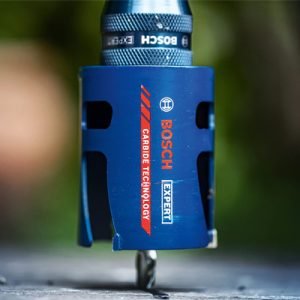
Bosch, for example, offers hole saw systems built around quick-change arbor technology. When comparing systems, check whether the cutters in the kit are compatible with the arbor supplied and whether additional cutters from the same range can be added later.
Compatibility with an impact driver should never be assumed simply because an arbor physically fits the chuck. Some hole saw systems are designed for use with impact-rated tools or specific drivers, while others are intended primarily for conventional rotary drilling.
For larger diameters, aggressive cutters can generate substantial torque. The manufacturer's instructions should therefore take priority over a generic claim that a particular arbor “fits” an impact driver.
For demanding work, also consider the control offered by the power tool. A drill with adjustable speed and a suitable clutch can be easier to manage than a high-powered driver operating without appropriate control.
A large kit looks attractive because it provides numerous diameters in one case, but a set is not automatically the best-value purchase. The ideal choice depends on how many sizes you genuinely expect to use.
For professional users, a modular system can be particularly useful because heavily used diameters can be replaced individually while the arbor and less frequently used cutters remain in service.
There is no universal list of “must-have” diameters because the correct sizes depend heavily on the trade and installation work. Electricians, plumbers, kitchen fitters, carpenters and general DIY users can have very different requirements.
Instead of choosing a kit based solely on the number of pieces, identify the diameters required by your most common jobs. Then check whether the kit contains those exact sizes.
Prioritise the diameters required for cable entry, electrical accessories, fittings, downlights and installation hardware relevant to your work. A compact kit containing frequently used sizes can be more useful than a large collection with numerous gaps in the range you actually need.
Plumbing installations can require larger openings and deeper cuts, particularly when routing pipework through timber, boards or other construction materials. Check both diameter and cutting depth, and pay attention to the ability to clear the cut core.
Cut quality becomes especially important when the finished hole remains visible. Tooth design, stability and the condition of the pilot drill can all influence the appearance of the opening.
A versatile mid-range kit can be sensible if you do not yet know which sizes you will need. However, avoid paying for a large number of diameters simply because the piece count looks impressive.
One of the easiest ways to shorten the useful life of a hole saw is to treat every material and diameter as though it should be cut at the same speed.
Larger hole saws naturally place different demands on the drill because the cutting circumference is greater. Metal also requires considerably more attention to speed, pressure and heat than a quick cut through soft timber.
Excessive heat can accelerate wear, damage cutting edges and reduce the effectiveness of a metal-cutting hole saw. For appropriate metal applications, use the manufacturer's recommended speed and cutting method, and use a suitable cutting lubricant where the instructions call for one.
Do not continue forcing a cutter through metal simply because it appears to be making progress. A slow, controlled cut can be preferable to excessive pressure that produces heat and premature wear.
The pilot drill establishes the initial hole and helps keep the hole saw aligned while the teeth engage the material. If the pilot drill is blunt, damaged or poorly suited to the application, the overall performance of the hole saw can suffer even when the saw teeth themselves remain sharp.
When comparing premium hole saw kits, investigate the availability of replacement pilot drills and arbor components. A durable saw can become less economical if a small consumable component is difficult to replace.
Clean cutting is not determined by the hole saw alone. The condition of the teeth, the stability of the drill, the direction of cutting and the material itself all affect the finished result.
If the hole is being cut into a finished worktop, cabinet panel, door or visible piece of joinery, make a test cut in a similar offcut whenever practical.
Metal cutting requires a different approach from drilling timber. The correct cutter, appropriate speed, controlled feed pressure and suitable lubrication can all matter.
Never judge the correct cutting speed from the behaviour of a hole saw in timber. Metal generates substantially different cutting conditions, and stainless steel in particular should be approached according to the cutter manufacturer's guidance.
A hole saw removes a circular core, but the rotating assembly can also create substantial torque. Safety should therefore be part of the buying decision rather than an afterthought.
More pieces do not necessarily mean better value. If half the diameters are unlikely to be used, a smaller professional-quality kit may make more sense.
Buyers sometimes focus on the saw bodies and overlook whether the supplied arbor is convenient, compatible and replaceable.
A general-purpose hole saw has practical limits. Always check the manufacturer's stated material applications.
A correctly sized diameter is not enough if the cutter cannot pass through the material thickness.
A 20-piece kit is not automatically better than a 9-piece kit. Compare the actual diameters, construction and included accessories.
Check whether individual hole saws, pilot drills and arbor components can be purchased separately.
Even a high-quality cutter can perform poorly when used at an unsuitable speed, with excessive pressure or on a material outside its intended application.
Brand reputation can help narrow the field, but it should not replace specification checking. Established manufacturers such as Bosch, Starrett, Milwaukee, Makita and Lenox produce different hole saw ranges for different applications, so comparing the brand alone is not enough.
The strongest comparison is therefore product-to-product rather than brand-to-brand.
Before choosing between two apparently similar products, compare the following specifications side by side:
Value should be judged over the useful life of the complete system rather than by the purchase price alone. A cheaper kit can become expensive if the arbor is unreliable, frequently used cutters cannot be replaced individually or the supplied sizes do not match the work.
Conversely, a premium set may be unnecessary for a DIY user who only needs to make a handful of holes in soft material.
A useful way to assess value is to ask how often each cutter will be used and whether the kit saves you from buying additional components later.
Prioritise sensible sizes, broad compatibility and straightforward storage. Avoid paying heavily for specialist cutting capability that you are unlikely to use.
Durability, cutting consistency, arbor convenience and replacement-part availability become more important. Time spent changing components or replacing an entire kit can have a greater practical cost than the initial price difference.
Focus on the exact metal, thickness, tooth specification, cutting depth and operating instructions. A general-purpose set should not automatically be treated as a specialist metalworking solution.
Good maintenance is straightforward but can make a meaningful difference to the working life of cutting accessories.
Visible tooth damage is an obvious warning sign, but performance changes can also indicate that a cutter has reached the end of its useful service life. Increasing cutting resistance, excessive heat, poor-quality holes and unusual vibration should prompt an inspection.
A hole saw does not necessarily become unusable at the first sign of reduced performance, but continuing to force a blunt or damaged cutter can create unnecessary strain on both the accessory and the power tool.
Rather than purchasing every diameter at once, a professional user can build a collection around actual workloads. Start with the sizes used most frequently, then add specialist diameters when a job requires them.
This approach can reduce unnecessary duplication and makes it easier to maintain a consistent set of accessories.
Electricians often benefit from fast cutter changes and a compact selection of commonly required diameters. For installation work, consider not only the finished hole size but also the material being drilled and the depth required.
Plumbers may place greater emphasis on larger diameters, deeper cutting capacity and the ability to remove the central core efficiently. Where pipework passes through thick timber or similar materials, cutting depth deserves particular attention.
Clean openings and repeatability can be more important than maximum cutting speed. Choose a cutter appropriate to the board material and use suitable support and drilling technique to minimise breakout.
A versatile bi-metal system can be attractive when the day's work involves several materials. However, the manufacturer's application limits should still be checked for each cutter.
Product descriptions can contain a large amount of technical terminology. The following specifications are among the most useful when comparing products:
Always distinguish between the number of hole saws and the total number of pieces in a kit. A “multi-piece” set may count arbors, pilot drills and other accessories towards the headline number.
For a purchase made in 2026, the most sensible approach remains specification-led rather than trend-led. Product ranges can change, kits can be revised and individual sizes can be added or removed, so check the current manufacturer's specification and the exact kit contents before purchasing.
When comparing today's options, consider the following order: