

♥ Wishlist
Compare 37 verified DeWalt Tool Case products in United Kingdom. Reviews, ratings, pros, cons and buying advice updated for October 2026.

![Easy Peel – Foam Inserts for DeWalt ToughSystem Drawers [Black 50mm Twin Pack] For Tool Organisation, Kaizen, 5s, Tool Storage & Storage Boxes](https://m.media-amazon.com/images/I/71VsYT3MZdS._AC_UL320_.jpg)








![Easy Peel – Toughsystem DS400 Insert [Black 50mm Twin Pack] Customisable Foam for DeWalt Toughsystem Toolboxes | Ideal for Lean, 5S, Kaizen & Custom Organisers](https://m.media-amazon.com/images/I/817lLg00KtS._AC_UL320_.jpg)
![ToughSystem 2.0 Toolbox Foam Inserts [Twin Pack] Cut and Peel Foam Inserts for DeWalt ToughSystem 2.0 Toolboxes | Tool Organisation, Kaizen, 5s, Tool Storage & Storage Boxes (50mm, Yellow)](https://m.media-amazon.com/images/I/81R56KsbzsL._AC_UL320_.jpg)

The best DEWALT tool case is not necessarily the largest, toughest or most expensive option. The right choice depends on what you need to carry, how often the case will be moved, the environment in which it will be used and whether you intend to build a larger modular storage system over time.
For occasional DIY use, a compact case may be more convenient than a heavy-duty professional storage box. Tradespeople travelling between a van, workshop and jobsite may place greater importance on stacking, secure latches, weather resistance, carrying capacity and compatibility with other storage modules.
DEWALT's UK storage range includes both TSTAK and TOUGHSYSTEM products, alongside smaller ToughCase accessory storage. The two principal modular systems are aimed at somewhat different priorities, so understanding the distinction can prevent an expensive mismatch.
A useful test is to list everything that normally travels with the tool. Include batteries, chargers, blades, discs, drill bits, dust extraction accessories, guards and hand tools. A case that fits the bare tool but leaves no sensible room for its working accessories can become frustrating very quickly.
One of the most important decisions when comparing DEWALT cases is whether to choose TSTAK or TOUGHSYSTEM. Neither is automatically the best for every buyer.
TSTAK is particularly attractive when portability, modularity and relatively compact storage are more important than maximum heavy-duty capacity. The system includes different box depths, drawers, organisers and tote-style options, allowing a user to assemble storage around the tools they actually carry.
The TSTAK range can be particularly useful for electricians, installers, maintenance workers and DIY users who need organised equipment without building an oversized mobile workstation.
Some DEWALT tools are supplied in TSTAK cases, which can also make the system appealing if you are gradually accumulating compatible equipment. DEWALT's UK product range confirms that individual power tools can be supplied in TSTAK cases rather than traditional tool-specific moulded cases.
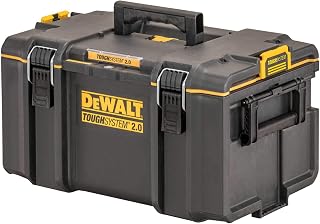
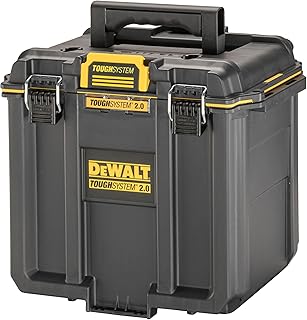
TOUGHSYSTEM is the more appropriate direction when demanding jobsite conditions, greater protection and substantial modular storage are priorities. TOUGHSYSTEM 2.0 boxes use reinforced construction, heavy-duty latching and stacking mechanisms designed around repeated transport between storage, vehicles and jobsites.
For example, the DEWALT TOUGHSYSTEM 2.0 DS400 is specified with an IP65 rating, a 50 kg loading capacity and a 55-litre stated capacity. It also incorporates metal-reinforced latching and an internal removable tray.
That specification illustrates why buyers should compare the intended use rather than simply choosing the box with the largest capacity. A larger heavy-duty case can provide excellent protection but may be unnecessarily cumbersome for someone who only needs to transport a drill and a handful of accessories.
Capacity should be considered alongside the physical shape of the contents. Two cases with similar stated volumes may be very different in practical usefulness because one may provide a more convenient internal layout.
Measure the longest, widest and tallest items you intend to carry. Pay particular attention to awkward accessories such as long drill bits, circular saw blades, chargers and dust extraction components.
External dimensions matter just as much as internal capacity. A case that fits comfortably in a workshop may be inconvenient in a crowded van, vehicle boot or narrow storage cupboard.
Before buying, check the case dimensions against your existing shelving, van racking and storage compartments. If you are building a stack, also consider the combined footprint and height of the complete configuration.
Do not confuse storage volume with permitted loading. A large box is not automatically suitable for carrying a very heavy collection of tools.
Check the manufacturer's stated load capacity and consider the weight of the case itself. The DEWALT TOUGHSYSTEM 2.0 DS400, for example, has a stated loading capacity of 50 kg.
For mobile setups, remember that every additional module adds weight. A fully loaded stack may be significantly harder to lift than individual boxes, even if the system is designed to stack together.
Protection against dust and water can be important for tradespeople who leave equipment in vans, work outdoors or move tools through unfinished buildings.
An IP rating should not simply be treated as a marketing number. Check what the stated rating actually covers and remember that resistance to water ingress does not mean a case should be deliberately submerged or treated as permanently waterproof in every situation.
DEWALT states that its TOUGHSYSTEM 2.0 DS400 has an IP65 rating for dust and water resistance.
Latches are among the most frequently handled components of a tool case. Look for a mechanism that can be opened and closed without excessive force while still providing a secure closure.
Metal-reinforced or metal latching components can be desirable for frequent professional use, but the complete design matters. Inspect the hinge arrangement, latch location, lid rigidity and how securely the lid closes around the perimeter.
A case can be technically excellent but unpleasant to carry. Pay attention to handle position, grip shape, overall weight and how the case balances when loaded.
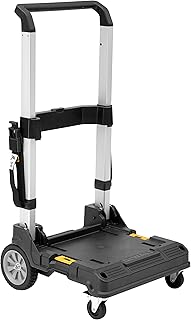
For larger storage systems, consider whether you will normally carry the boxes individually or transport them as a stack on wheels. DEWALT's TOUGHSYSTEM range includes trolley-based configurations designed for moving multiple modules together.
Stackability is useful only when the locking system is genuinely convenient. If assembling a stack requires excessive effort every time you need one box, the theoretical benefit can disappear in daily use.
Look for intuitive connection mechanisms and consider which modules you are likely to add later. DEWALT describes TOUGHSYSTEM 2.0 as a modular system designed to connect multiple storage products together.
If tools are regularly left in a vehicle or work environment, the ability to secure a case can be an important consideration. Check whether the particular model provides a padlock facility and whether that feature is genuinely useful with your intended storage arrangement.
The TOUGHSYSTEM 2.0 DS400 includes a metal-reinforced padlock eye according to DEWALT's UK specifications.
Most modern professional tool cases use engineered plastics, reinforced structural materials or combinations of plastics and metal components. The important question is not simply whether a case is described as plastic, but how that material is used throughout the design.
High-quality structural plastic can provide a useful combination of low weight, corrosion resistance and durability. For everyday transport, it can be preferable to a heavy metal case because the storage system itself does not consume as much of the user's carrying capacity.
Pay particular attention to stress points around handles, hinges, latches and stacking interfaces. These areas experience considerably more mechanical stress than large flat sections of the lid or base.
Metal hinges, latch components and reinforcement can increase durability in areas that are repeatedly operated. They can also add weight, so the best balance depends on whether the case is intended for stationary storage or constant transportation.
For indoor DIY storage, an IP-rated case may not be essential. For outdoor work, construction sites and vehicle storage, additional protection against dust and water can be considerably more valuable.
Consider your actual working environment:
Organisation is frequently overlooked when buyers concentrate on toughness. A case that protects tools but makes it difficult to find the required accessory can still reduce productivity.
A removable tray can create two levels of storage and provide rapid access to commonly used smaller tools. It is particularly useful when the larger equipment underneath is not needed for every task.
Drawer modules are useful when frequent access is more important than maximum enclosed volume. They can make small tools and consumables easier to reach without requiring the entire case to be opened and unpacked.
An open tote is convenient for items that are used repeatedly throughout the day. DEWALT's TSTAK Tote with Handle, for example, is designed for bulk storage and has a 27-litre stated capacity.
The trade-off is obvious: an open tote provides rapid access but offers less enclosed protection and security than a sealed toolbox.
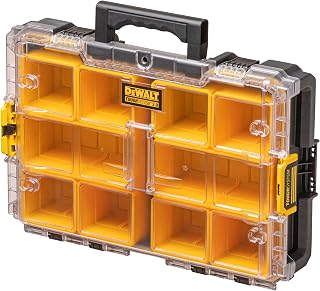
Small organisers are ideal for drill bits, screws, fixings and similar accessories. DEWALT's ToughCase accessory system is designed around stackable small cases, with clear lids intended to make contents easier to identify.
Professional users should prioritise the complete storage workflow rather than the specification of one box. A good professional setup should make it easy to identify, transport, access and return tools to their correct location.
Consider how the system works at three stages:
A modular system becomes particularly useful when your tool collection grows. Instead of replacing one large toolbox every time your equipment changes, separate modules can allow different groups of tools and accessories to remain organised.
DIY users often have different priorities from professional tradespeople. Maximum impact resistance and extreme loading capacity may be less important than affordability, manageable weight, internal organisation and the ability to store a changing selection of tools.
If your collection consists of a drill, driver, hand tools, measuring equipment and a modest selection of accessories, a compact TSTAK configuration or appropriately sized toolbox may provide a better balance than a large TOUGHSYSTEM stack.
It is also worth considering future purchases. If you expect to add several DEWALT cordless tools, choosing a modular system from the outset can avoid replacing storage later.
More capacity is not always better. A large case can become unnecessarily heavy and may encourage you to carry tools you do not actually need.
External measurements do not tell the whole story. Internal protrusions, trays and dividers can reduce usable space. Always check internal dimensions where the manufacturer provides them.
Cordless tools often need space for one or more batteries and a charger. A case that accommodates the bare tool may not be practical once its supporting equipment is included.
Do not assume that every DEWALT box, organiser and trolley will connect directly to every other DEWALT storage product. Check the manufacturer's compatibility information for the exact models before creating a mixed stack.
DEWALT does provide system adapters intended to connect certain TSTAK, ToughCase and TOUGHSYSTEM products, but compatibility should still be checked for the specific configuration being considered.
A case's empty weight matters. Add a full complement of batteries, tools and accessories and the final carrying weight can become substantial.
Ingress protection ratings have specific meanings. They should be used to compare products rather than interpreted as permission to expose a toolbox to conditions beyond its stated rating.
Customer feedback can be useful, but ratings do not replace technical specifications. Before buying, compare dimensions, capacity, compatibility, construction, protection level and intended use alongside verified customer reviews.
If you are not already committed to the DEWALT ecosystem, it can be useful to compare storage systems rather than individual boxes.
The most sensible comparison is usually between complete ecosystems. If most of your cordless tools already use DEWALT batteries and are supplied in compatible cases, staying within DEWALT storage can provide practical advantages even when another brand offers an attractive individual toolbox.
Rather than purchasing a complete stack immediately, many buyers can build a more useful system in stages.
DEWALT's TOUGHSYSTEM 2.0 range includes multi-box configurations with trolley transport, demonstrating how the system can be expanded beyond a single toolbox.
Tool cases require relatively little maintenance, but regular inspection can help identify problems before they affect tool protection.
Regular cleaning is particularly useful for cases used on dusty construction sites. Fine debris can accumulate around closure points and eventually interfere with smooth operation.
The ideal contents depend on the trade, but a well-organised general-purpose setup might include:
Avoid turning every case into a general-purpose dumping ground. Separating frequently used tools from specialist equipment makes a modular storage system considerably more efficient.
Before ordering, compare more than the headline case dimensions. Measure the tool in its most awkward orientation, including removable or fixed components that remain attached during transport.
Product model numbers are especially important because visually similar DEWALT tools can have different dimensions or packaging configurations.
A complete kit can be attractive when you need a coordinated transport solution immediately. DEWALT's TOUGHSYSTEM 2.0 4-in-1 configuration includes multiple box sizes and a trolley, creating a ready-made mobile storage arrangement.
However, a complete kit is not automatically better value for every buyer. If you only need one or two boxes, buying individual modules can make more sense and avoids paying for storage capacity you may not use.
Compare the contents of the kit with your actual tool collection. A bundle becomes more compelling when most of its included modules will have a defined purpose from day one.
TSTAK can be a strong choice when modular storage, portability and compatibility with other TSTAK modules are important. The best option depends on the tools being stored and the required level of protection.
Not universally. TOUGHSYSTEM is generally the more appropriate choice for buyers who prioritise heavy-duty protection, larger storage configurations and demanding jobsite use, while TSTAK can be preferable when a more compact and flexible system is sufficient.
Do not assume that every DEWALT case is waterproof. Protection varies by model. Check the manufacturer's specifications for the exact case, including any stated IP rating and its associated limitations.
Modularity allows separate boxes, organisers, drawers and transport components to be combined around a user's changing requirements. It can make a growing tool collection easier to organise and transport.
Compatibility depends on the specific products and configuration. DEWALT offers adapters for certain combinations, but buyers should verify the exact models rather than assuming universal compatibility.
Not necessarily. Professional users should choose capacity according to the equipment they actually transport. A smaller, well-organised case can be more efficient than a large box that becomes unnecessarily heavy.
They can be transported in an appropriate case when the manufacturer's guidance permits it, but batteries should be handled and stored according to the instructions supplied with the battery. Protect them from conditions that could damage the cells and avoid loose metal objects contacting battery terminals.
A compact organiser or ToughCase-style accessory storage product is generally more suitable than a large toolbox. Small compartments and clear lids can make frequently used consumables easier to identify.
Buy an individual case if your requirements are straightforward. A complete modular system becomes more attractive when you regularly transport multiple categories of tools and want them to stack and move together.
There is no universal replacement interval. Service life depends on loading, frequency of transport, exposure to dust and weather, handling and damage to components such as hinges and latches. Regular inspection is more useful than replacing a case simply because it has reached a particular age.
The strongest DEWALT tool case choice is the one that fits your actual workflow rather than the one with the most impressive specification. Start with the tools and accessories you need to transport, then work backwards to capacity, dimensions, protection, organisation and compatibility.
For compact everyday storage, TSTAK offers a broad modular approach. For demanding jobsite conditions and larger protected storage configurations, TOUGHSYSTEM 2.0 deserves closer consideration. For small accessories, a dedicated organiser can prevent bits, fixings and consumables from becoming mixed together.
Before purchasing, compare the exact model number, dimensions, loading capacity, compatibility and protection rating. Then check verified customer feedback and compare specifications from reputable UK retailers. This approach is more reliable than choosing purely on price, star rating or the appearance of the toolbox.
Most importantly, think beyond the first case. If you expect your DEWALT tool collection to grow, choosing a storage ecosystem that can expand with it may provide greater long-term usefulness than selecting the cheapest standalone toolbox today.