

♥ Wishlist
Compare 30 verified Oscillating Blades for Multi Tools products in United Kingdom. Reviews, ratings, pros, cons and buying advice updated for October 2026.
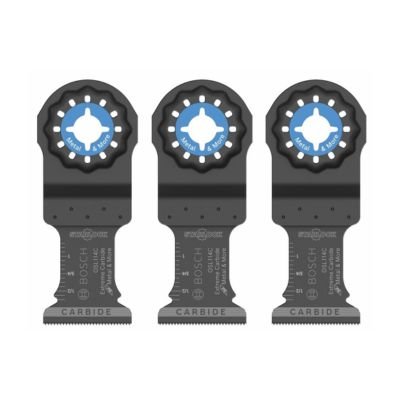
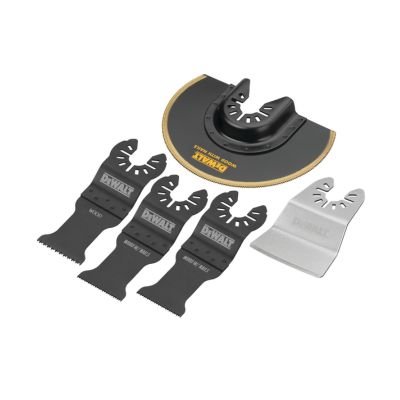
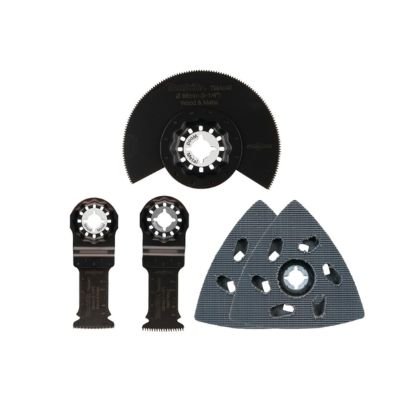
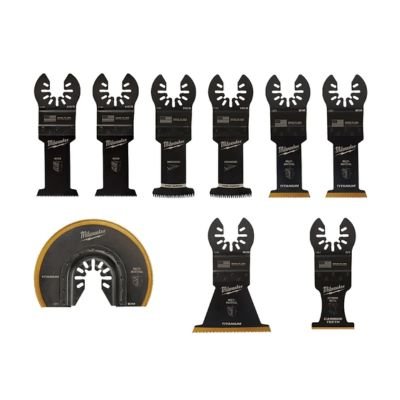






Choosing an oscillating blade is less about finding one universally “best” accessory and more about matching the blade to the material, cutting method, depth, finish and frequency of use. A blade that is excellent for cutting timber can be a poor choice for hardened fixings, while a carbide accessory designed for abrasive materials can be unnecessary for ordinary softwood trimming.
For UK DIY users and tradespeople, the most important buying decision is therefore the combination of blade material, tooth pattern, width, cutting depth and tool compatibility. Once those characteristics are understood, comparing Bosch, Fein, Makita, DeWalt, Milwaukee and other established manufacturers becomes considerably easier.
The material determines the type of blade you should put on the oscillating multi-tool. Before comparing individual products, identify whether the job involves clean timber, painted or treated wood, nails and screws, plastics, plasterboard, tile grout, cement board, adhesive or another abrasive material.
Softwood and ordinary timber: high-carbon steel or suitable wood-cutting blades can provide fast, controlled cutting for common carpentry and DIY work.
Hardwood: a blade designed for harder timber and a suitable tooth geometry can be preferable where a clean cut and reasonable service life matter.
Wood containing nails or screws: choose a bi-metal blade specifically intended for mixed wood and metal applications rather than an ordinary wood-only blade.
Metal: use a blade whose manufacturer specifically states that it is suitable for the type and thickness of metal involved.
Plastic and composite materials: select a tooth configuration intended to reduce grabbing and produce a controlled cut.
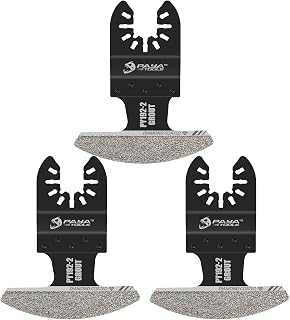
Grout: carbide-grit or other specialist grout-removal accessories are normally more appropriate than conventional toothed wood blades.
Cement board and other abrasive materials: carbide-based accessories are often the more appropriate category where the manufacturer permits that application.
Adhesive, sealant and flooring residue: a scraper rather than a saw blade is generally the relevant accessory.
Blade material has a direct effect on how an accessory behaves under load. The common categories include high-carbon steel, bi-metal and carbide-based accessories. They are not interchangeable in terms of intended application.
High-carbon steel, often abbreviated to HCS, is commonly associated with cutting wood, plastics and other relatively soft materials. These blades can be useful for general-purpose DIY because they can provide an economical way to stock several tooth patterns and widths.
The limitation is that a conventional wood blade is not the right choice for deliberately cutting through metal fixings. Accidentally striking a hidden nail may also shorten the useful life of a wood-only blade dramatically.
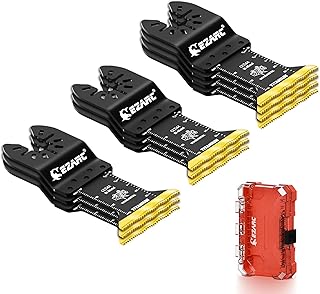
Bi-metal, or BIM, blades combine different grades of metal to balance cutting performance, flexibility and resistance to wear. They are particularly useful for demanding mixed-material work, including timber containing nails or screws, where a conventional wood blade may be damaged quickly.
For a general-purpose professional kit, bi-metal accessories can be particularly useful because one blade category can cover several common site tasks. However, the exact application still needs to match the manufacturer's specification; “bi-metal” does not automatically mean that a blade is suitable for every type of steel.
Carbide accessories are intended for applications where conventional steel teeth can wear rapidly. Depending on the accessory design, carbide can be useful for grout, cement-based materials, fibreglass, hardened materials and other abrasive applications.
They are usually a specialist purchase rather than the first blade to buy for ordinary timber cutting. If most of your work involves skirting boards, door casings and softwood, spending the majority of the blade budget on specialist carbide accessories may provide little practical benefit.
Two blades with the same width and attachment interface can behave very differently because their teeth are designed for different cutting conditions. Tooth spacing, tooth geometry and the shape of the cutting edge all influence how quickly material is removed and how controllable the cut feels.
Coarse teeth generally favour rapid material removal. They can be useful where speed is more important than achieving the finest possible edge, particularly when making rough cuts in timber.
The trade-off is that aggressive teeth can produce a less refined finish and may be less suitable when working close to a visible finished surface.
Fine-tooth accessories are useful where greater control and a cleaner finish are priorities. They can be particularly helpful for finish carpentry, trimming and smaller cuts where excessive material removal would make the job harder to control.
Japanese-tooth style blades are associated with efficient cutting of timber and can be attractive for users who regularly make plunge cuts or need a relatively clean cut in wood. Their performance depends on the exact tooth design, blade thickness and material being cut.
Flush-cutting is one of the defining strengths of an oscillating multi-tool. A suitably shaped blade can trim protruding dowels, nails, timber, pipework or other components almost level with an adjacent surface.
When comparing flush-cut blades, consider both the width and the working depth. A wider blade can make a long straight trim easier to control, while a narrower blade may be preferable where access is restricted.
Dimensions deserve more attention than they often receive in product listings. A blade can be technically compatible with a tool yet still be poorly suited to the particular job because its cutting width or usable depth is inappropriate.
Narrow blades: useful for detailed work, confined spaces and smaller cuts.
Medium-width blades: a practical general-purpose choice for many DIY and trade applications.
Wide blades: helpful for longer flush cuts where stability and consistent alignment are important.
Longer blades: useful when additional cutting depth is required, but they may flex more if excessive pressure is applied.
Shorter blades: can offer better control for shallow or precise work where deep penetration is unnecessary.
Do not assume that a longer blade should always be used for a deeper cut. The unsupported portion of an accessory can flex, especially when the operator applies too much pressure. The manufacturer's maximum cutting depth and intended application should take precedence over appearance alone.
Compatibility is one of the easiest areas in which to make an expensive buying mistake. Oscillating multi-tools do not all use exactly the same attachment system, and the name of a blade fitting can be more important than the brand printed on the packaging.
Starlock is a widely used accessory interface associated with Bosch and Fein and is available across a range of compatible tools and accessories. Within the Starlock family there are different levels, including Starlock, StarlockPlus and StarlockMax.
The important point for buyers is that these names should not be treated as interchangeable marketing terms. Always check the compatibility information for both the tool and the specific accessory before ordering.
Older oscillating multi-tools commonly use attachment patterns based around the Oscillating Tool Interface System, often abbreviated to OIS. Many aftermarket accessories are described as universal or compatible with multiple OIS-style tools.
“Universal” should not be interpreted as meaning every blade fits every oscillating tool. The safest approach is to compare the accessory's stated compatibility list with the exact model number of the multi-tool.
Some manufacturers use their own quick-change or proprietary arrangements, sometimes alongside adapters that broaden compatibility. DeWalt and Milwaukee, for example, have developed accessory systems designed around their respective tool ranges.
If you already own a cordless multi-tool, buying blades that match its native interface is usually the simplest approach. An adapter can expand options in some cases, but it introduces another component and may not provide the same convenience as a directly compatible accessory.
The Starlock family can be confusing because similar-looking names refer to different compatibility levels. In general terms, the different Starlock classes correspond to different tool power and accessory requirements.
Starlock: intended for compatible standard Starlock oscillating tools and accessories.
StarlockPlus: intended for compatible higher-capability machines and accessories.
StarlockMax: designed for compatible heavy-duty oscillating multi-tools and larger-duty accessories.
Before buying, check the tool manufacturer's compatibility chart rather than relying solely on the word “Starlock”. A blade designed for a particular interface may not be suitable for a tool that accepts a different member of the family.
For trimming skirting boards, architraves and other timber components in situ, a medium-width wood-cutting blade is often a sensible starting point. A relatively fine or medium tooth pattern can make controlled cuts easier when the visible finish matters.
For renovation work, however, hidden fixings are a possibility. If there is a realistic chance of encountering nails or screws, a suitable bi-metal blade may be a safer accessory choice than a wood-only blade.
Oscillating multi-tools are particularly useful for undercutting door casings when flooring needs to pass beneath the frame. A blade with suitable width and cutting depth can make this awkward job much easier than trying to manoeuvre a larger saw.
For visible joinery, prioritise control and tooth suitability rather than simply choosing the most aggressive blade available.
When the objective is to cut through fixings embedded in timber, choose an accessory explicitly designed for metal or mixed-material cutting. Bi-metal blades are commonly used for this type of work.
Do not use a worn wood blade and attempt to compensate by applying more pressure. Excessive force can reduce control, increase heat and accelerate accessory wear.
Grout removal calls for a specialist accessory. Carbide-grit or carbide-tipped grout accessories are designed for this purpose and are available in different widths and configurations.
The correct width depends on the joint and the level of control required. A narrow accessory can be useful for precise work, whereas a wider accessory can remove material across a larger area more efficiently.
Care is particularly important around glazed tiles and finished surfaces. The accessory should be used in accordance with the tool and blade manufacturer's instructions, with appropriate personal protective equipment and dust-control measures.
Plasterboard is relatively easy to cut, but the ideal accessory depends on whether the job requires a quick rough opening or a controlled, clean cut. A suitable wood or multi-material blade can be appropriate for many applications.
Where there may be hidden electrical cables, plumbing or other services, the choice of blade does not remove the need to establish what is behind the board before cutting.
Plastic pipe can generally be cut with a suitable fine-tooth accessory, but the correct choice depends on the plastic type, pipe thickness and desired finish. A blade that produces a controlled cut is preferable to one that aggressively grabs the material.
When working on installed pipework, confirm what the pipe carries and isolate relevant services where required before cutting.
Oscillating blades are useful for flooring detail work, including trimming around door frames, corners and awkward transitions. For laminate, engineered wood or other finished materials, choose an accessory appropriate to the material and prioritise control near the visible face.
Brand is not a substitute for checking specifications, but established manufacturers can make it easier to identify the intended application, interface and accessory grade.
Bosch offers a broad range of oscillating accessories, including Starlock products covering general cutting, wood and metal applications, specialist materials and heavy-duty work. Its accessory range is particularly relevant for users already working within the Bosch Professional or compatible Starlock ecosystem.
Fein has a long association with oscillating multi-tools and offers accessories aimed at both general and demanding applications. Fein is particularly relevant when compatibility with Starlock-based equipment is a priority.
Makita provides oscillating accessories across its cordless tool ecosystem, including Starlock-compatible options for applicable machines. Existing Makita users may find it convenient to standardise their accessory selection around the interface supported by their particular multi-tool.
DeWalt offers oscillating accessories for its cordless and corded multi-tool ranges, including blades intended for wood, metal and multi-material applications. Buyers should check the exact attachment requirements of their DeWalt model before selecting an accessory from another brand.
Milwaukee's oscillating accessories include options aimed at professional users and mixed-material cutting. Milwaukee owners should pay particular attention to the accessory interface and whether a particular blade is intended for direct compatibility or requires an adapter.
There is a substantial aftermarket for oscillating blades, ranging from inexpensive multi-packs to specialist accessories. Budget sets can make sense for occasional DIY, particularly when several blades are needed for rough work.
However, the lowest purchase price is not necessarily the lowest cost per usable cut. If an inexpensive blade becomes blunt quickly, flexes excessively or produces poor results, replacing it repeatedly can remove the initial saving.
The right question is not simply whether premium blades are “better”. The more useful question is whether the additional performance is relevant to your workload.
You use an oscillating multi-tool only occasionally.
The work involves rough cuts where appearance is not critical.
You need several different blade sizes for infrequent DIY jobs.
You expect to encounter materials that may quickly consume an accessory.
You use the multi-tool regularly for professional work.
Cutting speed has a direct impact on productivity.
You frequently cut nails, screws or other demanding mixed materials.
You need consistent results on visible finish work.
Reduced accessory changes and longer useful service life are important.
For frequent users, comparing the expected workload rather than the price of a single blade usually gives a more meaningful assessment of value.
The most avoidable mistake is ordering a blade that does not directly fit the tool. Always check the exact multi-tool model and attachment system before purchasing.
A wood-only blade should not be treated as a general metal-cutting accessory. If the job involves nails, screws or other metal, choose a blade whose specification covers that application.
A very cheap blade can look attractive when comparing pack prices, but pack size alone does not establish value. Consider the intended material, construction, tooth design and expected workload.
Wide blades can be useful for long flush cuts, but a narrower blade may provide better access and control in confined areas. Matching blade dimensions to the task is more important than choosing the largest available accessory.
A blade may have an impressive overall length without offering the exact working depth you need. Check the manufacturer's stated dimensions and intended application before buying.
Oscillating tools work by moving the accessory rapidly through a small arc. Excessive downward pressure can prevent the accessory from working efficiently and may increase heat and wear. Let the blade do the cutting and maintain controlled contact with the material.
A blade with damaged, missing or excessively worn teeth should not be kept in service simply because it can still cut. Inspect accessories regularly and replace them when their condition compromises safe, controlled operation.
The blade itself is only part of the cutting system. Tool speed, pressure, blade position, material support and technique can all affect the result.
Variable-speed control is useful because different materials and accessories respond differently to oscillation speed. Follow the manufacturer's recommendations for the blade and material rather than automatically using maximum speed.
Allowing the accessory to twist or lever sideways can reduce cutting efficiency and increase wear. Keep the tool stable and maintain a controlled cutting angle.
A blunt blade often tempts the operator to increase pressure. This rarely solves the underlying problem. Replacing a worn accessory can restore cutting performance more effectively than forcing it through the material.
Oscillating blades are designed to remove material through rapid movement rather than brute force. Excessive pressure can reduce the effectiveness of the oscillation and make the tool harder to control.
Oscillating blades are consumable accessories, but sensible care can help keep usable accessories in better condition and make it easier to identify when replacement is required.
Remove dust, resin and debris from accessories after use where appropriate.
Inspect teeth and cutting edges before installing a blade.
Discard accessories that are cracked, severely distorted or otherwise damaged.
Store blades where the cutting edges cannot be knocked against other tools.
Keep different blade types organised so the correct accessory is easy to identify.
Check the attachment area for accumulated debris before fitting a new blade.
Follow the multi-tool and accessory manufacturer's maintenance instructions.
There is no reliable universal number of cuts or hours that applies to every oscillating blade. Service life varies according to material, blade construction, cutting depth, pressure, tool speed, technique and whether the accessory encounters abrasive material or metal.
A blade used exclusively for occasional softwood trimming can have a very different service life from one repeatedly cutting through nails and screws. Similarly, a carbide accessory used for abrasive materials should be assessed according to its intended application rather than compared directly with a wood blade.
For this reason, be cautious about product descriptions that imply a fixed lifespan without explaining the conditions under which that figure applies.
Performance is often the clearest indicator. If a previously effective blade begins taking significantly longer to cut, requires increasing pressure, produces excessive heat or no longer creates the expected finish, inspect it closely.
Teeth are visibly worn or missing.
The cutting edge has become noticeably blunt.
The blade has become distorted.
The accessory vibrates unusually because of damage.
Cutting performance has deteriorated despite using the correct technique.
The blade has suffered visible damage after contacting an unsuitable material.
Do not continue using an accessory simply to extract the final few cuts if its condition makes the operation difficult to control.
Blade selection should always be considered alongside safe operating practice. An oscillating multi-tool can cut surprisingly quickly, and the small blade size can make the tool appear less hazardous than it is.
Read the instructions supplied with the multi-tool and accessory.
Wear eye protection suitable for the task.
Use hearing protection where the working environment and exposure require it.
Use suitable respiratory protection and dust extraction or control measures when the material and working conditions require them.
Secure the workpiece wherever practical.
Check for concealed electrical cables, pipes and other services before cutting into building materials.
Allow the accessory to stop before placing the tool down.
Disconnect the tool from its power source before changing accessories where required by the manufacturer's instructions.
Never assume that a blade suitable for one material is automatically safe for another.
Professional users should evaluate accessories differently from occasional DIY buyers. A trade user may make hundreds of cuts across different materials, making consistency, cutting speed, accessory changes and durability much more important.
A practical professional blade selection often includes several specialised categories rather than one supposedly universal blade.
A general wood blade for routine timber work.
A bi-metal blade for timber containing nails and screws.
A finer blade for controlled finish cuts.
A specialist metal blade for applications involving metal.
A carbide accessory for grout or other abrasive materials when required.
A scraper for adhesive, sealant and residue removal.
This approach can reduce the temptation to use the wrong blade simply because it happens to be fitted to the tool.
DIY users rarely need a large professional accessory collection. A small, carefully chosen selection can cover a surprisingly wide range of household jobs.
For occasional use, start by identifying the projects you actually expect to undertake. If the main tasks involve trimming timber and making occasional plunge cuts, prioritise suitable wood blades. If renovation work is likely to involve hidden nails, screws or mixed materials, include at least one appropriate bi-metal option.
Specialist grout, carbide and metal accessories can then be purchased when the project genuinely requires them rather than as part of an unnecessarily large starter kit.
Multi-packs can provide good value, but the number of blades in the box should not be the only comparison point. Examine what the pack actually contains.
How many blades are suitable for the material you commonly cut?
Are the blades all the same width and tooth pattern, or does the pack provide useful variety?
Does the attachment system match your multi-tool?
Are the blades intended for wood, metal, mixed materials or specialist applications?
Are replacement individual blades readily identifiable by their specification?
Would buying a smaller pack of better-suited accessories make more sense than buying a large mixed pack?
A ten-piece set containing accessories you never use can be worse value than a smaller set containing the exact blades required for your projects.
Product descriptions can contain a large amount of information, but only a few specifications are normally decisive for compatibility and performance.
Interface: confirm the attachment system.
Blade material: identify whether it is HCS, bi-metal, carbide or another construction.
Application: check the materials explicitly listed by the manufacturer.
Width: select a size suited to the required cut and access.
Length and cutting depth: make sure the accessory can reach the material without unnecessary flex.
Tooth pattern: match coarse, fine or specialist teeth to the job.
Pack quantity: compare the useful contents rather than the headline number.
Tool compatibility: verify the exact machine model where compatibility is uncertain.
There is no single best blade for every DIY task. For general household work, a suitable wood-cutting blade is useful for timber, while a bi-metal accessory is more appropriate when nails or screws may be encountered. The best choice depends on the materials involved and the type of cuts required.
They can be, particularly for frequent users who value consistent cutting, durability and reduced accessory changes. For occasional rough DIY work, a good-value blade set may be more appropriate. Compare the intended application and expected service life rather than choosing solely by brand or price.
Some multi-material or bi-metal blades are specifically designed for both wood and certain metal applications. A conventional wood-only blade should not be assumed to have the same capability. Always check the manufacturer's stated applications.
No. Starlock has different compatibility levels, and other manufacturers use different attachment systems. Check the exact tool model and the blade manufacturer's compatibility information before purchasing.
“Universal” generally means that the accessory is designed to fit multiple compatible interfaces, not that it will fit every oscillating multi-tool ever made. Compatibility should always be verified against the particular machine.
HCS blades are commonly used for softer materials such as timber, while bi-metal construction is intended to provide greater versatility and resistance to wear in demanding applications, including some mixed wood-and-metal cutting tasks.
A suitable bi-metal or multi-material blade specifically rated for cutting nails is generally the appropriate category. Avoid deliberately using an ordinary wood blade for metal fixings.
A specialist carbide-based grout-removal accessory is generally more appropriate than a conventional toothed wood blade. Choose the width and configuration according to the grout joint and the manufacturer's instructions.
Suitable metal or bi-metal accessories can be used for cutting certain screws and other fixings when the manufacturer specifies that application. The screw material and diameter still matter, so do not assume that every multi-material blade is suitable for every fixing.
Possible causes include a worn blade, unsuitable blade type, excessive pressure, incorrect speed, poor blade positioning or a material that the accessory was not designed to cut. Check the accessory specification and replace a worn blade before attempting to compensate with additional force.
Heat can increase when the blade is overloaded, blunt, unsuitable for the material or used with excessive pressure. Allow the accessory and tool to work at an appropriate rate and follow the manufacturer's guidance for the application.
Only if the contents match your likely workload. A large set is useful when you need several blade types, but a smaller selection of high-quality, task-specific accessories can be better value when your projects are predictable.
Not automatically in every situation. Established brands often provide clearly specified materials, applications and compatibility information, while aftermarket blades can offer useful value. Compare the actual construction, intended application and compatibility rather than assuming brand alone determines performance.
Start with compatibility, then compare the accessory specification and intended application. If you already own a particular manufacturer's multi-tool, its native accessory range can simplify compatibility. Beyond that, compare blade construction, tooth pattern, dimensions and the material you intend to cut.
Confirm the exact model of your oscillating multi-tool.
Check the attachment interface before comparing prices.
Identify the materials you will actually cut.
Choose HCS, bi-metal or carbide construction according to the application.
Match the tooth pattern to the required cutting speed and finish.
Check blade width and cutting depth.
Consider whether nails, screws or other metal fixings are likely to be present.
Compare individual blades as well as multi-packs.
Consider total cost of ownership rather than pack price alone.
Buy specialist grout or carbide accessories only when the project requires them.
Check current manufacturer specifications before purchasing.
Read verified customer feedback for information about real-world suitability, while distinguishing personal opinions from objective specifications.
A useful independent comparison should not rank accessories solely by popularity or the number of pieces in a pack. The more meaningful assessment considers whether the blade is appropriate for its stated application, whether the attachment system is clearly specified, whether the dimensions suit the intended work and whether the construction matches the level of use.
For commercial investigation, it is also important to distinguish between a blade that is excellent for one task and a genuinely versatile option. A premium specialist blade may be the right choice for a demanding application but unnecessary for occasional household cutting. Conversely, a low-cost general-purpose blade may prove false economy for a professional user who needs consistent results every day.
Use the recommendations on this page as a starting point, then check the latest manufacturer specifications and current retailer information before making a purchase. Product ranges, accessory compatibility and pack contents can change during the year, so the exact specification should always take precedence over an older product description.
For most buyers, the best oscillating blade is the one that matches the material and the tool rather than the one with the most impressive headline specification. A sensible selection usually starts with compatibility, followed by blade material, tooth pattern and dimensions.
For routine timber work, look towards suitable HCS or specialist wood blades. For wood containing nails and screws, consider an appropriately rated bi-metal accessory. For metal, use a blade specifically intended for the relevant metal application. For grout and abrasive materials, choose a specialist carbide accessory. For adhesive and sealant, a scraper is usually the more suitable tool accessory.
Users who rely on an oscillating multi-tool frequently should consider maintaining a small collection of task-specific blades rather than trying to make one accessory do everything. Occasional DIY users can usually keep costs under control by buying only the blade types their projects require.
Most importantly, check compatibility before buying, avoid using accessories outside their intended application and replace worn or damaged blades rather than compensating with excessive pressure. With the right accessory matched to the right job, an oscillating multi-tool becomes far more useful for precise renovation, carpentry, maintenance and repair work.