

♥ Wishlist
Compare 46 verified Bosch Light products in United Kingdom. Reviews, ratings, pros, cons and buying advice updated for October 2026.










The best Bosch light is not necessarily the brightest model or the most expensive option. The right choice depends on where you will use it, how much illumination you need, how frequently it will be used, and, importantly, which Bosch battery platform you already own. A compact inspection light can be more useful for working inside a cabinet or vehicle than a high-output floodlight, while a large jobsite light makes much more sense when you need to illuminate an entire garage, workshop or construction area.
Before comparing individual models, identify the type of lighting you actually need. Bosch offers cordless lights ranging from compact lamps intended for general DIY and portable illumination to professional jobsite lights designed for much higher output. Current Bosch examples include the Bosch DIY UniversalLamp 18 at 100 lumens, the EasySpotLight 18V-400 at up to 400 lumens and the UniversalWorkLight 18V-2100 at up to 2,100 lumens. Bosch Professional also offers substantially higher-output options, including the PRO GLI 18V-10000 C with a maximum luminous flux of 10,000 lumens.
Think about the lighting problem first. If you are changing a vehicle component, inspecting a cupboard, working beneath a sink or carrying out small repairs, a lightweight directional light is usually easier to position than a large floodlight. For decorating, flooring, plastering, woodworking or general workshop work, a wider beam can be more useful because it reduces dark areas around the immediate work zone.
For construction and professional applications, the priorities can change again. A robust light with a stable base, adjustable head, multiple brightness settings and a tripod-compatible mounting point may save considerably more time than a smaller lamp with a higher theoretical runtime. The practical question is therefore not simply “How many lumens does it have?” but “How effectively does it illuminate the area where I am working?”
One of the easiest mistakes when shopping for a Bosch cordless light is assuming that every Bosch 18V battery is interchangeable. Bosch has separate cordless ecosystems, and product compatibility should always be checked against the exact light and battery rather than inferred from the voltage printed on the battery.
Bosch DIY models such as the UniversalWorkLight 18V-2100 use the Bosch 18V POWER FOR ALL system. Bosch states that this system is designed around interchangeable 18V batteries for compatible products within the POWER FOR ALL Alliance.
Bosch Professional lighting uses the Bosch Professional 18V System. For example, the PRO GLI 18V-300 and PRO GLI 18V-10000 C are specified for Bosch Professional 18V batteries, while Bosch also identifies AMPShare compatibility for the GLI 18V-10000 C.
This distinction is important when calculating the real cost of a cordless work light. A tool-only light may look inexpensive until you discover that you also need a compatible battery and charger. Conversely, if you already own several compatible Bosch batteries, a body-only light can be a much more economical purchase.
Lumens measure luminous flux, so they are useful when comparing the overall amount of light produced. They should not, however, be treated as a complete measure of how useful a work light will be in practice.
A 300-lumen inspection or handheld light can be perfectly appropriate for illuminating a confined area, whereas a large workshop may benefit from thousands of lumens distributed across a broad beam. Bosch's current range demonstrates this spread: the PRO GLI 18V-300 is specified at 300 lumens, the UniversalWorkLight 18V-2100 at 2,100 lumens and the PRO GLI 18V-10000 C at up to 10,000 lumens.
Beam distribution: A broad flood can illuminate a working area more evenly than a narrow, intense beam.
Adjustment: A rotating or tilting head lets you direct light where it is needed rather than illuminating the wrong surface.
Brightness settings: Multiple levels allow you to balance visibility against battery consumption.
Mounting: Hooks, magnets, stands and tripod compatibility can be more important than raw output for hands-free work.
Work distance: The useful brightness at your work surface depends on how far the lamp is positioned and how its beam is shaped.
Runtime claims need to be interpreted carefully. Manufacturers commonly state runtime under particular operating conditions, and maximum brightness normally places a greater demand on the battery than lower settings. Bosch's specifications illustrate why battery capacity and brightness should be considered together rather than separately.
For example, Bosch specifies the UniversalWorkLight 18V-2100 with three brightness settings and a maximum lighting duration expressed in minutes per amp-hour. Its technical documentation also states that the maximum luminous flux is measured under specified test conditions.
For a buyer, this means a larger battery can be useful when extended cordless operation matters, but it can also increase the overall weight of a portable light. A compact light intended to be carried around a vehicle may benefit from a smaller battery, while a stationary jobsite floodlight can make better use of a larger-capacity pack.
Smaller capacity: Often preferable when portability and low weight are the priorities.
Mid-range capacity: A practical compromise for general DIY and workshop use.
Larger capacity: More attractive for extended work sessions and high-output lighting where additional weight is less important.
Battery capacity is only one part of the equation. The light's power demand, selected brightness level, battery condition, ambient temperature and other operating conditions can all affect actual runtime. Avoid treating a manufacturer's runtime figure as a universal promise for every job.
Compact Bosch lights are particularly useful when the lighting source needs to move with you. The Bosch Professional PRO GLI 18V-300, for example, weighs 0.3 kg without its battery and provides 300 lumens. Bosch specifies a hanging hook and multiple adjustment angles, making this style of light suitable for narrow or awkward spaces.
This type of light can make sense for mechanics, electricians, installers, DIY users and anyone who frequently works inside restricted spaces. Its main advantage is not headline brightness but controllability and portability.
An adjustable head is particularly valuable when the light needs to be positioned around furniture, machinery, vehicles or temporary workstations. The Bosch DIY EasySpotLight 18V-400, for instance, has a foldable and rotatable light head, three brightness settings and both warm and cool white light options.
This design can be more versatile than a fixed lamp because you can change the direction without repeatedly moving the entire unit.
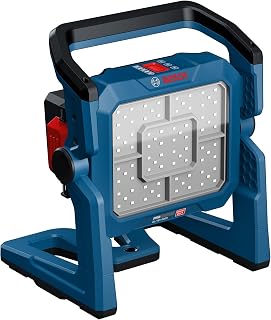
High-output floodlights are designed for a different purpose. The Bosch Professional PRO GLI 18V-10000 C is specified at up to 10,000 lumens and uses a solid metal body with a shock-absorbing rubber frame and protective safety bars. Bosch also lists three brightness settings, adjustable angles and a 5/8-inch tripod thread.
For large areas, these features can be more significant than portability. A floodlight that can be positioned securely and directed across a whole work zone can reduce the need to reposition a smaller lamp repeatedly.
Work lights can be exposed to knocks, dust, workshop debris, transport between jobs and repeated repositioning. Durability should therefore be assessed according to the environment in which the light will actually be used.
Protective frame: A rubberised or reinforced exterior can help protect vulnerable components from everyday impacts.
Stable base: A broad, secure base is useful when the lamp is frequently used on floors or benches.
Hanging hardware: Hooks can be invaluable when floor or bench space is limited.
Magnetic mounting: Useful on suitable ferrous surfaces, particularly for vehicle and workshop tasks.
Adjustable components: Hinges and pivots should feel appropriate for repeated positioning without becoming a nuisance to use.
Protective guards: Larger professional lights may use additional structural protection around the lamp assembly.
Do not confuse a rugged appearance with a particular ingress-protection rating. If resistance to dust or water is important, check the manufacturer's stated rating for the exact model rather than assuming that a professional-looking housing is weatherproof.
A good work light should give you practical ways to put the light where you need it. Hands-free positioning is particularly important because holding a torch while operating a drill, saw, wrench or measuring equipment can be awkward and potentially unsafe.
Depending on the model, useful mounting features can include integrated hooks, magnets, freestanding bases, adjustable heads and tripod threads. Bosch's current products illustrate the range: the UniversalWorkLight 18V-2100 incorporates hooks and magnets, the PRO GLI 18V-300 has a hanging hook, and the PRO GLI 18V-10000 C includes a 5/8-inch tripod connection.
Colour temperature can influence how comfortable a work area feels and how surfaces appear under artificial lighting. Some Bosch lights offer a choice between warmer and cooler white light, while others are designed around a fixed colour temperature.
The Bosch DIY EasySpotLight 18V-400 is an example of a model offering warm and cool white settings.
For general workshop use, the ability to adjust the character of the light can be useful. For detailed inspection work, however, the more important consideration may be whether the lighting makes the surface, edges, markings and defects you need to see sufficiently clear.
A medium-output adjustable work light is often the most versatile choice for household repairs, decorating, garage projects and occasional maintenance. Look for several brightness levels, flexible positioning and a sensible size rather than automatically choosing the highest-output model.
A workshop user should prioritise broad illumination, hands-free mounting and the ability to direct light across benches, machinery or vehicles. A higher-output floodlight can be useful for illuminating an entire workspace, while a smaller handheld light can complement it for close inspection.
Vehicle work often benefits from a compact light that can be positioned inside engine bays, beneath dashboards or underneath a vehicle. A hanging hook, adjustable head or magnetic attachment can be particularly useful, provided the mounting surface is suitable.
For frequent professional use, durability, battery-system compatibility, mounting flexibility and predictable operation can matter more than the lowest purchase price. The Bosch Professional range includes lights specifically designed around its professional 18V platform, including compact models and high-output jobsite floodlights.
If you need to illuminate a substantial area, prioritise high luminous output, wide coverage, adjustable positioning and secure mounting. A model such as the Bosch Professional PRO GLI 18V-10000 C is aimed at this category, with Bosch specifying up to 10,000 lumens and tripod compatibility.
When comparing several models, use the same criteria for every product. This prevents a strong specification in one area from hiding a weakness in another.
Light output: Compare the stated maximum lumens and consider whether that level is appropriate for your workspace.
Brightness adjustment: Check how many settings are available and whether lower settings can extend useful operating time.
Battery platform: Confirm exact compatibility before assuming an existing Bosch battery will work.
Battery included: Establish whether the listing is for the bare light or a complete kit.
Runtime: Examine the manufacturer's conditions and determine whether the stated figure relates to maximum brightness or another operating mode.
Weight: Consider the weight of the light plus the battery, not just the tool body.
Mounting: Check for hooks, magnets, stands, adjustable heads and tripod compatibility.
Physical protection: Look for construction appropriate to the intended environment.
Colour options: If colour temperature matters to your work, check whether the model offers warm, cool or adjustable lighting.
Controls: Consider whether the switches are easy to operate while wearing work gloves.
Storage: A compact design can be preferable when the light travels between home, garage and worksite.
Long-term ecosystem value: If you are already invested in a battery platform, compatible bare tools may offer better overall value.
More light is not automatically better. Excessive brightness can be unnecessary for close-up work and may consume battery capacity faster. Match output to the size and nature of the area you need to illuminate.
This is one of the most important checks. Bosch DIY POWER FOR ALL products and Bosch Professional 18V products belong to different ecosystems. Verify the exact compatibility information before buying a light or battery.
A tool-only listing can make the initial price appear lower. If you do not already own the appropriate battery and charger, calculate the cost of the complete setup before deciding which model represents better value.
Runtime varies according to operating mode and test conditions. Look at the manufacturer's stated conditions and consider the brightness level you are likely to use in real work.
A heavy high-output light may be excellent when placed on the floor or a tripod but inconvenient when carried or held for extended periods. For inspection work, a lighter model can be considerably easier to live with.
A light that cannot be positioned securely may be less useful than a lower-output model with a good hook, magnetic mount or adjustable stand.
If you are not already committed to Bosch batteries, it can be sensible to compare the wider cordless lighting market before purchasing. Brands such as Makita, DeWalt, Milwaukee and Ryobi also offer battery-powered work lights, but the most meaningful comparison is normally between equivalent battery ecosystems and similar classes of light.
Compare like with like rather than putting a compact inspection lamp against a professional floodlight simply because both are marketed as cordless work lights. Consider luminous output, beam coverage, mounting options, battery compatibility, weight, controls, durability and the cost of entering the relevant battery platform.
For existing Bosch users, ecosystem compatibility may outweigh small differences in headline specifications. Someone who already owns several suitable Bosch batteries may reasonably value a compatible bare light differently from a first-time cordless-tool buyer who needs a complete battery and charger setup.
The cheapest Bosch light is not necessarily the best-value option, and the most powerful model is not necessarily the best investment. Value depends on how closely the product matches the job and how often you will use it.
For occasional household use, paying substantially more for professional-grade output may provide little practical benefit. For daily trade work, however, durability, mounting flexibility, battery compatibility and time saved through better illumination can justify choosing a more capable model.
When checking today's prices, compare equivalent package contents. A bare light, a light with one battery, and a complete light-and-charger kit should not be treated as equivalent offers. Retailer promotions can also change the relative value between kits, so check the current specification and included accessories before purchasing.
Basic maintenance can help preserve performance and reduce avoidable wear. Always follow the manufacturer's instructions for the particular model, especially when cleaning, storing or handling the battery.
Keep the lens or light-emitting surface clean and free from dust or workshop residue.
Inspect the housing, mounting points, switches and battery connection periodically for damage.
Do not use a damaged battery or damaged electrical connection.
Store the light and battery in conditions recommended by the manufacturer.
Keep ventilation areas clear where the design includes them.
Use only compatible batteries and chargers specified for the product.
Follow the supplied safety instructions rather than relying on general assumptions about cordless tools.
Product listings can differ in how they present specifications and package contents. Before placing an order, verify the exact model number rather than relying only on a product photograph or shortened product name.
Confirm the exact model designation.
Check whether a battery is included.
Check whether a charger is included.
Verify the battery platform.
Check maximum luminous output.
Check the number of brightness settings.
Check weight with and without the battery where the figures are available.
Review mounting and adjustment features.
Read the manufacturer's technical documentation for important environmental or operating restrictions.
Compare the current retailer price with other offers for the same exact variant.
Read recent verified customer reviews for recurring issues, but distinguish user opinions from manufacturer specifications.
For general DIY, the best choice is usually a versatile model with enough output for the work area, adjustable positioning and a battery platform that fits the tools you already own. A compact lamp can be preferable for small repairs, while a higher-output work light is more suitable for garages and larger projects.
It can be. A 300-lumen light can be appropriate for close-range inspection, confined spaces and targeted illumination. Whether it is sufficient depends on the distance, beam pattern and size of the area you need to illuminate. Bosch's PRO GLI 18V-300, for example, is designed as a compact handheld work light rather than a whole-room floodlight.
A 2,100-lumen light can provide substantial illumination for many garage and workshop tasks, but the result depends on the size and layout of the space, the beam distribution and where the lamp is positioned. The Bosch UniversalWorkLight 18V-2100 provides up to 2,100 lumens and three brightness settings.
No. A DIY user can choose a Bosch Professional light if its features and battery ecosystem suit the intended work, but professional-grade output may be unnecessary for occasional household jobs. Bosch DIY and Bosch Professional lights should be compared according to the application and battery system rather than the label alone.
Do not assume that they can. Bosch uses different cordless systems, so compatibility must be checked for the exact product and battery. The Bosch DIY 18V POWER FOR ALL system and Bosch Professional 18V System should be treated as distinct platforms unless the manufacturer explicitly states compatibility.
No. High output is useful for large work areas but can be unnecessary for close-up tasks. A lower-output light with better portability, positioning and beam control may be the better choice for inspection and repair work.
An adjustable head lets you direct illumination without repeatedly moving the whole lamp. This is useful around vehicles, benches, machinery, cupboards and other areas where the ideal lighting angle changes during a project.
It depends on the specific variant. Bosch lists both bare-tool versions and products sold with different package configurations, so check the exact retailer listing and manufacturer model designation before comparing prices.
Battery capacity affects the potential operating time but also adds weight and cost. If the light will remain stationary, a larger battery may be more attractive. If you will carry the light around for inspections, keeping the overall weight down can be more important.
Yes, Bosch Professional offers cordless jobsite lighting specifically aimed at professional applications. Its range includes compact 18V lights as well as high-output floodlights such as the PRO GLI 18V-10000 C.
Prioritise portability, hands-free mounting, an adjustable beam or head, sufficient brightness for confined areas and compatibility with a battery you already own. A compact hook or magnetic mounting option can be particularly useful around suitable vehicle surfaces.
The best Bosch light for you is the one that solves your particular lighting problem without adding unnecessary weight, cost or complexity. Start by identifying the workspace, then decide whether you need a compact inspection light, an adjustable general-purpose work light or a high-output floodlight.
After that, check the battery platform. This is particularly important because Bosch's DIY 18V POWER FOR ALL and Professional 18V ranges should not be assumed to be interchangeable. Once compatibility is established, compare lumens, brightness settings, runtime information, mounting options, weight and physical construction.
For occasional DIY, versatility and portability will often be more useful than maximum output. For garages and workshops, broad illumination and hands-free positioning become more important. For professional jobsites, durability, battery-system integration, mounting flexibility and high-output performance can justify moving into the Bosch Professional range.
Before buying, compare the exact model number, package contents and current retailer prices, and read verified customer feedback alongside the manufacturer's specifications. That approach gives you a more reliable basis for choosing between Bosch lights than relying on a single star rating, a headline lumen figure or the lowest advertised price.